
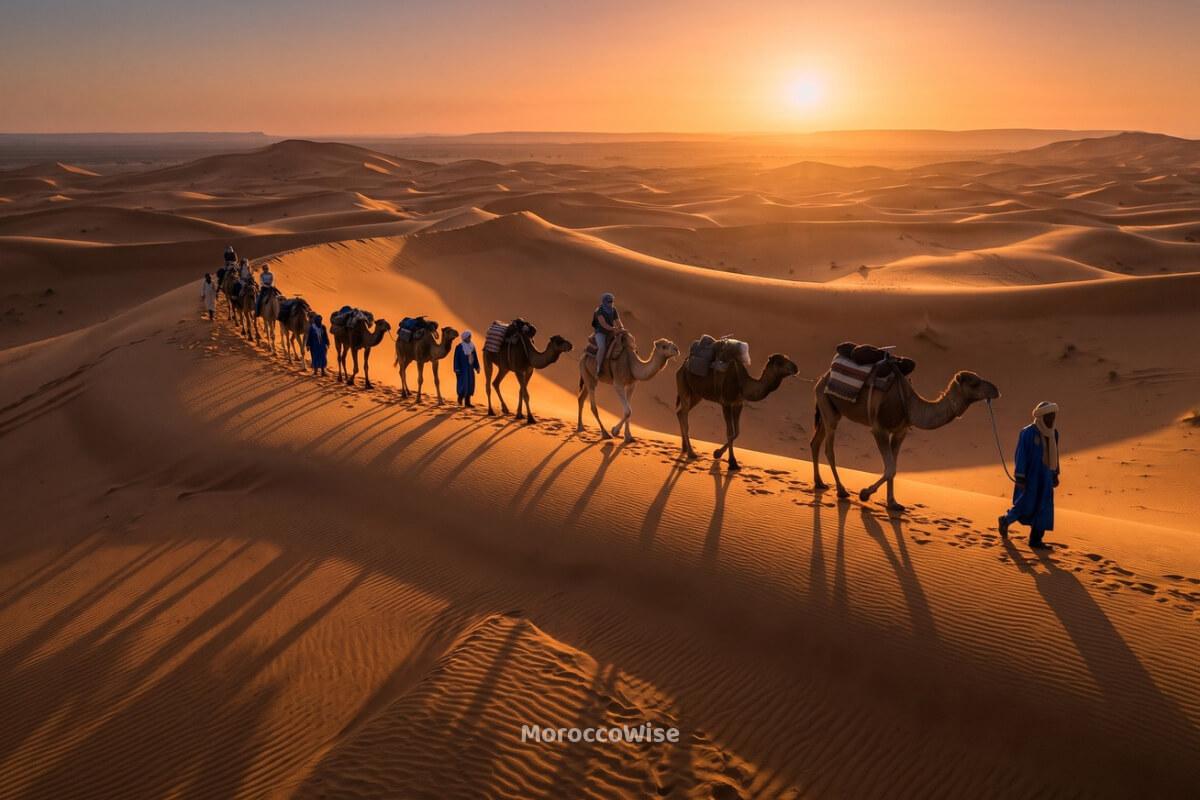
Planning a Sahara trip from Marrakech usually starts with a photo of towering orange dunes at sunset and a tour brochure claiming the desert is just two days away. The dunes in the photo are real. The two-day version of that trip, in almost every case, delivers a grueling 18-hour round-trip drive to a flat, rocky plain.
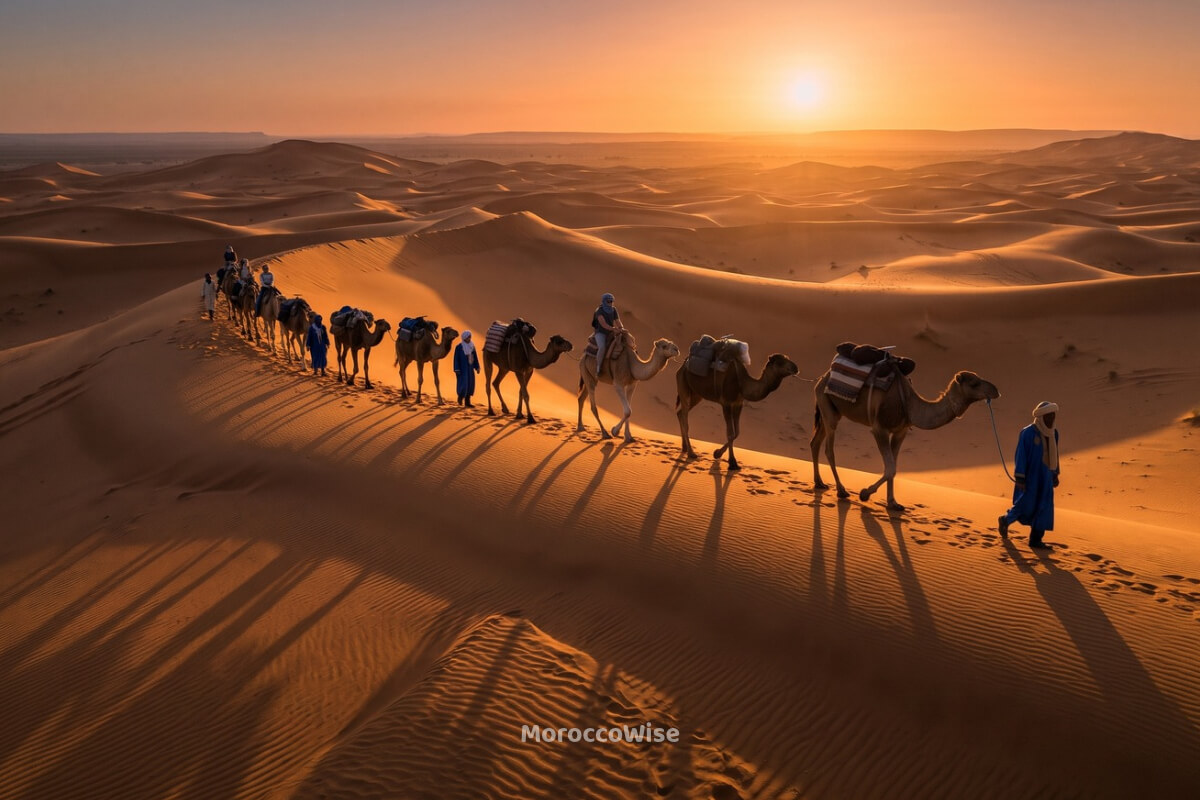
The massive golden sand dunes of Erg Chebbi sit roughly 560 km from Marrakech, completely on the opposite side of the High Atlas mountain barrier. Reaching them takes 9 to 10 hours of pure driving time, extending well past 12 hours once you factor in mountain traffic, meals, fuel stops, and photos. A genuine Sahara expedition is one of the most rewarding adventures in North Africa, provided you plan for the physical distance.
Give the journey three days at a bare minimum, choose your desert destination with clear eyes, and decide whether a shared budget minibus or a private 4x4 fits your endurance.
Planning a Sahara trip from Marrakech starts with the distance
Marrakech sits on the western plains of the High Atlas. The true Saharan dune fields lie in the far southeast, bordering the closed Algerian frontier. Every overland route requires crossing the formidable Atlas mountain spine.
Actual Marrakech to Sahara desert drive times vary depending on which destination you choose:
- Marrakech to Merzouga (Erg Chebbi): ~560 km, 9 to 10 hours of non-stop driving.
- Marrakech to M'Hamid (gateway to Erg Chigaga): ~500 km, around 9 hours (including roughly 2 hours of unpaved off-road driving).
- Marrakech to the Agafay Desert: 45 minutes.
For official regional details, visit the Moroccan National Tourism Office Sahara Information.
Crossing the Tizi n'Tichka pass
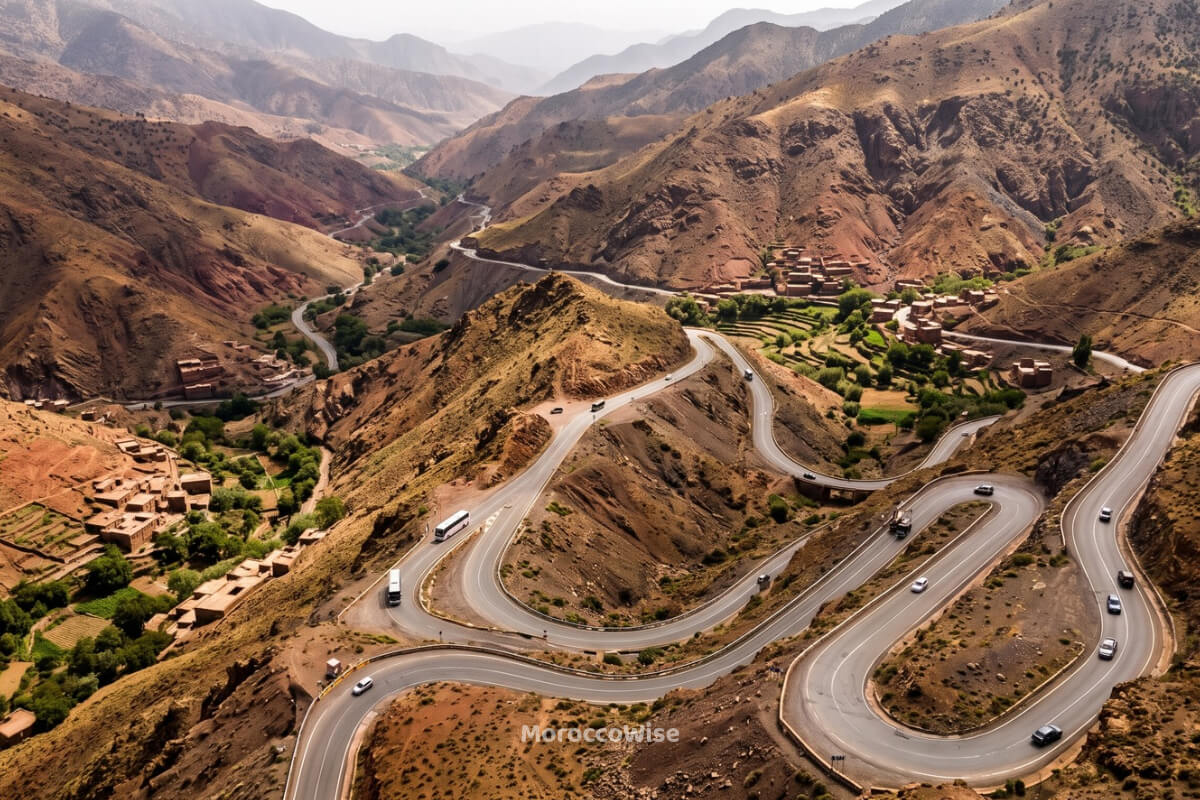
Most journeys to Merzouga climb through the Tizi n'Tichka pass, topping out at 2,260 meters elevation. The road winds through dozens of tight hairpin turns, where heavy commercial trucks crawl along steep grades with few safe passing zones. In winter (December through February), sudden mountain snow can slow traffic significantly.
Motion sickness is the most frequent traveler complaint on this leg. Take motion sickness medication before the ascent begins, keep your eyes on the distant horizon, sit near the front of the vehicle, and tell your driver early if you feel unwell.
Why map distance is deceptive
560 kilometers looks like a casual five-hour cruise on an open American highway or European motorway. In Morocco, that same distance represents a grueling full-day transit. Between steep gradients, winding switchbacks, slow trucks, rural police speed checks, and roadwork, your average speed rarely exceeds 60 km/h. Factor in a sit-down tagine lunch and photography stops, and the drive consumes all available daylight.
Public buses (such as CTM and Supratours) reach transit towns like Ouarzazate or Erfoud, but desert camps sit isolated in the deep dunes and still require private transfers. That is why most travelers book organized tours or hire private drivers. For transit comparisons, see our guide to Getting Around Morocco: The Ultimate Guide to Trains, Buses, and Taxis.
Erg Chebbi vs. Erg Chigaga vs. Agafay: which desert fits your trip?
Three distinct landscapes are marketed under the umbrella of "the desert" from Marrakech. Only two feature genuine Saharan sand dunes.
Erg Chebbi (Merzouga)
Erg Chebbi is the classic Sahara postcard. Its glowing apricot dunes rise up to 150 meters high. A smooth paved highway runs right up to Merzouga village, meaning ordinary vehicles can reach the foot of the dunes before travelers transfer to camels or 4x4s for the short ride into camp. Erg Chebbi offers the most developed camp infrastructure, including luxury glamping suites with private flush toilets and hot running showers. The compromise is popularity: you will share sunrise views with fellow travelers.
Erg Chigaga (M'Hamid)
Erg Chigaga is the true expedition choice. From the outpost town of M'Hamid El Ghizlane, reaching the dunes requires a two-hour off-road journey across rocky desert tracks (reg) that strictly demands a high-clearance 4x4 and an experienced local desert driver. The dune sea is vast, wild, and untouched by mass tourism. Camps here are predominantly rustic, though luxury options exist. Choose Chigaga if you prioritize raw wilderness, wide-open silence, and off-grid adventure.
Agafay (the 45-minute alternative)
The Agafay Desert is a dry, barren stone desert (reg) of undulating limestone hills, situated just 45 minutes southwest of Marrakech. It contains zero sand dunes and is not part of the Sahara. However, it is an excellent escape for travelers who have only one or two nights to spare, offering luxury boutique tented camps, camel rides, and pool lounges beneath the Atlas peaks without the exhausting 10-hour drive.
Desert Comparison Matrix
| Destination | Landscape | Distance from Marrakech | Accessibility | Atmosphere | Best For |
|---|---|---|---|---|---|
| Erg Chebbi (Merzouga) | Towering orange sand dunes (up to 150m) | ~560 km (9–10 hrs driving) | Paved road to edge; short transfer | Classic dunes, luxury glamping | First-time Sahara travelers (3–4 days) |
| Erg Chigaga (M'Hamid) | Remote, sprawling wild dune field (50–150m) | ~500 km (9 hrs, incl. 2 hrs off-road) | 4x4 required across rocky desert tracks | Remote, off-grid, quiet solitude | Adventure travelers with private 4x4 (4+ days) |
| Agafay Desert | Rocky stone hills and gravel plains (no dunes) | ~35 km (45 mins) | Paved roads; accessible by standard taxi | Boutique resort, glamping dining | 1-night desert fix with limited time |
How many days do you need for a Sahara trip from Marrakech?
The 2-day Zagora trap
The standard "2-Day Sahara Tour" sold aggressively across Marrakech souk stalls goes to Zagora, not to the sand dunes of Merzouga. Over 48 hours, you will spend 16 to 18 hours trapped inside a minibus, traversing the exact same mountain highway in both directions. The destination is a flat, gravelly plain with minor mounds of sand. Travelers almost universally regret this option. If you have only two days, book a night in Agafay instead.
The classic 3-day route (The Sweet Spot)
A 3-day desert tour to Merzouga is the most popular route because the outbound journey is split across two days:
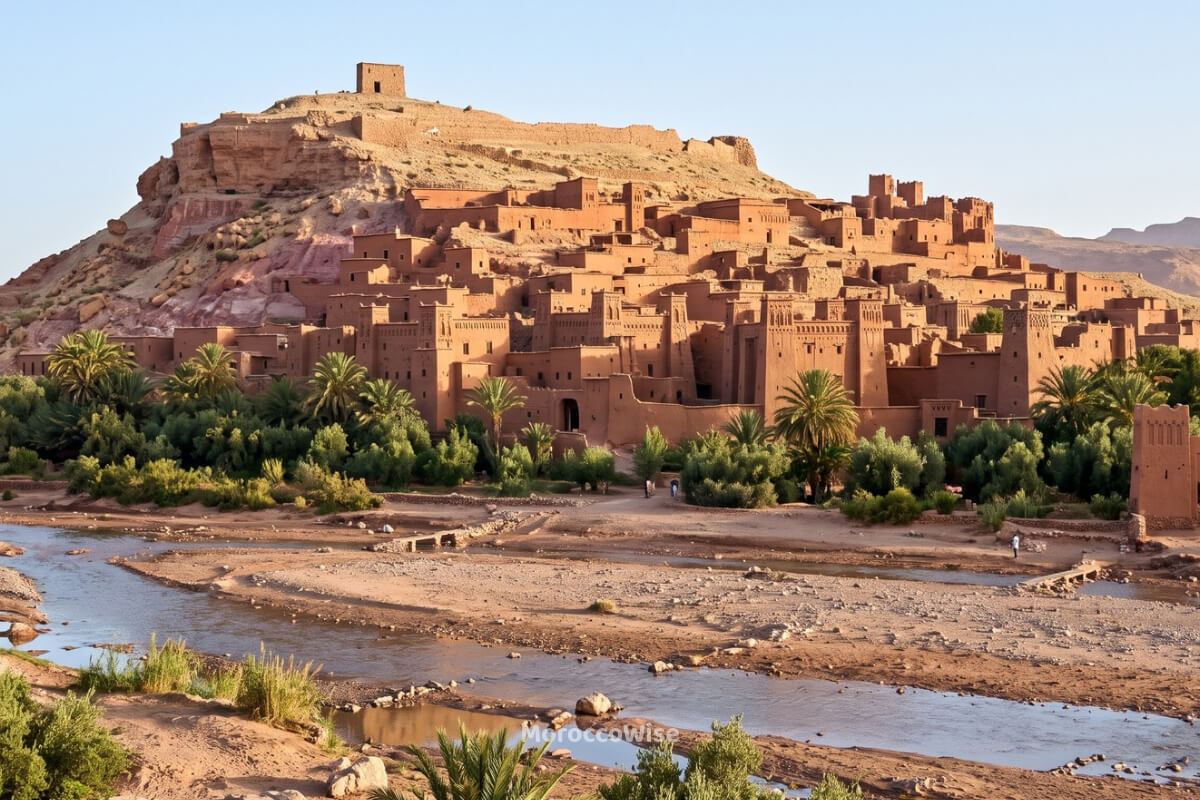
- Day 1: Marrakech to Dades Valley (or Todra Gorge): Cross the Tizi n'Tichka pass, explore the UNESCO ksar of Aït Benhaddou, pass Ouarzazate, and sleep in a valley guesthouse.
- Day 2: Dades/Todra to Merzouga (Erg Chebbi): Drive past Tinghir and Erfoud, reach Merzouga by late afternoon, trek by camel into the dunes, and spend the night in a desert camp.
- Day 3: Merzouga to Marrakech (or onward to Fes): Catch the dune sunrise, eat breakfast, and begin the long 9-to-10-hour drive back to Marrakech.
Pro-tip: If your wider itinerary includes northern Morocco, do not backtrack to Marrakech on Day 3. Instead, book a tour that drops you off in Fes (approx. 7–8 hours drive north through the Ziz Valley and Midelt).
The 4-day route (Recommended)
Adding a fourth day transforms an endurance test into a genuine vacation. You can explore Aït Benhaddou, Ouarzazate film studios, and the towering Todra Gorge without checking your watch. It also allows two nights in the desert, giving you a full, unhurried day to sandboard, visit nomadic families, or relax in camp.
The 5+ day road trip
With five or more days, the journey becomes an expansive southern circuit. You can loop south through the Draa Valley, visit the sacred pottery workshops and subterranean medina of Tamegroute, stop at the desert trade hub of Rissani, and keep driving stints down to a comfortable 3 to 4 hours per day.
The Classic Route Breakdown: Waypoints to Merzouga
When driving from Marrakech to Erg Chebbi, these major waypoints structure the journey:
- Tizi n'Tichka Pass (2,260m): The High Atlas summit with panoramic mountain vistas.
- Aït Benhaddou: The ancient 11th-century earthen clay fortress featured in Gladiator and Game of Thrones. Recognized on the UNESCO World Heritage Aït Benhaddou Listing.
- Ouarzazate: Known as Morocco’s film capital; the ideal stop for fuel, ATM cash withdrawals, and a sit-down meal.
- Skoura Oasis & Dades Valley: Lush date-palm groves and rugged limestone cliffs known as the "Road of a Thousand Kasbahs."
- Todra Gorge (Tinghir): 300-meter sheer red rock canyon walls carved by the Todra River.
- Erfoud: The gateway to the desert, famous for ancient marine fossils and premium Medjool date markets.
- Merzouga: The desert outpost village sitting directly at the foot of Erg Chebbi’s glowing dunes.
Budget minibus tour vs. private 4x4: what your money buys
The €80 to €100 shared minibus
Budget shared tours pack 14 to 17 passengers into a standard Mercedes Sprinter van. Seats are cramped for 9-hour mountain transits, air conditioning can be strained in summer, and the itinerary is inflexible. You must stop at predetermined tourist restaurants where set-menu lunches cost double normal rates. Camps are basic, and morning departures are early. For budget backpackers, it gets the job done cheaply; for couples or families, it can feel like a grueling commute.
The private 4x4 expedition
A private vehicle with a professional driver-guide offers complete control: stop whenever motion sickness hits, pull over for dramatic mountain photos, choose authentic roadside cafés, and listen to music at your own volume. For parties of 3 to 5 people, the per-person cost often rivals a mid-tier shared package while offering vastly superior comfort.
Hidden costs to anticipate
Before paying your deposit, verify what is included in writing:
- Lunches and drinks: Rarely included; plan on 100–150 MAD per person per day.
- Kasbah local guides: While entering Aït Benhaddou is free, freelance guides charge 20–30 MAD per person.
- Driver and camp tips: Budget 150–200 MAD per day for a private driver, and 50–100 MAD for camp staff.
- Cash requirements: Desert card machines frequently lose cellular signal. Carry ample Moroccan Dirhams in small notes. Review our guide on Cash vs Credit Card in Morocco: How Much to Bring & ATM Tips.
- Tour touts: Beware of medina street touts selling "luxury tours" that turn out to be bare-bones shuttles. Read 10 Common Scams in Morocco: How to Avoid Them.
Desert camps explained: standard vs. luxury glamping
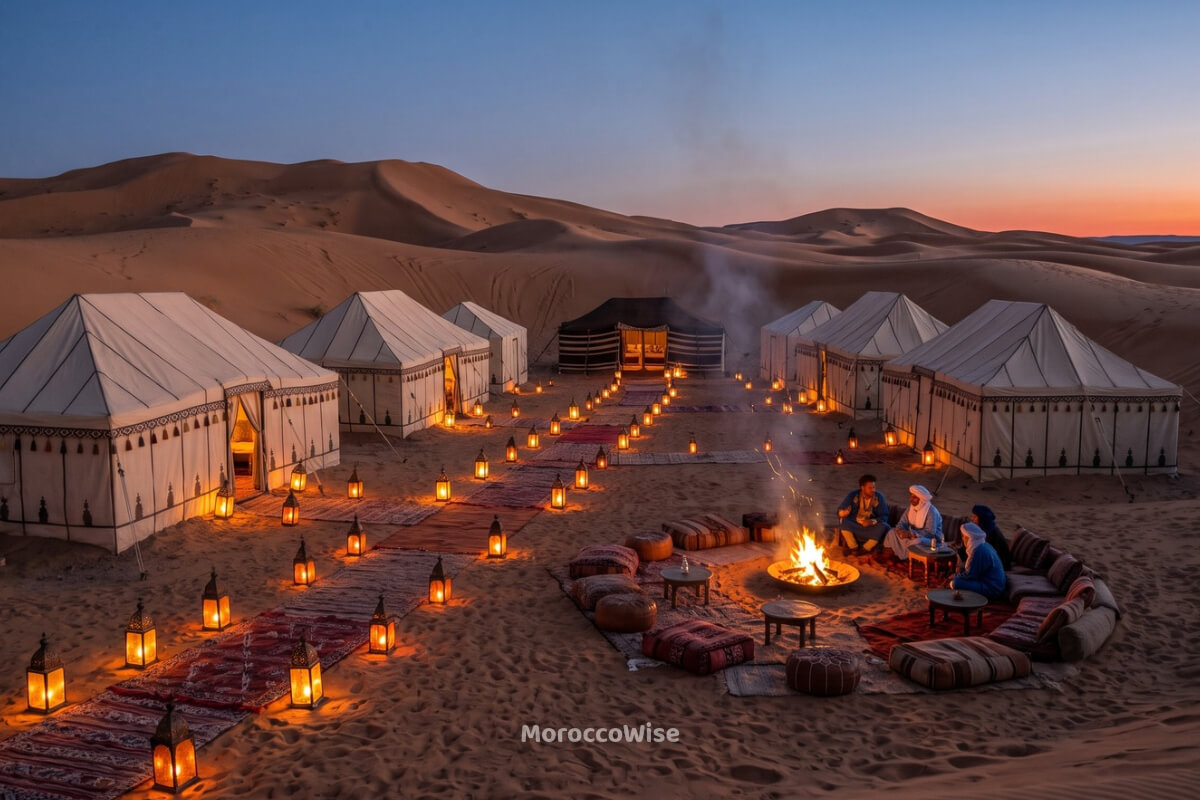
Standard Berber camps
Traditional camps consist of heavy wool or canvas tents pitched over the sand. You will sleep on basic mattresses with heavy shared blankets. Bathroom facilities are communal, located in a separate outdoor block with basic toilets and intermittent warm water. Charging outlets are typically restricted to the main dining tent.
Luxury glamping
Luxury desert camps feature spacious walk-in canvas suites with carpeted wood flooring, king-sized beds, electric lighting, and private en-suite bathrooms equipped with flush porcelain toilets and private hot showers. High-end camps feature private woodstoves or reverse-cycle AC heating units. Solar battery banks charge devices in-tent.
What to pack for the Sahara desert in Morocco
Desert climates feature extreme diurnal temperature variations: hot, sun-drenched afternoons give way to near-freezing nights. Pack for both extremes. For broader baggage advice, see What to Pack for Morocco: Money, Connectivity, and Everyday Essentials and What to Wear in Morocco: 2027 Dress Code & Packing Guide for Women.
Essential Sahara Packing Checklist:
- Thermal base layers: Essential for sleeping in unheated tents between November and March.
- Warm fleece or packable down jacket: Desert nights drop rapidly once the sun sets.
- Breathable linen/cotton daytime clothes: Loose, light-colored long sleeves for sun defense.
- Closed-toe shoes/sneakers: Dune sand gets scorching hot by midday and is impossible to walk on barefoot.
- Camp slip-on shoes/sandals: For moving comfortably around the carpeted camp after sunset.
- Cotton Tagelmust (desert scarf): Purchase a 4-meter indigo or cotton nomad scarf; it protects your face, eyes, and mouth from blowing sand far better than any bandana.
- High-capacity power bank (10,000–20,000 mAh): In-tent electrical charging is limited or turned off late at night in solar-powered camps.
- Headlamp or compact flashlight: Indispensable for walking between camp tents and dunes after dark.
- UV400 Sunglasses & wide-brim hat: The glare off golden sand dunes causes intense eye strain.
- Moisturizing eye drops & lip balm: Desert air combined with fine silica dust dries out mucous membranes rapidly.
- Biodegradable wet wipes: Critical for cleaning sand and dust off hands and camera gear when water is scarce.
- Motion sickness medication: Indispensable for the winding Tizi n'Tichka pass.
- Compact overnight duffle bag: Large hard-shell suitcases remain locked in your tour van; you take only an overnight daypack to the tent.
Best time of year to visit the Sahara desert
The prime season for visiting the Moroccan Sahara spans October through April. Seasonality dictates your experience:
- October to November: Warm, clear sunny days (25°C-28°C) and comfortably brisk nights (12°C-15°C). Peak travel season.
- December to February: Crisp, bright sunny days (18°C-22°C), but nighttime temperatures plummet near freezing (0°C-4°C). Thermals and winter coats are mandatory.
- March to April: Mild temperatures, wild spring desert flowers, but occasional spring sandstorms (sirocco winds).
- May & September: Rapidly climbing temperatures. Midday heat reaches 36°C-38°C, though mornings and evenings remain pleasant.
- June to August: Dangerous extreme heat exceeding 45°C (113°F). Most reputable desert camps close entirely for the summer. Avoid Sahara desert treks during midsummer.
Check official forecasts before traveling via Meteo Maroc Official Weather Service.
Final verdict: how to do the Sahara right
Treat reaching the Sahara as an expedition rather than a casual afternoon detour. Allocate at least three full days, prioritize Erg Chebbi for classic sand dunes, avoid the two-day Zagora compromise, and choose Agafay if your schedule allows only a single night.
If your travel budget allows, booking a private 4x4 elevates the journey from a grueling road trip into one of the most unforgettable overland adventures in North Africa. Bring motion sickness pills for the mountain pass, pack warm thermals for the cold desert night, keep a power bank handy, and embrace the rhythm of the open dunes. For wider safety protocols, see our comprehensive guide on Is Morocco Safe for Tourists? An Honest Guide to Scams, Safety, and Common Sense.
Frequently asked questions
How long is the drive from Marrakech to the Sahara Desert?
To reach Erg Chebbi (Merzouga), expect roughly 560 km and 9 to 10 hours of pure driving time without stops. To reach Erg Chigaga (M'Hamid), expect 500 km and about 9 hours, which includes 2 hours of unpaved off-road desert driving.
Can you do a day trip to the Sahara Desert from Marrakech?
No. Driving to the true Sahara and back requires at least 18 to 20 hours on mountain roads, making a day trip physically impossible. If you have only one day, visit the Agafay Desert (45 minutes from Marrakech), which offers stone desert landscapes and tented dining.
Which is better: Merzouga or Zagora?
Merzouga is far superior if you want to experience massive, classic golden sand dunes (Erg Chebbi). Zagora is closer, but the landscape is flat, rocky, and features only small, scattered sand mounds.
How cold does the Sahara Desert get at night?
During winter (December to February), desert temperatures regularly drop to between 0°C and 4°C (32°F-39°F). Because standard camp tents lack central heating, heavy fleece jackets, thermal base layers, and warm socks are necessary.
Is the 3-day Marrakech desert tour worth the long drive?
Yes, provided you understand that Day 1 and Day 3 consist almost entirely of driving through the High Atlas and pre-Saharan valleys. Breaking the drive at Dades Valley or Todra Gorge makes the distance manageable, and the sunset over Erg Chebbi rewards the effort.
Can you travel from Marrakech to the Sahara and end your trip in Fes?
Yes, this is an excellent itinerary. Instead of driving 10 hours back to Marrakech on Day 3, you head north through the Ziz Valley, Midelt, and the cedar forests of Ifrane, arriving in Fes in approximately 7 to 8 hours.