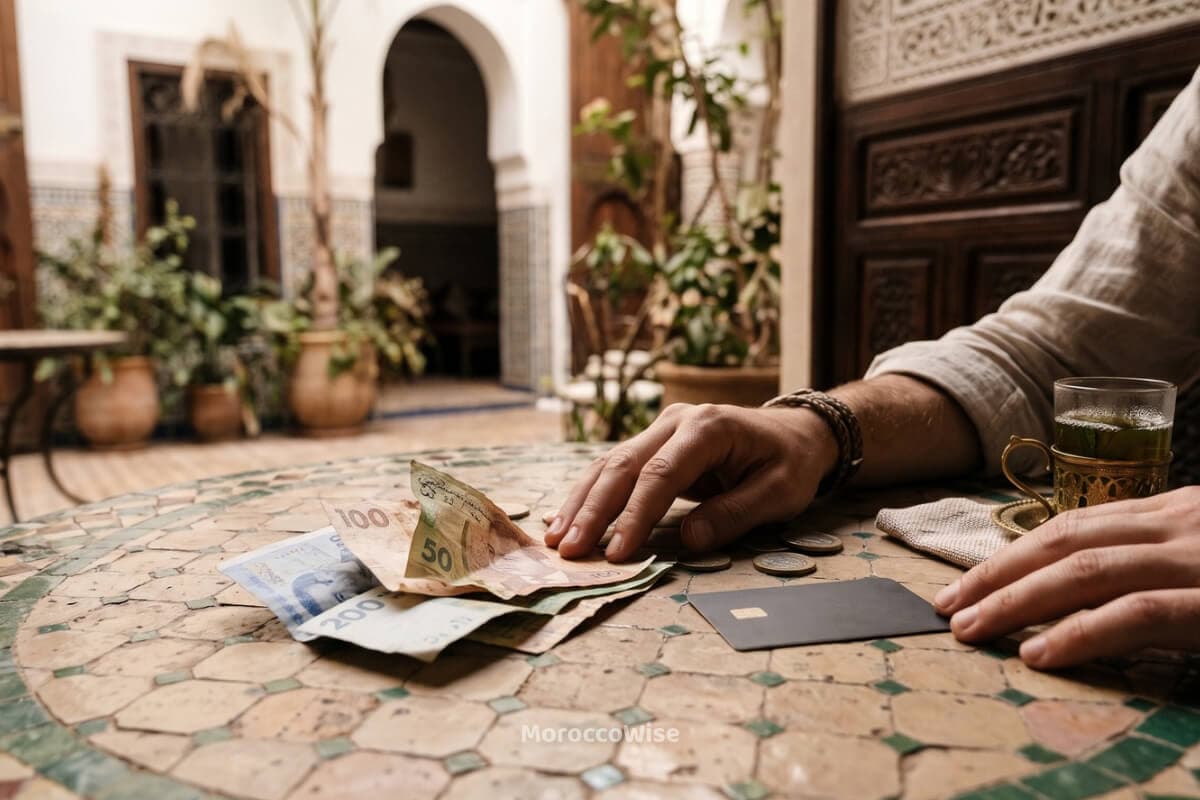
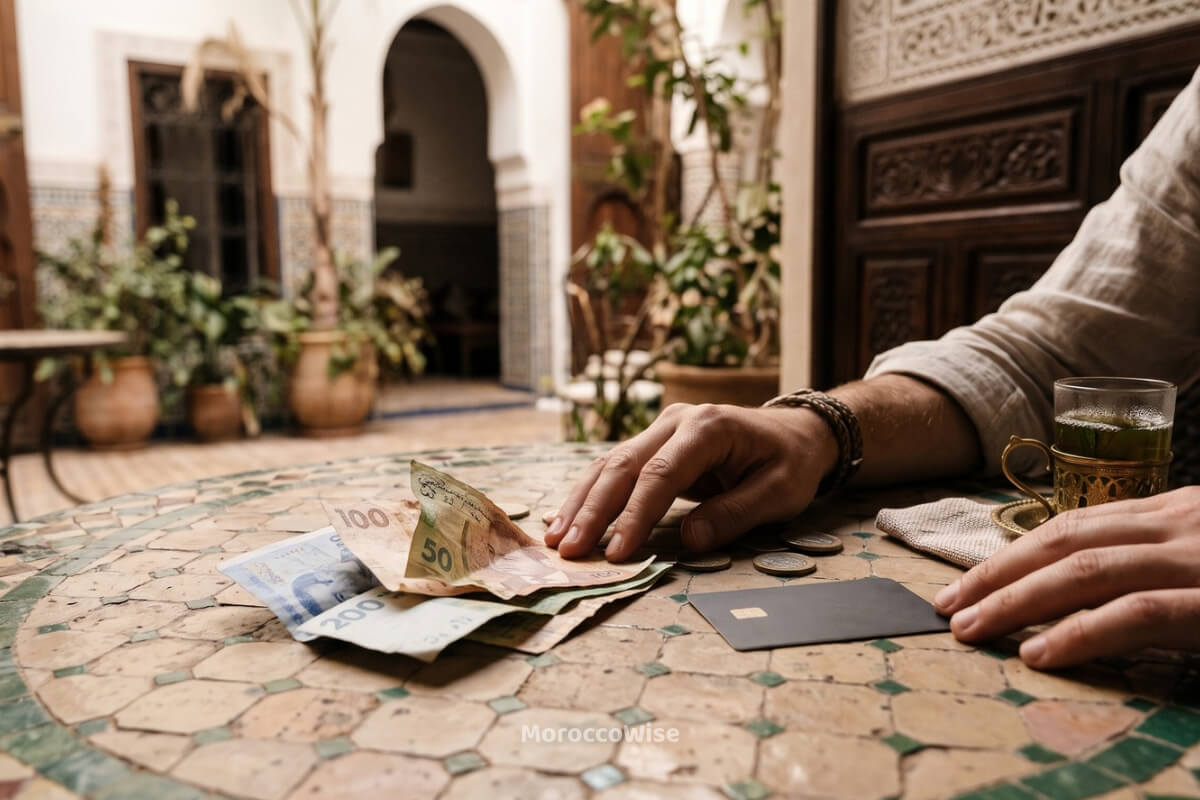
Cash vs credit card in Morocco has a short answer: bring both. The country runs two economies side by side. In Gueliz restaurants, supermarkets, and decent riads, you tap and go. In the medina souks, a petit taxi, or at the orange juice cart on Jemaa el-Fna, a Visa card is a very expensive bookmark.
Cards handle the big, boring bills. Cash handles most of what you will actually do all day. Travelers who bring only one end up either hunting for an ATM or paying more than they need to.
Quick answer: Bring one main bank card, a second card from a different bank as backup, and enough dirhams for everyday spending. Withdraw dirhams from a bank ATM in a city, choose MAD when the machine asks which currency to use, and plan roughly 200 to 600 MAD per person per day in cash if your hotel and big costs go on a card.
Cash vs Credit Card in Morocco: What's the Best Choice?
Morocco's national tourism office says ATMs are widespread and that Visa and Mastercard are accepted by most hotels and by some restaurants, shops, and petrol stations. Card acceptance follows the size of the business: the bigger and more built for tourists or salaried locals, the more likely it has a working terminal. See official traveler resources at the Morocco National Tourism Office.
Treat the table below as a general pattern, because individual businesses differ.
| Where you're paying | Card or cash? | What to do |
|---|---|---|
| Hotels and riads | Cards are common at hotels and higher-end riads. Small riads vary. | Ask when you book—not at checkout—whether they take cards or cash only, and whether they add a card surcharge. |
| Upscale restaurants | Often cards (especially sit-down spots in Gueliz and Casablanca) | Keep cash for tips (left in dirhams) and as a backup, since card machines love to lose their connection at the worst moment. |
| Small cafés | Mostly cash | Carry coins and small notes. |
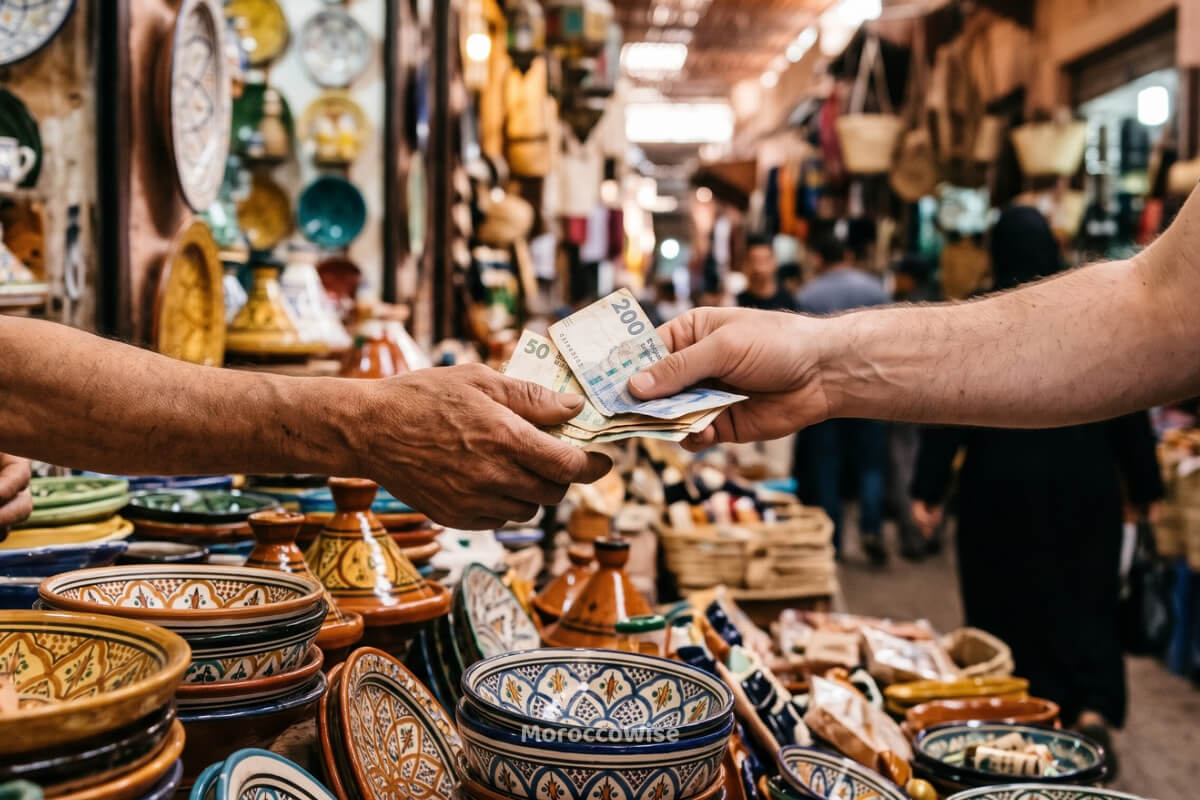
| Souks and traditional markets | Mostly cash | Larger tourist bazaars may take cards, but small stalls won't. If haggling over a rug, ask about card payments before bargaining—the agreed price can change at the register. |
| Street food vendors | Cash | Bring small change for Jemaa el-Fna stalls and snack carts. |
| Taxis | Cash | Petit taxis run on the meter and do not have card readers. |
| Supermarkets | Usually cards | Major chains like Carrefour and Marjane are the safest bet for cards and breaking large notes. |
| Fuel stations | Some take cards, cash in smaller towns | Petrol stations are still cash territory in many towns. Keep enough cash to fill up if the terminal is down. |
| Rural destinations | Cash | ATMs thin out fast outside major cities. |
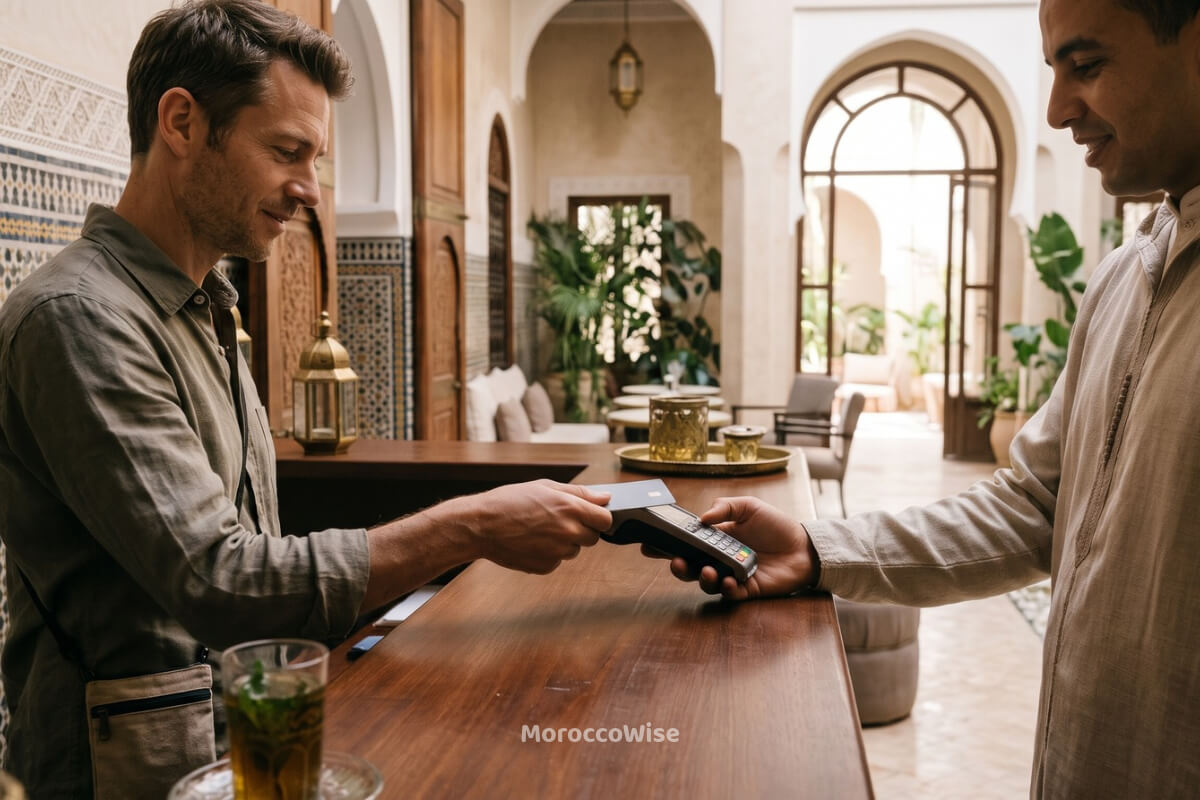
Your hotel may happily accept your card, while the little café around the corner only takes dirhams. For how taxis and city transport work, see our guide on Getting Around Morocco: The Ultimate Guide to Trains, Buses, and Taxis. For intercity rail and how to book tickets, see Train travel in Morocco: Tickets, Routes, and Tips.
How Much Cash to Bring to Morocco
Think of your money in four layers:
- Arrival cash covers the first few hours: airport transfer, tip, and a first snack.
- Everyday spending cash covers cafés, petit taxis, entry fees, souk purchases, and tips.
- An emergency reserve sits apart from your wallet in case your card is declined or an ATM is empty.
- Your total trip budget is the sum of everything, and most of it can stay on a card.
Carrying your entire trip budget as banknotes is unnecessary and risky. Tours, desert camps, and riads you booked online are usually paid by card in advance, which leaves your cash strictly for daily spending. For a broader breakdown of daily currency habits, see Money in Morocco: Cash, ATMs, and Tipping Guide.
The figures below rest on 2026 price roundups, which put a mint tea at roughly 5 to 15 MAD, a casual tagine or couscous at roughly 40 to 100 MAD, a main course at a mid-range restaurant at roughly 80 to 180 MAD, and short petit taxi rides at roughly 15 to 50 MAD. Location matters: the same tagine can cost 80 to 150 MAD on a tourist-facing Marrakech square and 30 to 50 MAD two streets away.
How Much Cash Should You Carry Each Day?
Assuming your accommodation is prepaid or goes on a card, 300 to 500 MAD per person per day (roughly €30 to €50) is a solid starting point for most travelers. For a three-day city trip, that works out to about 1,000 to 1,500 MAD in cash before souk shopping.
| Travel style | Cash per person per day | What it covers |
|---|---|---|
| Lean | About 200 to 350 MAD | Street food and local cafés, short taxi rides, one paid sight |
| Comfortable | About 350 to 600 MAD | Café meals, one dinner paid in cash, taxis, tips, small souk purchases |
Souvenirs and guided activities are extra. Solo travelers can't split a taxi fare, so lean toward the higher end. Couples can pool, since taxi fares are per ride, though each person should still carry some cash and a backup card.
Tipping eats more small change than you would think. Porters, guides, the person who fixed your riad's Wi-Fi, and the parking attendant all expect a few dirhams. Because ATMs mostly hand out 100 and 200 MAD notes—which are annoying to break in a souk—stop by a Carrefour or Marjane supermarket early on to get smaller change.
A typical Moroccan ATM caps a single withdrawal at around 2,000 MAD, meaning one withdrawal covers roughly three to six days of everyday cash.
How Much Cash Should You Have When You Arrive?
Aim for roughly 300 to 500 MAD per person upon arrival—enough for a taxi into town, a tip for the luggage handler, and a first meal. Get it from a bank ATM at the airport or in the city, and check the screen for fees before confirming.
Should You Bring Euros, US Dollars, or British Pounds?
Foreign banknotes are only for exchanging. The Moroccan dirham (MAD) is the only legal currency for everyday transactions. Some hotels may take euros informally, but at an unfavorable rate they set themselves. If you carry backup foreign cash, euros are the easiest to exchange, followed by US dollars and British pounds in tourist hubs.
Using Credit Cards in Morocco
Using credit cards in Morocco is straightforward in places built for international visitors: hotels, higher-end riads, Carrefour and Marjane supermarkets, and sit-down restaurants in Gueliz and Casablanca.
Stick to Visa or Mastercard. American Express is rarely accepted, so leave it at home unless you carry a Visa or Mastercard alongside it.
Contactless tap-to-pay works at many city terminals, but always remember your four-digit PIN, as terminals and ATMs frequently require it. Also tell your bank you are traveling before you fly, or your card may get frozen the first time you swipe it in Marrakech. For a complete pre-trip checklist, see What to Pack for Morocco: Money, Connectivity, and Everyday Essentials.
Does Visa Work in Morocco?
Yes. Visa is widely accepted at hotels, upscale restaurants, larger shops, and petrol stations, and works reliably at Moroccan bank ATMs.
Does Mastercard Work in Morocco?
Yes, with the same caveats. Mastercard is accepted alongside Visa at hotels, restaurants, supermarkets, and bank ATMs, while acceptance drops off in traditional markets and rural towns.
Can You Use a Wise Card in Morocco?
Yes. Wise in Morocco works like any other Visa or Mastercard debit card in shops that take cards and at ATMs. It converts at the mid-market rate and shows its fee up front, letting you skip the padded exchange rate traditional banks quietly bake into every purchase. On a week-long trip, that adds up.
Keep three details in mind before you fly:
- Wise gives you a limited number of free ATM withdrawals each month, and fees after that depend on where your account is based.
- The local Moroccan ATM operator can still add its own machine fee on top.
- Order the physical card early, because delivery often takes longer than travelers expect.
Where to Get Cash in Morocco
Where to get cash in Morocco is simple: a city bank ATM, not the exchange desk at the airport. Airport exchange counters give some of the worst rates you will find, and hotel desks are not much better.
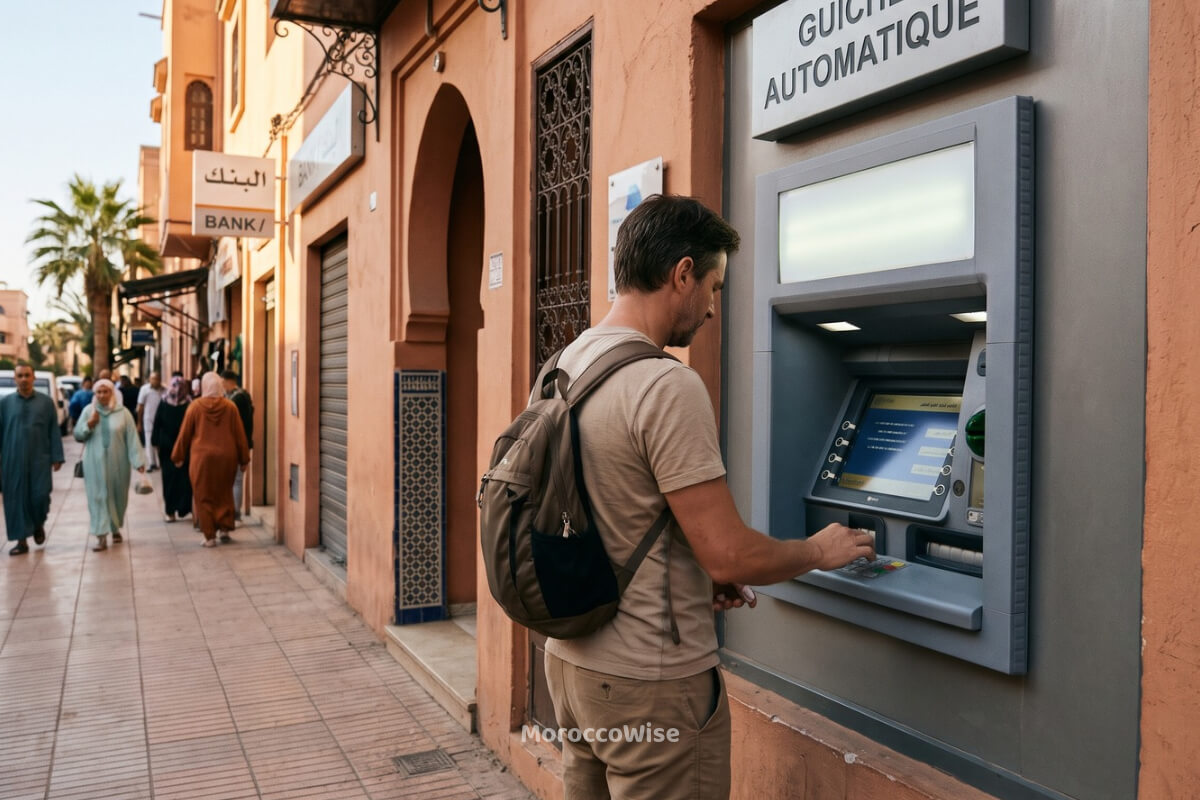
Withdrawing Cash at Moroccan ATMs
ATMs are easy to find in Marrakech, Casablanca, Rabat, Fes, and Tangier. Follow these habits to avoid headaches:
- Stick to real bank branches: Use ATMs attached to local banks such as Al Barid Bank or CIH. Avoid standalone machines in heavy tourist zones—Euronet ATMs in particular have a reputation for stacking steep fees on top of a poor exchange rate.
- Withdraw during bank hours: Machines inside or right next to an open bank branch are the safest choice. If the machine decides to swallow your card, someone inside can open the door and help.
- Use a four-digit PIN: Most Moroccan machines expect a standard four-digit PIN.
Airport ATMs vs City ATMs
An airport ATM is convenient for grabbing arrival cash, whereas airport currency exchange booths should be avoided unless you only need a tiny amount to reach town.
Keep in mind that bank fee policies change. In early 2026, travelers reported that Al Barid Bank ATMs—which had long been described in older guides as fee-free for foreign cards—began charging 35 MAD per withdrawal. Treat any “free ATM” claim as outdated until the screen in front of you confirms it.
Authorized Currency Exchange Offices
If you prefer exchanging euros, dollars, or pounds in cash, city exchange offices offer much fairer rates than the airport. The Moroccan Office des Changes states that non-residents should exchange currency only at banks or authorized manual exchange counters, never with unofficial street changers.
A legitimate counter will give you an official exchange slip (bordereau de change) for each transaction. Keep every slip—you will need them if you want to convert leftover dirhams back at the end of your trip.
Getting Cash Before Visiting Remote Areas
ATMs become scarce once you leave major cities, and small mountain or desert merchants rarely take cards. Withdraw enough dirhams in the city before heading out. For desert route logistics, read Planning a Sahara Trip from Marrakech: Routes, Time, and What to Pack.
Morocco ATM Fees: How to Avoid Paying More
Fees at a Moroccan ATM come from several places at once:
| Charge | Who sets it | What to check |
|---|---|---|
| Local ATM operator fee | The Moroccan bank | Typically 22 to 50 MAD per withdrawal on foreign cards, with 35 MAD commonly charged. Withdraw fewer, larger amounts (up to the ~2,000 MAD cap) to minimize flat fees. |
| Foreign withdrawal fee | Your home bank | Check your account terms for flat fees or percentage charges. |
| Foreign transaction fee | Your card issuer | Often 1% to 3% on standard bank cards; waived by many travel cards. |
| Exchange-rate markup (DCC) | The ATM or merchant terminal | The most avoidable cost—always decline the machine's conversion offer. |
| Withdrawal limits | The ATM and your home bank | Many Moroccan ATMs cap single withdrawals around 2,000 MAD. |
Always Check the ATM Screen Before Confirming
Read the prompts carefully before pressing confirm. If the machine offers to convert the withdrawal into your home currency, it should show the exchange rate and markup. When in doubt, decline the conversion.
Choose Moroccan Dirhams (MAD), Not Your Home Currency
This is the single most useful payment habit in Morocco. When an ATM or card terminal asks whether to charge you in euros, dollars, or pounds instead of dirhams, it is offering Dynamic Currency Conversion (DCC). Say no and choose MAD (dirhams) every time. The terminal's “helpful” conversion rate is almost always worse than your bank or card network's rate.
Debit Card vs Credit Card for ATM Withdrawals
Use a debit or travel card (like Wise) at ATMs. Withdrawing cash with a credit card is treated as a cash advance, which triggers immediate interest and extra cash-advance fees. Save your credit card for hotel bills and larger purchases.
Practical Money Tips Before Traveling to Morocco
- Tell your bank you are traveling so fraud filters don't freeze your card.
- Enable international ATM withdrawals in your banking app and verify your 4-digit PIN.
- Carry a backup card from a different bank, stored separately from your main wallet.
- Break 200 MAD notes at supermarkets (Marjane or Carrefour) so you always have small notes and coins for petit taxis, mint tea, and tips.
- Save every ATM receipt and bordereau de change slip until you fly home.
- Avoid pulling out a thick wad of banknotes in crowded medina alleys.
Important Moroccan Currency Rules Before You Leave
Confirm current currency regulations with the Moroccan Office des Changes before flying:
- Bringing foreign currency in: Non-residents may bring foreign currency into Morocco without limit, but foreign banknotes worth 100,000 MAD or more (roughly €9,000 to €10,000) must be declared in writing to customs upon arrival.
- Exchanging leftover dirhams: Authorized banks and airport exchange counters can buy back leftover dirhams before departure if you prove where they came from using an official exchange slip (bordereau de change) or ATM withdrawal receipt. Without a customs import declaration, buyback against receipts is capped at 20,000 MAD.
- Taking dirhams out of Morocco: Exporting large sums of Moroccan currency is restricted; the Office des Changes tolerates carrying up to 2,000 MAD in banknotes in or out of the country.
Final Verdict: Cash or Card in Morocco?
Use both. Your bank card handles hotels, upscale restaurants, and supermarkets. Cash handles the medina, taxis, cafés, and tips.
Follow this simple five-step plan:
- Before you fly: Switch on international withdrawals, check your fees, and pack two cards from different banks.
- On arrival: Withdraw up to 2,000 MAD from a bank-branch ATM (such as CIH or Al Barid Bank) during daylight, choose MAD, and decline any currency conversion offer.
- Day one: Break your 200 MAD notes at a supermarket or sit-down restaurant so you have change for taxis and tips.
- During your trip: Pay hotels and big bills by card, and top up your cash before leaving major cities for the desert or mountains.
- Until you fly home: Keep your exchange slips and ATM receipts so you can exchange leftover dirhams at the airport before security.
Frequently Asked Questions
Should I bring cash or use a card in Morocco?
Bring both. Use a Visa or Mastercard at hotels, upscale restaurants, and supermarkets, and carry dirhams for taxis, small cafés, souks, tips, and street food.
How much cash should I bring to Morocco for one week?
Plan for roughly 1,500 to 4,000 MAD per person in cash over a week—withdrawn in stages from local bank ATMs—assuming your hotels and major tours are paid by card. Souvenirs and shopping cost extra.
Can I use my Visa or Mastercard in Morocco?
Yes. Both are widely accepted at hotels, modern restaurants, supermarkets, and bank ATMs, while American Express is rarely accepted. Small medina shops and taxis take cash only.
Are ATMs easy to find in Morocco?
In cities and tourist areas like Marrakech, Casablanca, Fes, Rabat, and Tangier, yes. They become scarce in rural areas and desert towns, so withdraw cash before leaving the city.
Can I use euros or US dollars in Moroccan shops?
The Moroccan dirham (MAD) is the legal currency for everyday spending. While some tourist hotels or bazaar shops may accept euros informally, they use a poor exchange rate. Always pay in dirhams.
Should I choose MAD or my home currency at an ATM?
Always choose MAD (Moroccan dirhams). Selecting your home currency lets the ATM operator apply Dynamic Currency Conversion at an inflated exchange rate.
Can I use a Wise card in Morocco?
Yes. Wise supports Moroccan dirhams for both card payments and ATM withdrawals at the mid-market rate. Remember that Wise caps free monthly ATM withdrawals and local Moroccan bank ATMs may still charge their own machine fee (around 22 to 50 MAD).
Can I exchange leftover Moroccan dirhams at the airport?
Yes, at authorized bank or exchange counters before security, provided you show your original ATM withdrawal receipts or official bordereau de change slips.