If you are planning a trip to North Africa and asking, "What currency is used in Morocco?", the official currency of Morocco is the Moroccan Dirham, abbreviated internationally as MAD and written locally as DH or درهم. One Moroccan Dirham is divided into 100 santimat (centimes).
While modern hotels, upscale restaurants, and large supermarkets in cities like Marrakech, Casablanca, and Tangier accept Visa and Mastercard, Morocco remains a heavily cash-driven economy. You will need physical Moroccan Dirham banknotes and coins every single day for medina souks, petit taxis, street food stalls, historical monument entry fees, and tipping.
Because the Moroccan Dirham is a restricted (closed) currency, it is difficult and expensive to buy outside the country. The smartest strategy for 2027 is to travel with a fee-free debit card (like Revolut, Wise, or Starling) to withdraw Dirhams directly from Moroccan bank ATMs upon arrival, alongside a backup stash of crisp Euros (£/€/$) or British Pounds to exchange at an official Bureau de Change.
This definitive money guide answers every question about what currency is used in Morocco, how much 100 Dirhams is worth, whether they accept Euros in Marrakech, how to use Revolut without hidden fees, and how to avoid common ATM and taxi traps.
Quick-Answer Cheat Sheet: Moroccan Dirham (MAD) at a Glance
For travelers looking for a fast overview of currency Morocco dirhams, use this reference table before you fly:
| Currency Feature | Practical Details for Travelers (2027) |
|---|---|
| Official Currency Name | Moroccan Dirham (Issued by Bank Al-Maghrib) |
| Currency Code & Symbols | MAD (International code) / DH or Dhs (Used on local price tags and menus) |
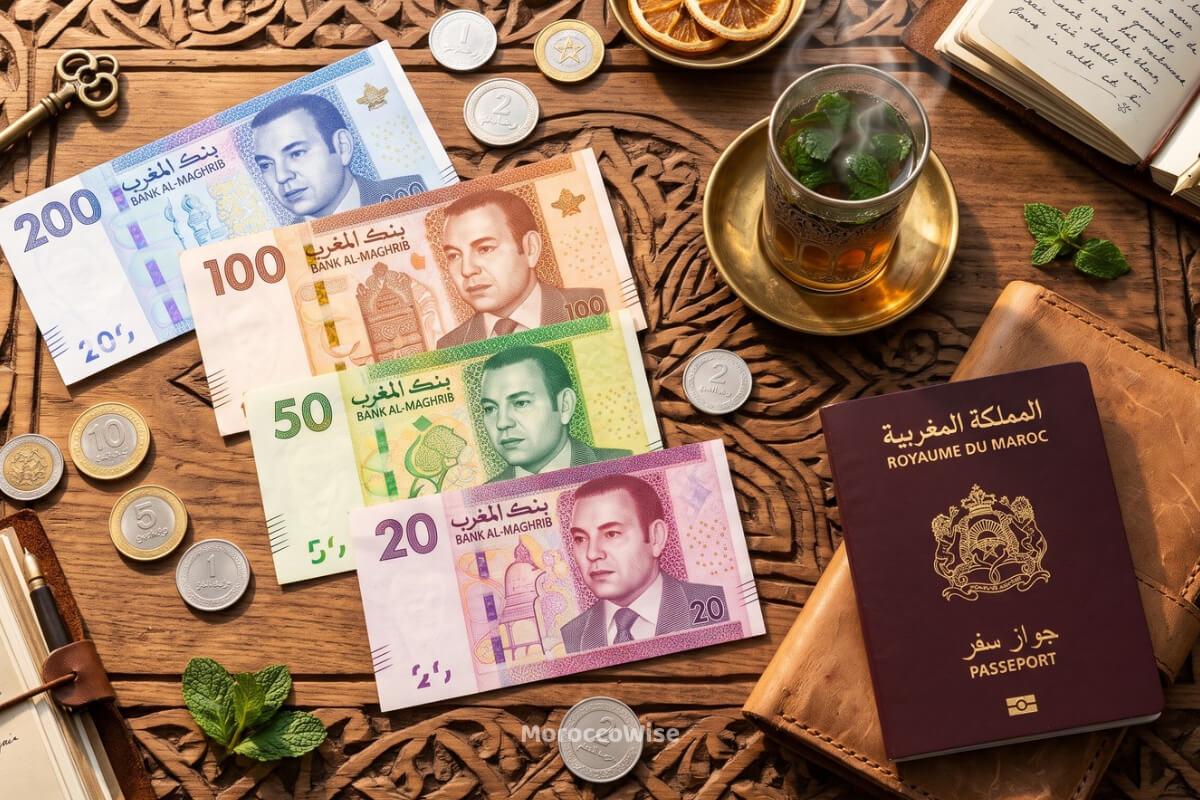
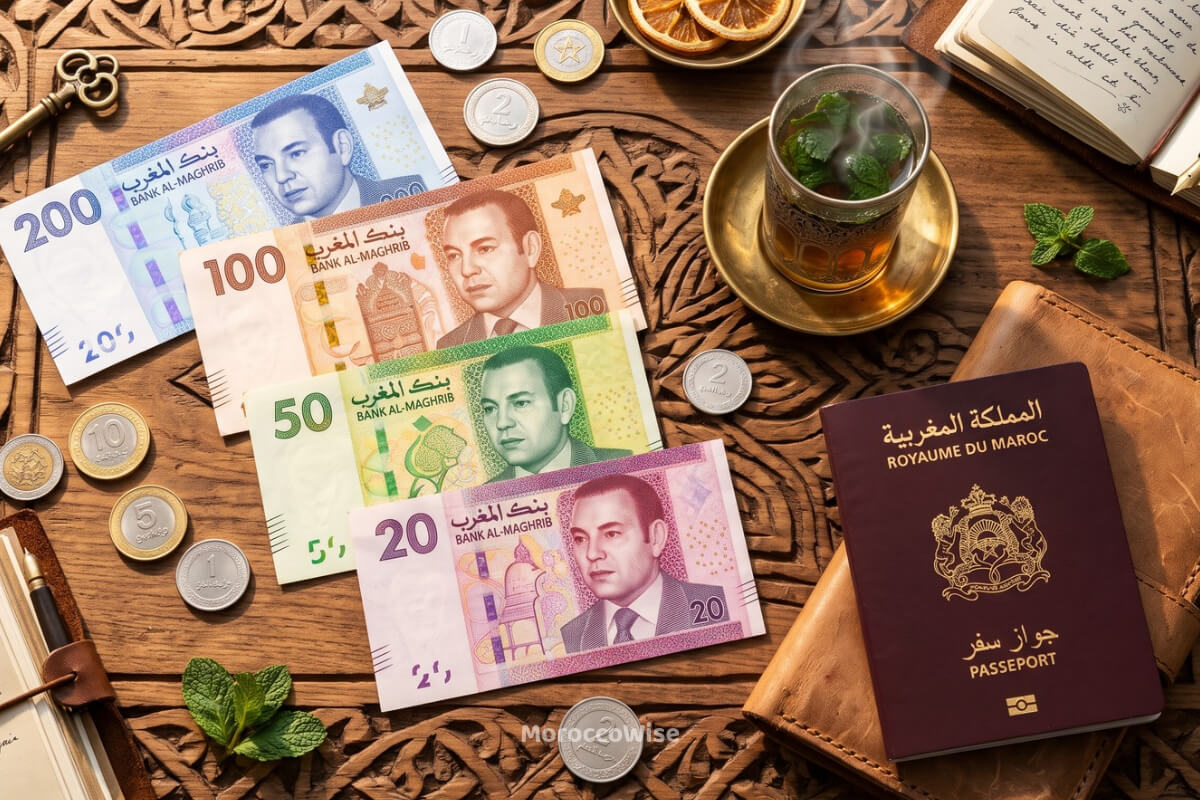
| Banknotes in Circulation | 20 MAD (Purple), 50 MAD (Green), 100 MAD (Brown/Yellow), 200 MAD (Blue) |
| Coins in Circulation | 1/2 MAD (50 santimat), 1 MAD, 2 MAD, 5 MAD, 10 MAD (Bimetallic gold & silver) |
| Approximate Exchange Rates | £1 GBP ≈ 12.50–13.00 MAD | €1 EUR ≈ 10.50–10.80 MAD | $1 USD ≈ 9.80–10.20 MAD |
| 100 MAD Rule of Thumb | 100 MAD ≈ £7.80 GBP / €9.30 EUR / $10.00 USD |
| Import / Export Legal Limit | Strictly capped at 2,000 MAD in cash when entering or leaving Morocco (Office des Changes rule) |
| Best Way to Pay | 70% Cash (MAD) for souks, taxis, cafés, and tips; 30% Card for hotels, upscale dining, and ONCF trains |
(First time heading to North Africa? Pair this money guide with our complete survival guide on Visiting Morocco for the First Time).
Understanding Currency Morocco Dirhams: Notes, Coins & The "Rial" Trap
When handling currency Morocco dirhams on the ground, knowing your denominations prevents costly confusion in busy markets.
Moroccan Banknotes: Why 20 and 50 MAD Notes Are Gold
Morocco prints four paper/polymer banknotes: 20, 50, 100, and 200 Dirhams.
- The 200 MAD Note Problem: Whenever you withdraw money from a Moroccan ATM, the machine will almost always dispense crisp 200 MAD notes (worth roughly £15.50 / $20). If you try to pay a petit taxi driver for a 15 MAD ride or buy a 10 MAD bottle of water with a 200 MAD bill, the vendor will throw their hands up and claim they have no change ("Pas de monnaie").
- The Solution: Break your 200 MAD and 100 MAD bills at your hotel reception, large supermarkets (Carrefour or Marjane), or upscale cafés, and hoard your 20 MAD, 50 MAD, and 10 MAD coins for daily street transactions.
Beware of the "Santim" and "Rial" Pricing Confusion
In traditional souks and rural markets, older vendors often quote prices not in Dirhams, but in Centimes (Santim) or Rials:
- Centimes (Santim): Because 1 Dirham equals 100 Centimes, some locals drop the decimal. If a leather bag vendor says something costs "10,000" (Ashra-alaf), they almost certainly mean 10,000 Centimes = 100 Dirhams ($10), NOT 10,000 Dirhams ($1,000)!
- Rials: The Rial is an old pre-independence colonial unit still used in spoken Darija. 20 Rials = 1 Dirham (so 1,000 Rials = 50 Dirhams).
- Pro Tip: Whenever haggling in the medina, always clarify by asking: "Is that in Dirhams?" or have the seller type the number in MAD on a smartphone calculator.
What Currency Is Used in Morocco Marrakech? (And Do They Use Euros?)
Travelers booking a short city break frequently search "what currency is used in Morocco Marrakech" and "do they use euros in Morocco".
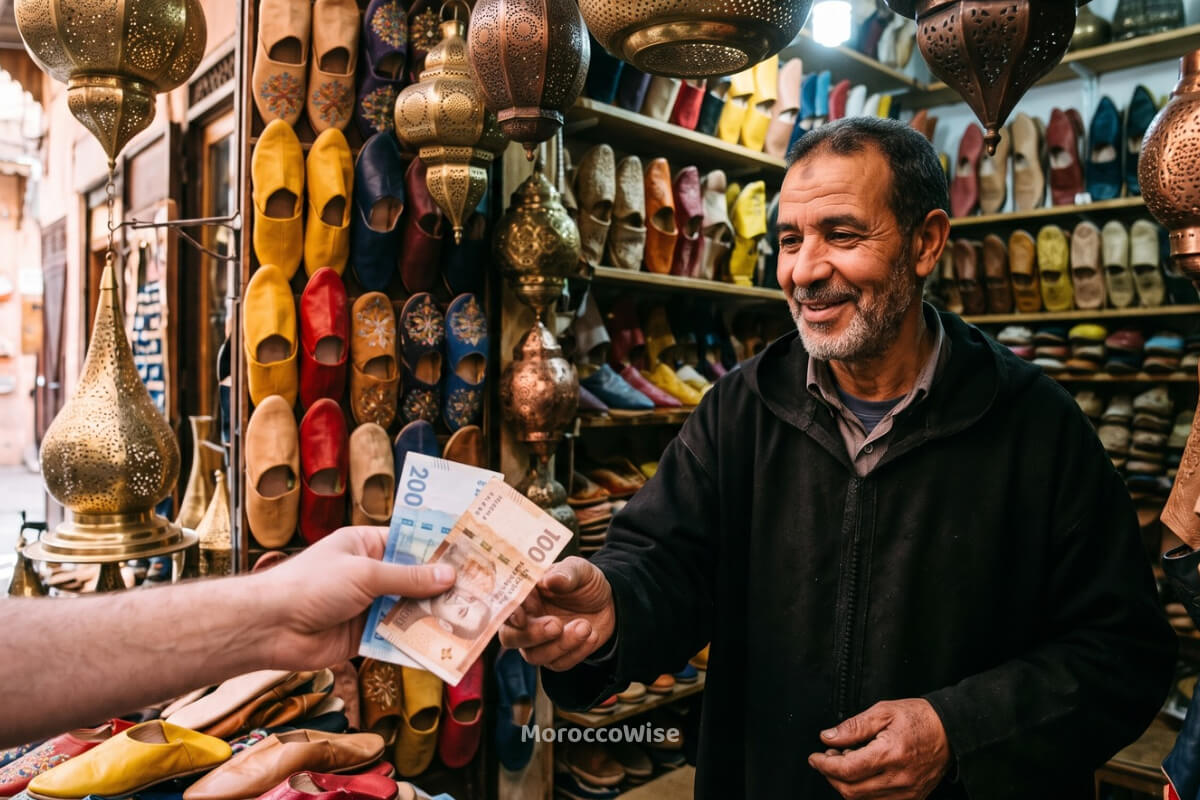
The official currency in Marrakech is strictly the Moroccan Dirham (MAD). However, because Marrakech receives millions of European visitors each year, many souk vendors, riad owners, desert tour operators, and excursion guides will happily offer to accept Euros (€), British Pounds (£), or US Dollars ($).
Why You Should Almost Never Pay in Euros in Morocco
So, do they use Euros in Morocco? Informally in tourist zones, yes—but paying in Euros is a bad financial deal for you:
- The 10-to-1 Exchange Rip-off: The real market exchange rate is usually around €1 = 10.60 to 10.80 MAD. When a shopkeeper in Jemaa el-Fnaa or a taxi driver accepts Euros, they round the rate down to €1 = 10 MAD (or worse), instantly costing you a 6% to 10% hidden markup.
- Change Given in Dirhams: Even if you pay with a €20 note, your change will be handed back to you in Moroccan Dirhams, often miscalculated in the vendor's favor.
- Euro Coins Are Useless to Locals: Moroccan banks only exchange foreign paper banknotes; they do not exchange Euro or Pound coins. Never tip locals in Euro coins, as they cannot cash them in at the bank and are forced to beg other tourists to swap them for Dirhams.
The Golden Exception: The only time paying in Euros makes sense is if your boutique riad or private Sahara tour quotes its official room/tour price in Euros (e.g., €120 per night) and lets you pay that exact figure in Euro cash to avoid a 3% to 5% credit card machine surcharge.
How Much Is 100 in Morocco Currency? (And Morocco Currency to Pound, Euro & Dollar)
One of the most popular conversion queries is "how much is 100 in Morocco currency" alongside "Morocco currency to pound".
Because the Moroccan Dirham is pegged by Morocco's central bank (Bank Al-Maghrib) to a basket of currencies weighted heavily toward the Euro (60%) and the US Dollar (40%), the Dirham is remarkably stable and rarely suffers wild inflation swings.
Mental Math Conversion Shortcuts for 2027:
- Morocco Currency to US Dollar ($): Divide the Dirham price by 10.
- 100 MAD ≈ $10.00 USD (Conversely, $100 USD ≈ 990–1,010 MAD).
- Morocco Currency to Euro (€): Divide the Dirham price by 10.7.
- 100 MAD ≈ €9.30 EUR (Conversely, €100 EUR ≈ 1,060–1,080 MAD).
- Morocco Currency to Pound (£): Divide the Dirham price by 12.7 (or multiply by 0.08).
- 100 MAD ≈ £7.80 GBP (Conversely, £100 GBP ≈ 1,250–1,300 MAD).
What Does 100 MAD Actually Buy in Morocco? (Real Purchasing Power)
To help you understand what 100 in Morocco currency feels like on the ground, here is what typical items cost in 2027:
| Item or Experience | Typical Cost in Moroccan Dirhams (MAD) | Approximate Cost in GBP / EUR / USD |
|---|---|---|
| Bottle of 1.5L Water at a Shop | 5–7 MAD | £0.45 / €0.55 / $0.60 |
| Pot of Mint Tea or Espresso at a Local Café | 12–20 MAD | £1.20 / €1.50 / $1.60 |
| Short Petit Taxi Ride Across Town (Metered) | 15–30 MAD | £1.50 / €2.00 / $2.20 |
| Street Food Lunch (Bocadillo, Harira & Skewers) | 35–60 MAD | £3.50 / €4.50 / $5.00 |
| Traditional Tagine Meal at a Mid-Range Restaurant | 80–130 MAD | £7.50 / €9.50 / $10.50 |
| Entry Ticket to Bahia Palace or Kasbah Museum | 70–100 MAD | £6.50 / €8.00 / $9.00 |
| 3-Course Dinner at a Luxury Rooftop in Marrakech | 350–600 MAD per person | £30–£48 / €33–€56 / $35–$60 |
Where Can I Get Morocco Currency? (And What Currency Should I Take?)
Travelers planning ahead often ask "where can I get Morocco currency" before their flight, and "what currency should I take to Morocco".
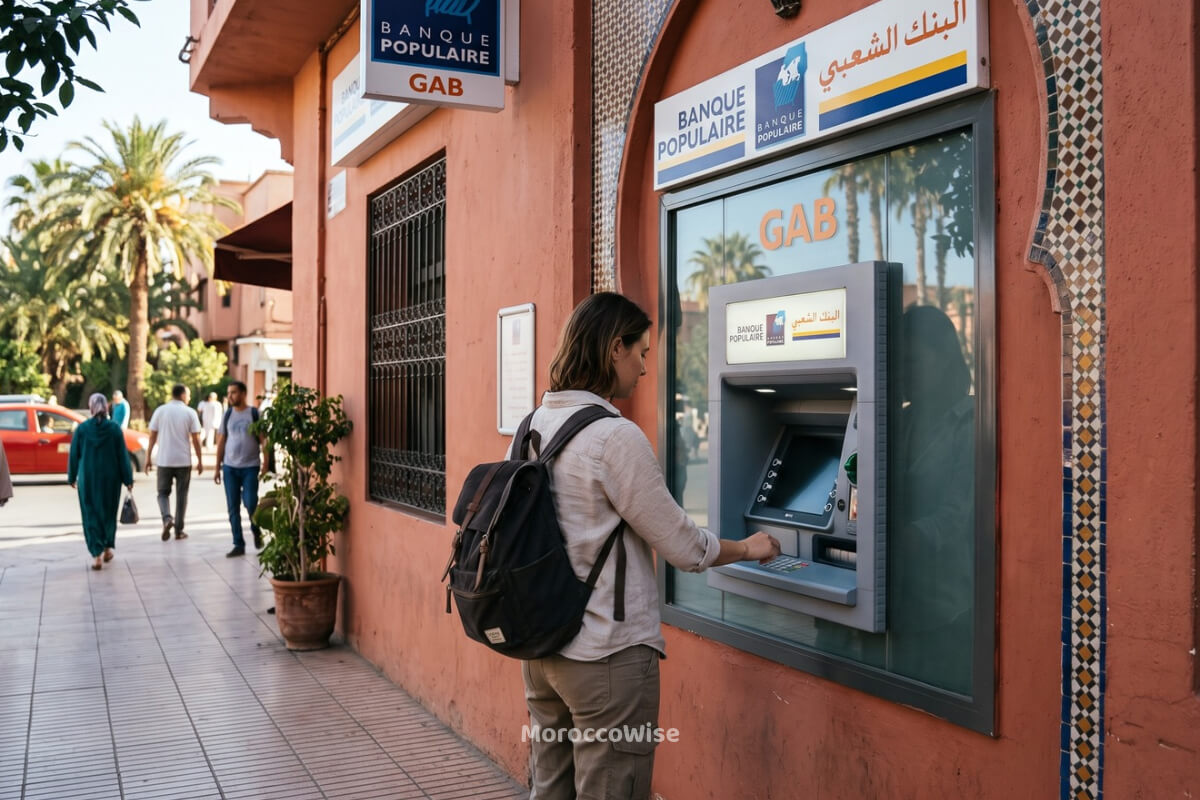
1. Why You Should NOT Buy Moroccan Dirhams Before You Fly
Technically, the Moroccan Dirham is a closed currency, meaning Moroccan law prohibits importing or exporting more than 2,000 MAD across the border. While a few airport bureaux de change in London, Paris, or New York stock small amounts of Dirhams, their exchange rates are atrocious—often charging a 15% to 20% spread compared to the rate inside Morocco. Wait until you land in Morocco to get your Dirhams.
2. What Currency Should I Take to Morocco?
If you prefer bringing physical foreign cash from home to exchange upon arrival, here is the hierarchy of what currency should I take to Morocco:
- Euros (EUR) — #1 Best Choice: Euros command the tightest exchange spreads everywhere in Morocco.
- British Pounds (GBP) & US Dollars (USD) — Tied for #2: Widely accepted and easily exchanged at competitive rates at every official Bureau de Change in the country.
- Canadian & Australian Dollars (CAD / AUD): Accepted at major city exchange offices, though with slightly wider spreads than EUR, GBP, or USD.
Crucial Condition Rule for Foreign Banknotes: Moroccan exchange offices and banks are notoriously strict about note condition. Bring crisp, clean, unripped banknotes printed recently (for US Dollars, bring post-2013 blue-ribbon $50 and $100 bills). Any note with a tiny tear, ink stamp, or heavy crease will be rejected!
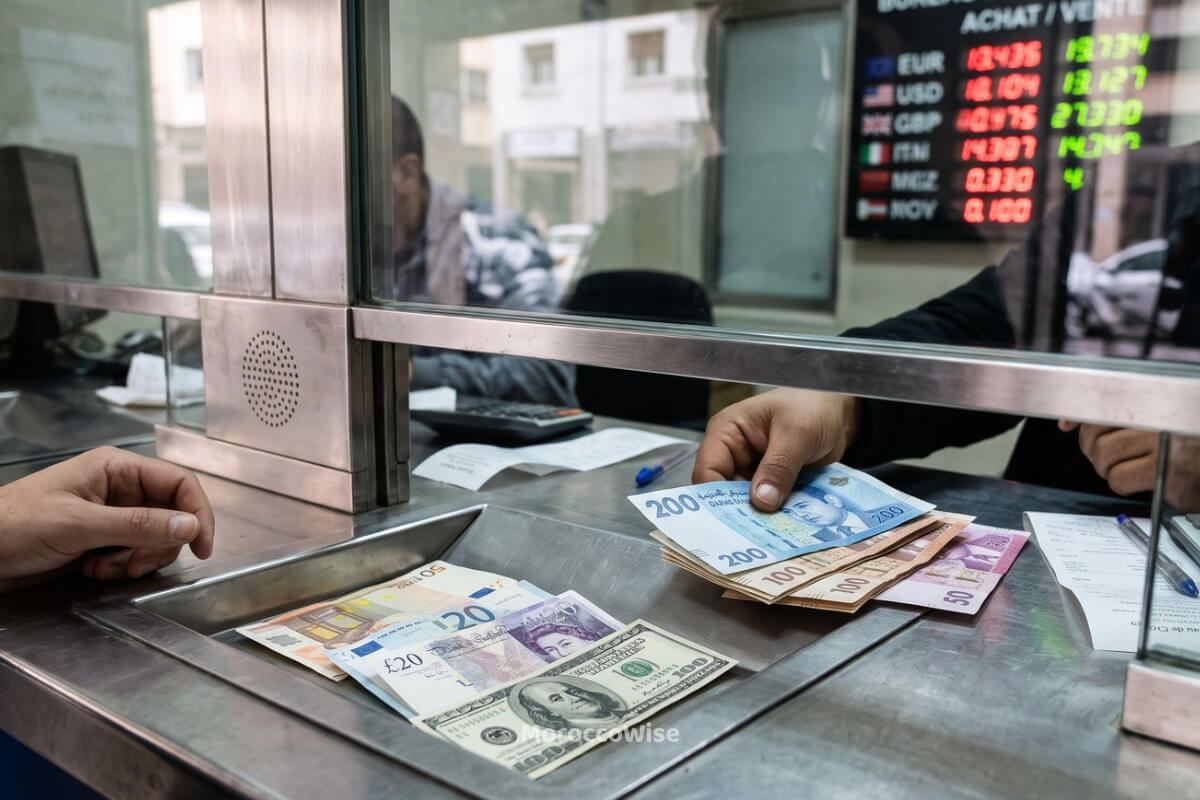
3. Where Can I Get Morocco Currency Once I Land?
Once you step off the plane at Marrakech Menara (RAK), Casablanca (CMN), Tangier (TNG), or Fes (FEZ), you have three legitimate ways to get Dirhams:
- Option A: Airport ATMs (Best for Immediate Cash): Walk past baggage claim into the arrivals hall and withdraw Dirhams using your Revolut, Wise, or bank debit card from a bank ATM (such as Banque Populaire, BMCE Bank of Africa, or Attijariwafa Bank).
- Option B: City Center "Bureaux de Change" (Best for Exchanging Foreign Cash): Only exchange €20–€30 at the airport kiosk to pay for your airport transfer, as airport exchange kiosks offer poor rates. Wait until you reach the city center to swap the rest of your Pounds, Euros, or Dollars at a licensed, zero-commission Bureau de Change (in Marrakech, the exchange offices near Jemaa el-Fnaa—such as Bureau de Change Hôtel Ali on Rue Moulay Ismail—are famous for offering near-interbank rates).
- Option C: Keep Your Exchange Receipts! When exchanging cash, always keep the paper receipt (bordereau de change). If you have leftover Dirhams at the end of your holiday, the airport bank will only convert your Dirhams back into Pounds, Euros, or Dollars if you show an official exchange or ATM receipt proving where you got them.
Can I Use Revolut in Morocco? (Plus Wise, Monzo & Starling)
One of the fastest-growing questions among modern travelers is: "Can I use Revolut in Morocco?"
Yes, Revolut works seamlessly in Morocco—both for contactless/chip-and-PIN card payments at hotels, restaurants, and supermarkets, and for withdrawing Moroccan Dirhams at ATMs. However, there is one very important technical quirk you must understand before you go.
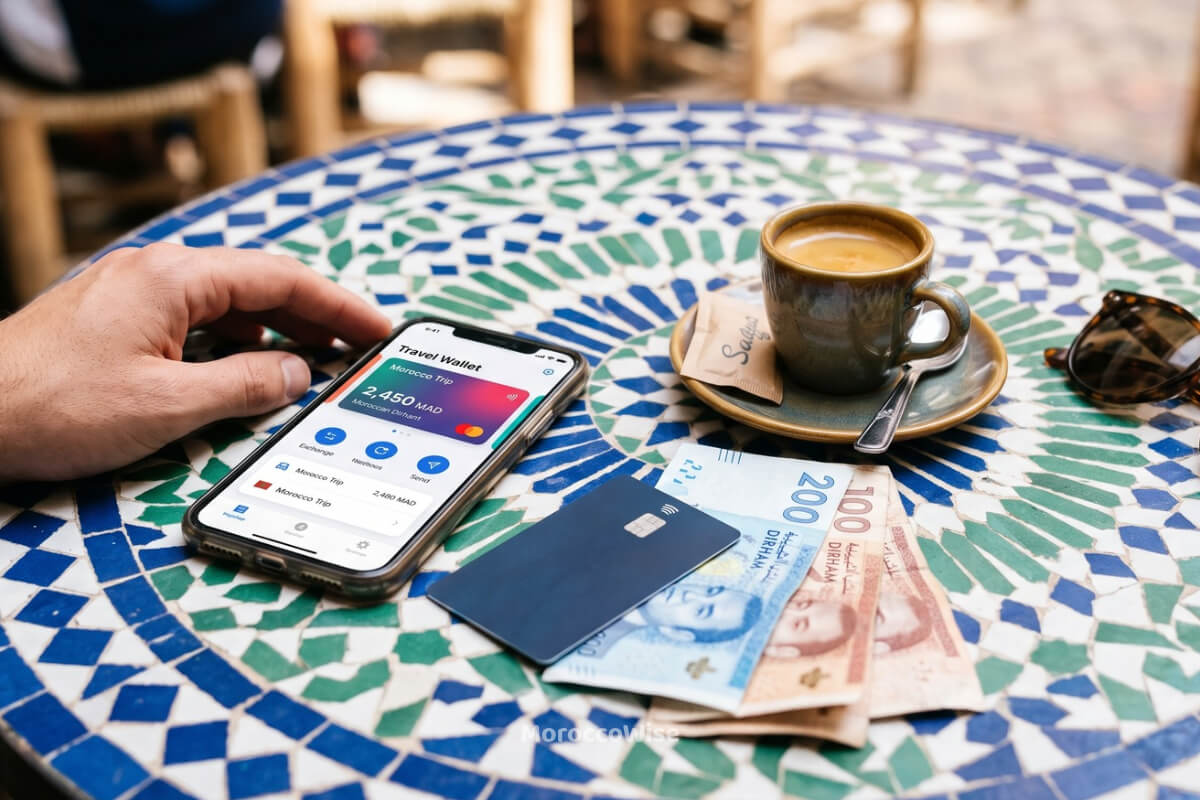
How Revolut Works with Moroccan Dirhams (No In-App MAD Wallet)
Because the Moroccan Dirham (MAD) is a restricted currency, you cannot pre-buy or hold a Moroccan Dirham balance inside the Revolut app before your trip.
Instead, here is how you use Revolut in Morocco:
- Top Up Your Home Currency: Simply keep money in your primary Revolut wallet (GBP, EUR, or USD).
- Spend or Withdraw Directly in MAD: When you tap your Revolut card at a restaurant or withdraw Dirhams at a Moroccan ATM, Revolut automatically converts your GBP/EUR/USD into MAD on the fly at the real live interbank exchange rate!
- Beware the Revolut Weekend Markup (1% Fee): On Saturdays and Sundays (between Friday 5:00 PM New York time and Sunday 6:00 PM New York time), Revolut charges a 1% weekend currency exchange fee on all conversions—and because you cannot pre-convert MAD on a Friday, any ATM withdrawal or card payment you make with Revolut on a Saturday or Sunday will incur that 1% fee.
- How to Beat the Weekend Fee: Withdraw your weekend cash from an ATM on Thursday or Friday, or carry a backup card like Wise (which lets you hold a MAD balance in-app ahead of time!), Starling Bank, or Chase UK (which charge 0% on weekends).
- Bring the Physical Card: Do not rely solely on Apple Pay or Google Wallet on your phone. Most Moroccan ATMs and many older restaurant card terminals require a physical chip-and-PIN card.
The Moroccan ATM Survival Guide: Fees, Limits & Scams
Using ATMs (Guichet Automatique) in Morocco is safe and convenient, provided you know three insider rules:
1. Which Moroccan Bank ATMs Charge the Lowest Fees?
Even if your Revolut, Wise, or Monzo card charges "zero foreign ATM fees," the local Moroccan bank operating the ATM usually adds its own fixed access fee of 28 MAD to 37 MAD (£2.20–£3.00 / $3.00–$3.70) per withdrawal.
- Lowest Fee Secret — Al Barid Bank (La Poste): Yellow-and-burgundy ATMs attached to Moroccan post offices (Al Barid Bank) have historically charged 0 MAD (or the lowest fee in the country, around 22 MAD depending on card network) for foreign card withdrawals!
- Most Reliable Mainstream Banks: Attijariwafa Bank, Banque Populaire, BMCE Bank of Africa, and CIH Bank have modern, reliable ATMs in every city.
- Avoid Euronet ATMs: Just like in Europe, standalone blue-and-yellow Euronet ATMs placed in tourist squares charge predatory fees and terrible exchange rates. Always use an ATM physically attached to an actual bank branch during daytime banking hours (in case the machine ever swallows your card).
2. ATM Withdrawal Limits
Most Moroccan ATMs cap a single withdrawal at 2,000 MAD (roughly £155 / €185 / $200) per transaction, though some BMCE and Attijariwafa machines allow up to 4,000 MAD. Because you pay a local ATM fee per withdrawal, always withdraw the maximum 2,000 MAD at once rather than making four separate 500 MAD withdrawals.
3. Decline "Dynamic Currency Conversion" (DCC)
When using a Moroccan ATM or paying by card at a hotel/restaurant, the screen will often ask: "Would you like to be billed in your home currency (GBP/EUR/USD) with a guaranteed conversion rate, or in Moroccan Dirhams (MAD)?"
- ALWAYS choose Moroccan Dirhams (MAD) / "Continue Without Conversion". Choosing GBP, EUR, or USD lets the local machine apply an outrageous 7% to 12% markup!
Tipping Etiquette in Morocco (How Much to Tip in Dirhams)
Tipping (Baksheesh) is deeply woven into Moroccan daily life, as service workers rely on tips to supplement modest wages. Always tip in Moroccan Dirham cash (never add a tip to a credit card slip, as it rarely reaches the waiter).
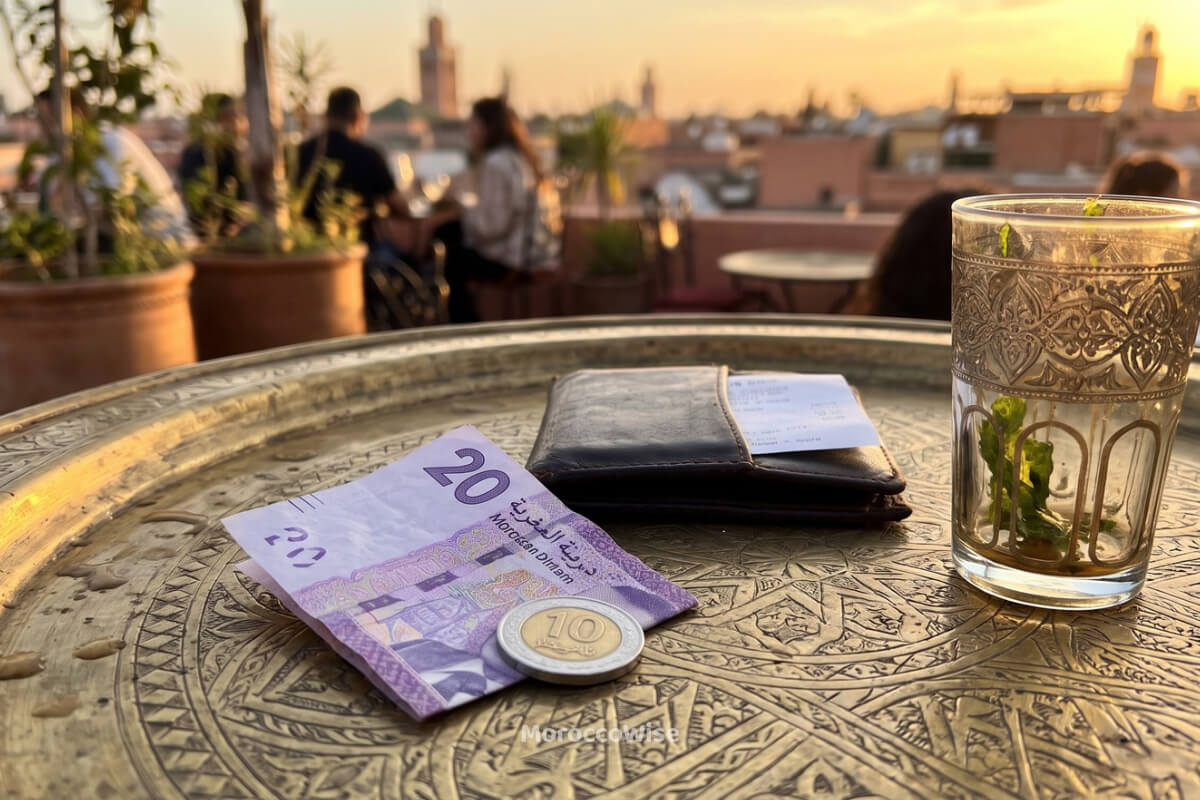
- Local Cafés (Mint Tea / Coffee): Leave 2 to 5 MAD in coins on the table.
- Casual Restaurants: Leave 10 to 20 MAD (or roughly 10% of the bill).
- Upscale Restaurants: Tip 10% to 15% in cash (typically 40–100 MAD).
- Riad Luggage Porters (Handcart men in the medina): 20 to 30 MAD per bag (up to 50 MAD if they haul heavy bags up steep stairs in Chefchaouen or Fes).
- Riad Housekeeping Staff: 20 to 30 MAD per day left in an envelope or handed directly at checkout.
- Licensed Half-Day Tour Guide: 100 to 150 MAD.
- Private Driver (Full Day): 100 to 200 MAD per day.
- Public Restroom Attendants: 2 to 5 MAD (always keep coins in your pocket for this!).
(Want to avoid overpaying on the street? Read our full breakdown of Common Scams in Morocco).
Do's and Don'ts: Managing Money in Morocco
| Do | Don't |
|---|---|
| Wait until you land in Morocco to withdraw or exchange into Moroccan Dirhams (MAD) | Buy Dirhams at your home airport before flying (you will lose 15%–20% on the rate) |
| Carry a fee-free travel card like Revolut, Wise, or Starling alongside backup EUR/GBP/USD cash | Rely 100% on Apple Pay or cards—souks, taxis, and small cafés are strictly cash-only |
| Always choose to be charged in MAD (Without Conversion) at ATMs and card machines | Accept Dynamic Currency Conversion into GBP, EUR, or USD on payment terminals |
| Break 200 MAD notes at supermarkets or hotels and hoard 20/50 MAD bills and coins | Hand a 200 MAD note to a petit taxi driver for a 15 MAD fare |
| Clarify whether spoken souk prices are in Dirhams, Centimes, or Rials | Tip local service workers with Euro or British Pound coins (banks won't exchange them) |
| Keep your official exchange or ATM receipts to convert leftover Dirhams back at the airport | Leave Morocco with more than 2,000 MAD in cash (it is illegal under customs law) |
Frequently Asked Questions (FAQ)
What currency is used in Morocco and is it better to take cash or card?
The official currency is the Moroccan Dirham (MAD). The best approach is a hybrid strategy: bring a fee-free travel debit card (like Revolut or Wise) to withdraw Dirham cash from local bank ATMs and pay for hotels, plus €100–€200 (or £100–£200 / $100–$200) in crisp paper notes as an emergency cash backup to exchange at a city Bureau de Change.
Can I use Euros or US Dollars in Marrakech?
While larger tourist shops in the Marrakech souks, upscale riads, and desert tour agencies will accept Euros, Pounds, or US Dollars, they will apply a poor exchange rate (usually 10 MAD per €1/$1) and give your change in Dirhams. For daily expenses like taxis, restaurants, pharmacies, and food stalls, you must use Moroccan Dirhams.
Can I hold Moroccan Dirhams in my Revolut account before traveling?
No. Revolut does not currently offer an in-app MAD currency wallet. Simply hold GBP, EUR, or USD in your Revolut account and spend or withdraw in Morocco—Revolut will automatically convert the funds at the live interbank rate at the moment of the transaction. (Note: Wise does allow you to hold a MAD balance in-app).
What should I do with leftover Moroccan Dirhams at the end of my trip?
Because you cannot legally export more than 2,000 MAD or easily exchange Dirhams back home, spend your small notes on duty-free shopping, snacks, or souvenirs, or convert your remaining Dirhams back into Euros, Pounds, or Dollars at the bank exchange booth inside the Moroccan airport before passing through security (you will need to show your original ATM or exchange receipt).
Official and Practical Reference Links
Before traveling, verify live central bank exchange rates and official Moroccan customs currency declarations using these authoritative portals:
- Bank Al-Maghrib – Central Bank of Morocco (Official Daily MAD Exchange Rates)
- Office des Changes – Official Moroccan Foreign Exchange & 2,000 MAD Customs Regulations
- XE Currency Converter – Live Moroccan Dirham (MAD) to GBP, EUR & USD Rates
- Revolut Official Site – International Travel Card Fees & Exchange Rules
(Packing your bags for departure? Check our complete checklist on What to Pack for a Trip to Morocco and our Morocco Visa Requirements Guide!)