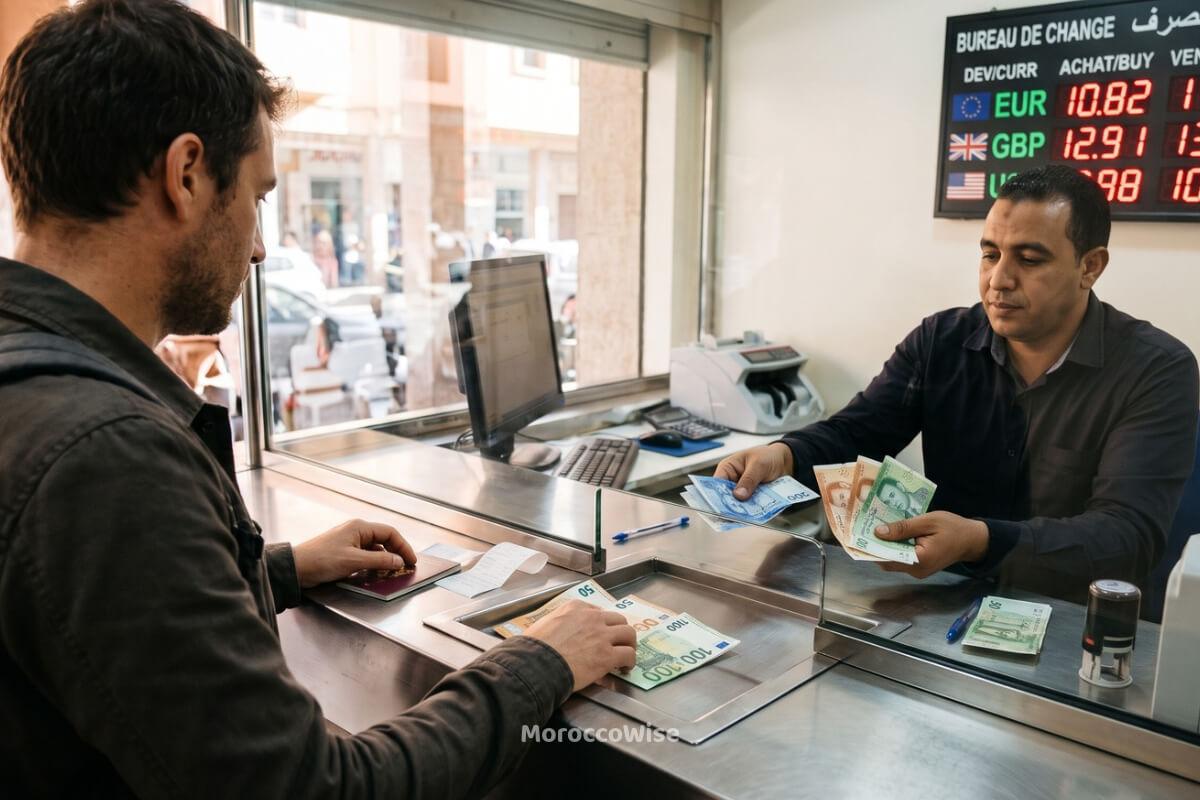
Knowing where to exchange money in Morocco safely and without losing 10% to 15% on hidden markups is essential for every traveler. Because Morocco remains a predominantly cash-based society—where medina souks, petit taxis, street food stalls, and local cafés only accept physical Moroccan Dirhams (MAD)—you will need a reliable strategy for converting your Pounds, Euros, or US Dollars.
The best place to exchange money in Morocco is at a licensed city-center Bureau de Change (currency exchange office) authorized by Morocco's Office des Changes, or directly at an official Moroccan commercial bank. These regulated city exchange booths charge 0% commission and offer exchange rates within 1% to 1.5% of the live interbank market rate. By contrast, exchanging money at your home airport before flying or exchanging large sums at Moroccan airport arrival kiosks will cost you between 8% and 18% in unfavorable rate spreads.
This comprehensive 2027 guide answers every question about where to exchange money in Morocco, including the famous Hotel Ali exchange hub in Marrakech, the best spots in Gueliz and Casablanca, whether you can walk straight into a Moroccan bank to swap cash, and how to handle airport currency booths.
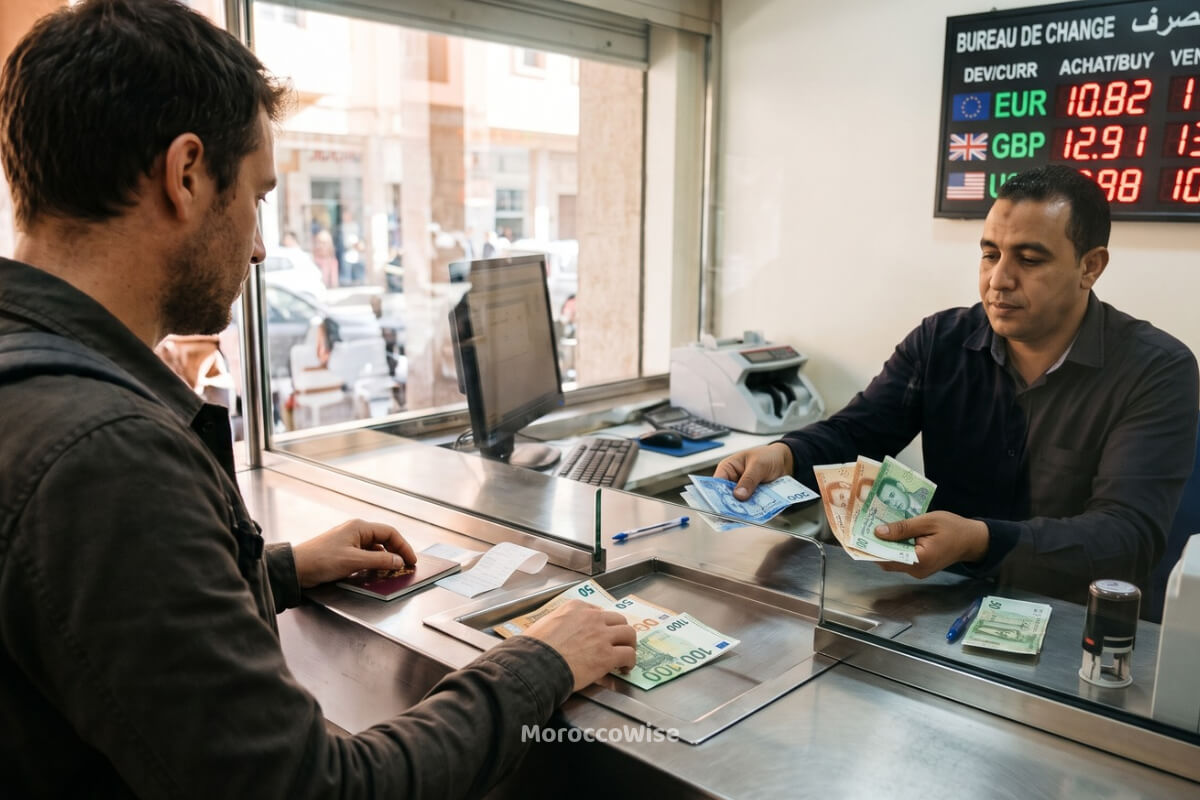
Quick-Answer Comparison: Where Is the Best Place to Exchange Money in Morocco?
When travelers ask, "Where is the best place to exchange money in Morocco?", comparing the five legal exchange channels side-by-side makes the right choice obvious:
| Exchange Location | Rate Quality | Commission / Fee | Convenience & Best Use Case |
|---|---|---|---|
| City-Center Licensed Bureau de Change | Excellent (Best Rates) | 0% Commission | #1 Choice for Foreign Cash. Fast, safe, and open late in tourist areas like Jemaa el-Fnaa, Gueliz, and downtown Casablanca. |
| Moroccan Commercial Banks (Walk-In) | Very Good (Official Central Bank Rate) | 0% Commission | Great for large sums or smaller towns without independent exchange booths. Slower due to banking hours (8:30 AM–3:30 PM). |
| Moroccan Bank ATMs (Debit Card) | Excellent (With Revolut/Wise) | 22–37 MAD local ATM fee | Best if you don't want to carry wads of foreign cash from home. Always decline "Dynamic Currency Conversion." |
| Moroccan Airport Exchange Kiosks | Poor (6%–10% markup) | 0% Commission (Hidden in spread) | Emergency Use Only. Only exchange £20/€20/$30 here to pay for your taxi or bus into the city. |
| 4- & 5-Star Hotel Receptions | Poor to Fair (5%–8% markup) | None | Convenient late at night when city booths are closed, but poor value for large amounts. |
| Home Country Airport (Before Flying) | Terrible (15%–20% markup) | Often charges service fees | Avoid Completely. Never buy Moroccan Dirhams before boarding your flight. |
(Want to understand Moroccan banknotes, coins, and travel cards first? Read our full guide on What Currency Is Used in Morocco?).
Is It Better to Exchange Money in Morocco or Before You Fly?
One of the most frequent questions from first-time visitors is: "Is it better to exchange money in Morocco?"
Yes—it is always significantly better to exchange money inside Morocco rather than in your home country. There are two reasons for this:
- The Dirham Is a Restricted Currency: Under Moroccan foreign exchange law (Office des Changes), the Moroccan Dirham (MAD) is a closed currency that cannot legally be imported or exported in amounts exceeding 2,000 MAD. Because global supply outside Morocco is tiny, foreign bureaux de change in the UK, Europe, the US, and Canada charge a massive scarcity premium—often giving you only 10.50 MAD per £1 GBP when the real rate inside Morocco is nearly 12.80 MAD!
- Regulated Tight Spreads Inside Morocco: Inside Morocco, currency exchange rates are tightly regulated by the central bank (Bank Al-Maghrib). Licensed exchange offices cannot invent predatory rates; they must buy and sell within a narrow daily band set by the central bank.
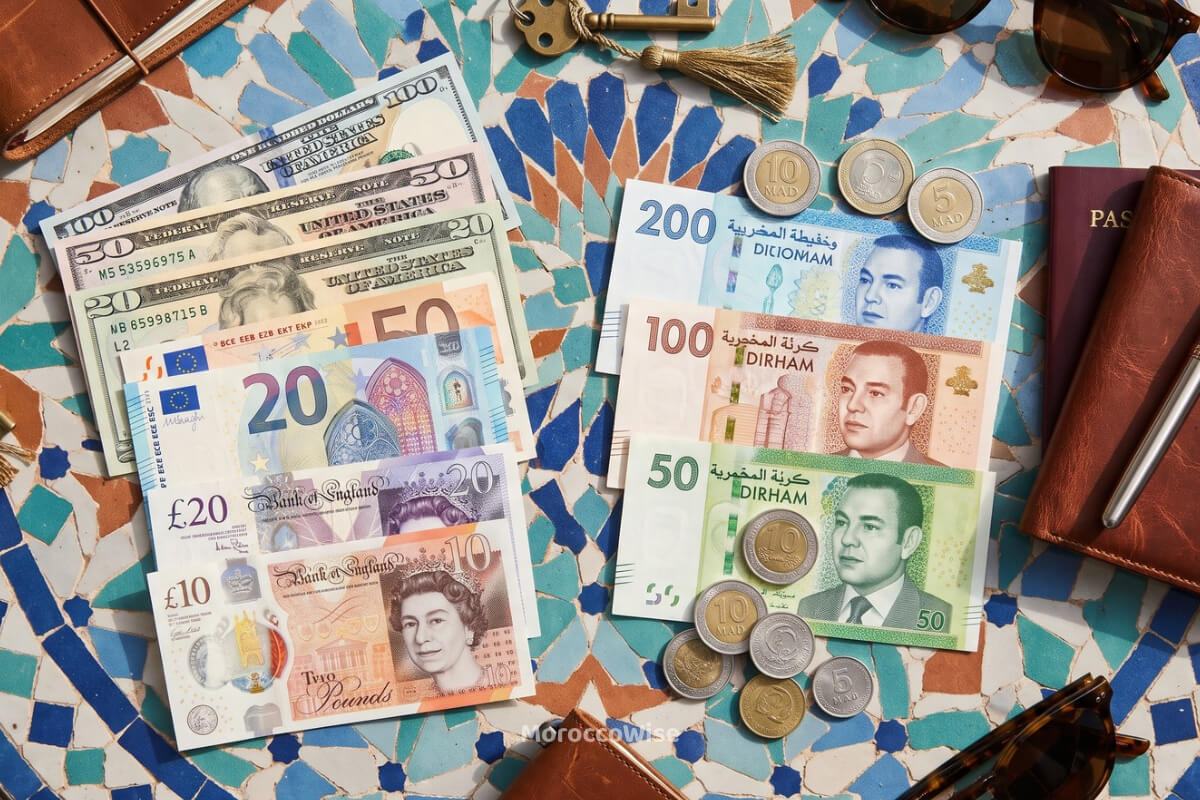
What Foreign Cash Should You Bring to Exchange?
- Euros (€), British Pounds (£), and US Dollars ($) are the "Big Three" currencies accepted at every single bank and Bureau de Change across Morocco.
- Canadian Dollars (CAD), Swiss Francs (CHF), and Gibraltar Pounds are also exchanged at major city bureaux, though EUR, GBP, and USD get the sharpest rates.
- Bring Pristine, Unripped Banknotes: Moroccan exchange clerks inspect every foreign bill closely. Any note with a tear, missing corner, heavy ink mark, or faded print will be handed right back to you. If bringing US Dollars, ensure they are post-2013 series notes (with the blue 3D security ribbon), as older "small-head" $100 bills are routinely refused.
Best Place to Exchange Money in Marrakech (Medina, Hotel Ali & Gueliz)
Because Marrakech is the starting point for the majority of tourists, searches for "best place to exchange money in Marrakech", "money exchange Marrakech", and "money exchange Gueliz" top travel forums every year.
Marrakech is divided into two main districts: the historic walled Medina and the modern French-built district of Gueliz (Nouvelle Ville). Both have outstanding, safe places to swap your cash.
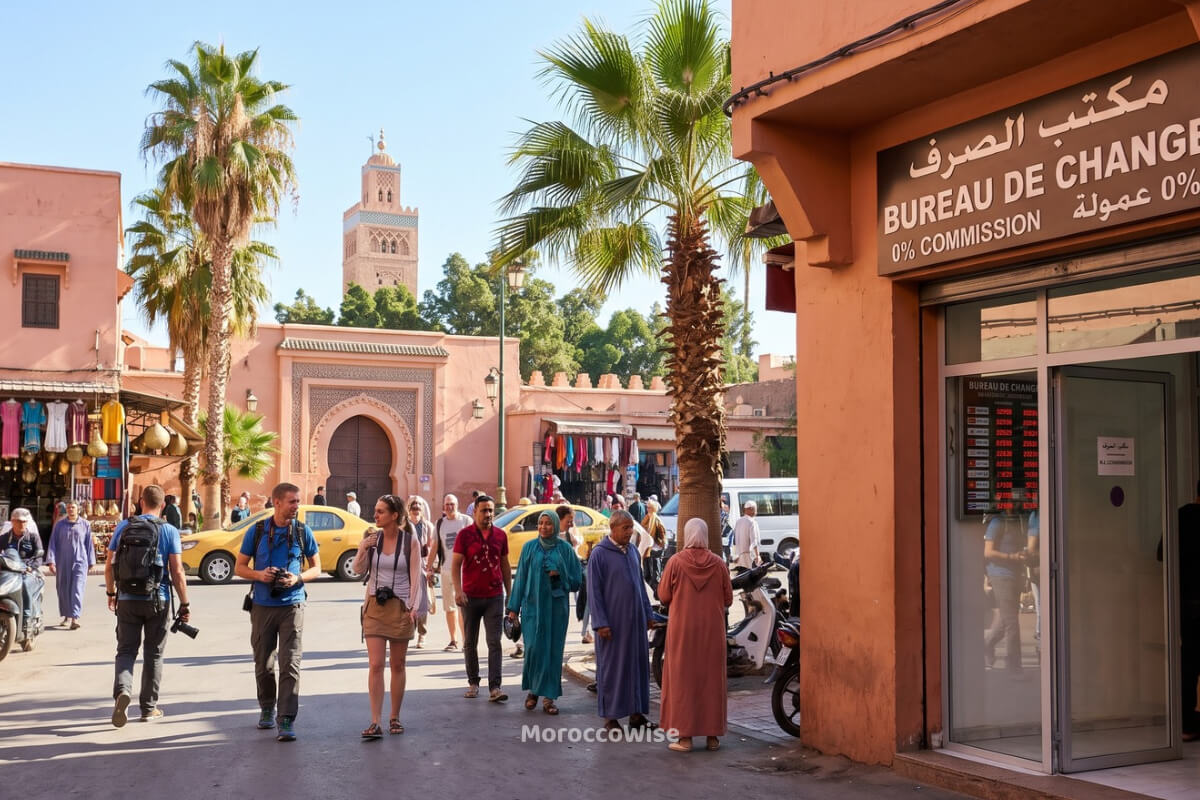
1. The Legendary Spot: Bureau de Change Hotel Ali & Rue Moulay Ismail (Medina)
If you ask seasoned travelers or locals for the single best place to exchange money in Marrakech, one name comes up more than any other: Bureau de Change Hôtel Ali.
- Where It Is Located: Just a 2-minute walk south of the main Jemaa el-Fnaa square, right along Rue Moulay Ismail (on the way toward the Koutoubia Mosque).
- Why It Is Famous: For decades, the exchange booth attached to Hôtel Ali—along with the cluster of 5 to 6 neighboring licensed Bureaux de Change lining Rue Moulay Ismail—has offered the sharpest retail exchange rates in Marrakech, often within 0.5% to 1% of the live XE mid-market rate, with zero commission.
- Opening Hours: Most exchange offices along Rue Moulay Ismail stay open daily from 8:30 AM until 9:00 PM or 10:00 PM, making them far more convenient than traditional banks.
- Other Reliable Medina Spots: You will also find licensed, zero-commission exchange booths along Rue Bani Marine (just off Jemaa el-Fnaa) and near the Bab Doukkala and Bab Laksour gates. Because multiple booths sit side by side, you can check two LED rate boards in 30 seconds and pick the highest buy rate (Achat).
2. Money Exchange Gueliz (Modern Marrakech)
If you are staying in a modern hotel or apartment outside the old walls—or visiting the Majorelle Garden and YSL Museum—searching for "money exchange Gueliz" will lead you to Marrakech's commercial heart.
- Avenue Mohammed V & Rue de la Liberté: The main artery of Gueliz (stretching from Place du 16 Novembre and Carré Eden Shopping Center down toward the Medina) is packed with both independent Bureaux de Change and major bank headquarters (Attijariwafa Bank, Banque Populaire, BMCE Bank of Africa).
- Inside Carré Eden Mall: If you prefer exchanging money inside an air-conditioned shopping center with security guards at the doors, there are exchange services and bank ATMs directly inside and around the Carré Eden complex on Avenue Mohammed V.
(Planning your days in the Red City? Check out our complete Marrakech Travel Guide for neighborhood maps and top sights).
Best Place to Exchange Money in Marrakech Airport (RAK)
Travelers landing on late flights often search "best place to exchange money in Marrakech airport". Here is the honest truth about airport currency booths in Morocco.
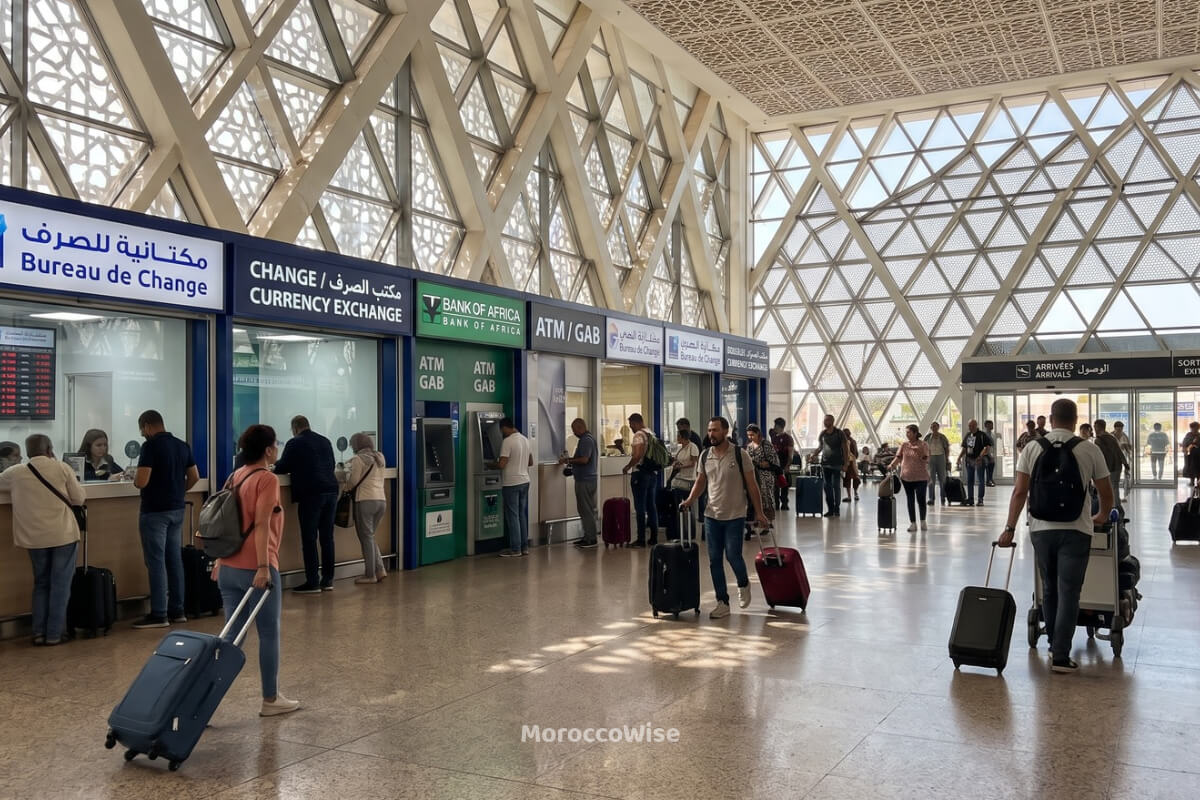
Inside Marrakech Menara Airport (RAK), you will see currency exchange kiosks first inside the baggage reclaim hall (before customs) and then several more bank booths and ATMs in the main public arrivals concourse after you exit customs.
- The Airport Rate Reality: Because airport kiosks have a captive audience and pay high terminal rents, their exchange rate is roughly 6% to 10% worse than what you will get 15 minutes away on Rue Moulay Ismail or in Gueliz.
- The Smart Airport Strategy:
- Best Option (Use a Bank ATM in the Arrivals Hall): Skip the cash exchange booths in baggage claim. Walk out into the public arrivals hall and use a bank ATM (Banque Populaire, Attijariwafa, or BMCE) with your Revolut, Wise, or bank debit card to withdraw Dirhams at the true interbank rate.
- Second Option (The €20 / £20 Rule): If you only brought physical cash, exchange only £20, €20, or $30 at the airport booth—just enough to get 200–300 MAD to pay for the L19 Airport Express Bus (30 MAD) or an official airport taxi into the city. Exchange the rest of your holiday budget once you reach the city center!
Best Place to Exchange Money in Casablanca (City Center & CMN Airport)
As Morocco's economic and banking capital, finding the best place to exchange money in Casablanca is straightforward once you know the prime business districts:
- Downtown Casablanca (Boulevard Mohammed V & Place des Nations Unies): Just steps from the Casa-Port train station and the Central Market (Marché Central), Boulevard Mohammed V and Boulevard Hassan II host dozens of licensed Bureaux de Change and the flagship national headquarters of Morocco's biggest banks. Competition here keeps rates just as tight as in Marrakech.
- Maarif & Gauthier Districts: Around the Twin Center towers in Maarif and Boulevard Moulay Youssef, you will find modern, secure currency exchange offices and 24/7 bank ATMs.
- Morocco Mall & AnfaPlace (La Corniche): Both major coastal shopping malls feature licensed currency exchange booths inside the mall concourses, open 7 days a week until 9:00 PM.
- Casablanca Mohammed V International Airport (CMN): Located in Terminal 1 and Terminal 2 arrivals (and near the underground airport train station), official bank booths operate 24/7. Just like in Marrakech, only swap enough cash at CMN Airport to buy your ONCF train ticket into the city or onto Tangier or Fes, then exchange the bulk of your money in town.
Can I Just Walk Into a Bank and Exchange Currency in Morocco?
A major question on Google's People Also Ask is: "Can I just walk into a bank and exchange currency?"
Yes, absolutely! Unlike in the UK, US, or Europe—where retail banks often refuse to exchange foreign currency unless you hold an account with them—any foreign tourist can walk into a major Moroccan commercial bank and exchange Euros, British Pounds, or US Dollars for Moroccan Dirhams, even if you are not a customer.
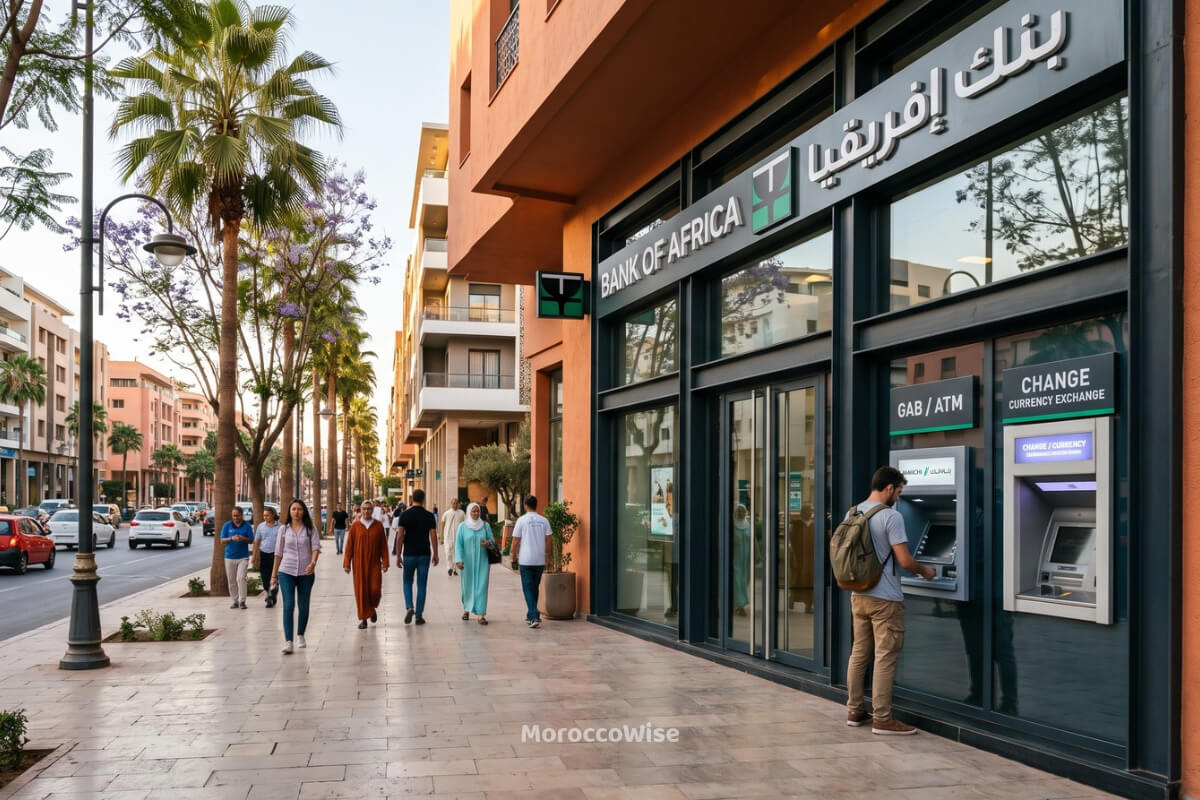
How Walk-In Bank Currency Exchange Works in Morocco:
- Which Banks to Use: Look for branches of Attijariwafa Bank, Banque Populaire, BMCE Bank of Africa, Crédit du Maroc, or Société Générale Maroc.
- Bring Your Physical Passport: By law, Moroccan bank tellers must record your passport details when exchanging currency over the counter. (Some banks also have 24/7 automated Automatic Currency Exchange Machines in the lobby where you simply feed in Euro, Pound, or Dollar bills and the machine dispenses Dirhams without needing a bank card!).
- Pros of Using a Bank: Complete security, guaranteed authentic notes, zero commission, and official rates set by Bank Al-Maghrib.
- Cons of Using a Bank: Strict opening hours (usually Monday to Friday, 8:15 AM to 3:45 PM, closed on weekends) and slower queues compared to a dedicated 2-minute transaction at a licensed Bureau de Change.
Where Can I Exchange Money Safely? 7 Golden Rules to Avoid Scams
When travelers search "where can I exchange money safely" or "exchange money near me" while already on the ground in Morocco, following these seven golden safety rules ensures you never lose a single Dirham:
- Look for the Official "Office des Changes" License: Every legal Bureau de Change in Morocco displays an official license plaque from the Office des Changes and an electronic LED board showing daily Achat (We Buy) and Vente (We Sell) rates.
- Never Exchange Money on the Street (Black Market): If a tout approaches you outside a closed bank or in the medina offering a "better rate" for your Euros or Dollars, walk away immediately. Street money changing is illegal in Morocco and is a classic setup for sleight-of-hand shortchanging or counterfeit bills. (Read our complete guide to Common Scams in Morocco to stay street-smart).
- Understand "Achat" vs. "Vente" on the Rate Board: When you hand over Pounds, Euros, or Dollars to get Dirhams, the bureau is buying your foreign currency—so look at the "Achat" (Buy) column. The closer the Achat number is to the Vente (Sell) number, the fairer the bureau!
- Do the Math on Your Phone First: Before handing your cash through the glass window, multiply your foreign cash by the posted Achat rate on your smartphone calculator so you know the exact Dirham amount to expect.
- Count Your Dirhams Before Stepping Away from the Window: Always count your banknotes slowly in front of the clerk before putting them in your wallet.
- Ask for Smaller Denominations (20, 50, and 100 MAD Notes): Politely ask the cashier: "S'il vous plaît, donnez-moi des billets de 20, 50 et 100 dirhams." Having smaller bills saves you huge headaches when paying taxi drivers and market vendors.
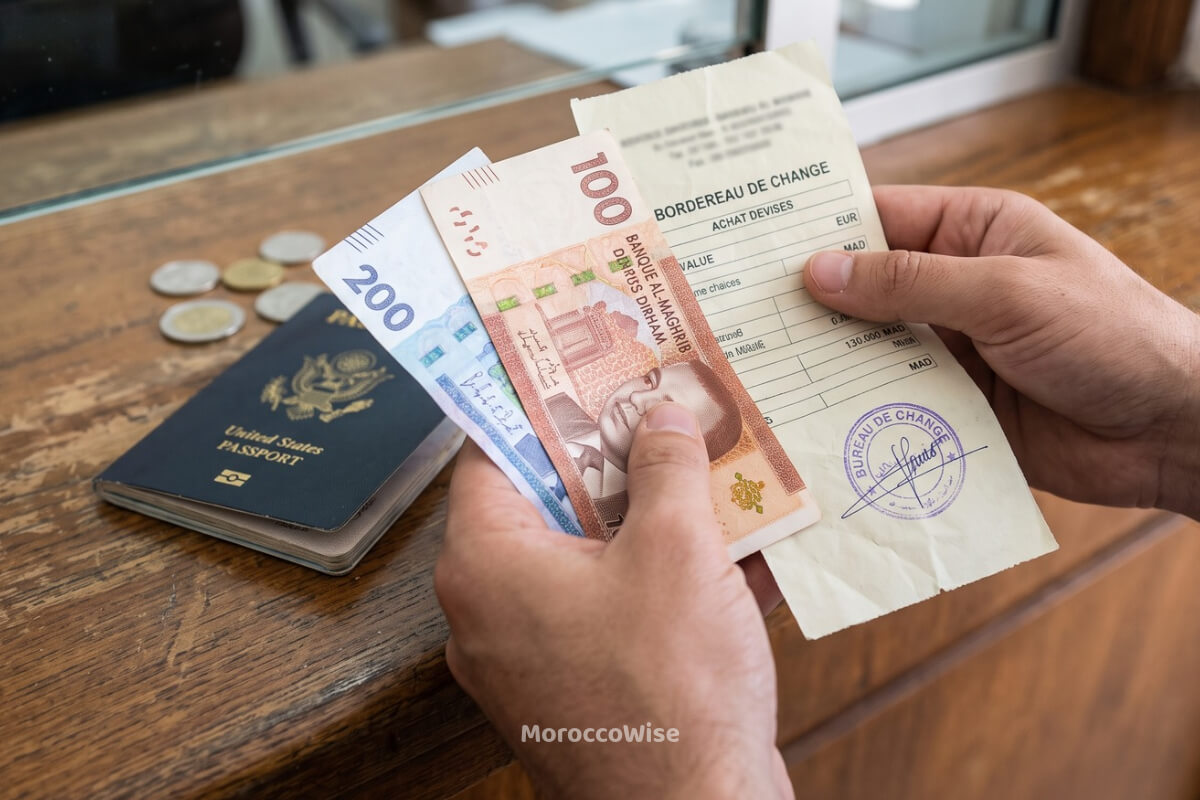
- Always Keep Your Official Exchange Receipt (Bordereau de Change): The clerk will print a small paper receipt stamping the amount exchanged. Do not throw this away!
How to Exchange Leftover Dirhams Back Before Flying Home
Because you cannot easily exchange Moroccan Dirhams once you land back in London, Paris, New York, or Toronto, you must convert any leftover Dirhams back into Pounds, Euros, or Dollars at the Moroccan airport before your departure flight.
- Where to Go: Visit the bank exchange booths (Banque Populaire, BMCE, or Attijariwafa) in the departures terminal at Marrakech, Casablanca, Agadir, Fes, or Tangier airport.
- The Mandatory Receipt Rule: Moroccan airport banks will only buy back your leftover Dirhams if you show an official exchange receipt (bordereau de change) or a Moroccan bank ATM withdrawal slip proving you acquired the Dirhams legally during your trip.
Do's and Don'ts: Currency Exchange in Morocco
| Do | Don't |
|---|---|
| Exchange the bulk of your cash at licensed city-center Bureaux de Change (like Rue Moulay Ismail or Gueliz) | Exchange all your holiday money at your home airport before flying |
| Only swap £20/€20/$30 at Moroccan airport arrival kiosks for taxi/bus fare | Use street touts or unlicensed individuals offering "special" exchange rates |
| Bring crisp, clean, untorn GBP, EUR, or post-2013 USD banknotes | Bring torn, ink-stamped, or heavily creased foreign bills (they will be rejected) |
| Check the "Achat" (Buy) column on the digital LED board and calculate the total on your phone | Step away from the counter window before counting your Dirham notes |
| Request a mix of 20, 50, and 100 MAD bills when exchanging cash | Accept only 200 MAD notes (small shops and taxis rarely have change for 200 MAD) |
| Save your stamped bordereau de change receipt in your passport wallet | Forget that you need an official receipt to change leftover Dirhams back at the airport |
Frequently Asked Questions (FAQ)
Where is the best place to exchange money in Morocco?
The best place to exchange money in Morocco is at an officially licensed city-center Bureau de Change (such as the cluster of exchange offices around Hôtel Ali on Rue Moulay Ismail near Jemaa el-Fnaa in Marrakech, along Avenue Mohammed V in Gueliz, or on Boulevard Mohammed V in Casablanca). They charge 0% commission and offer rates within 1% of the official interbank rate.
Can I just walk into a bank and exchange currency in Morocco?
Yes. Any foreign traveler with a valid passport can walk into a commercial Moroccan bank branch (such as Attijariwafa Bank, Banque Populaire, or BMCE Bank of Africa) during normal banking hours (Monday–Friday, 8:30 AM–3:30 PM) and exchange Euros, British Pounds, or US Dollars into Moroccan Dirhams with zero commission. Many bank lobbies also feature 24/7 automated currency exchange machines that accept foreign banknotes directly.
Is it better to exchange money in Morocco or in the UK / US before leaving?
It is much better to wait and exchange your money inside Morocco. Because the Moroccan Dirham is a closed currency, bureaux de change in the UK, US, and Europe charge a 15% to 20% markup. Bring crisp Pounds, Euros, or US Dollars and exchange them in Morocco, or withdraw Dirhams from a Moroccan bank ATM using a fee-free card like Revolut or Wise.
Is Bureau de Change Hotel Ali in Marrakech still open and safe in 2027?
Yes, the licensed exchange offices at and immediately surrounding Hôtel Ali on Rue Moulay Ismail (just steps from Jemaa el-Fnaa and the Koutoubia Mosque) remain open daily from morning until late evening. They are fully licensed, safe, and continue to offer some of the most competitive retail exchange rates in Morocco.
Official and Practical Reference Links
Before traveling, you can verify official central bank exchange rates, licensed currency regulations, and airport banking facilities through these authoritative Moroccan institutions:
- Bank Al-Maghrib – Official Daily Reference Exchange Rates for the Moroccan Dirham
- Office des Changes – Official Moroccan Foreign Currency & Authorized Exchange Rules
- ONDA (Moroccan National Airports Office) – Official Airport Banks & Currency Exchange Directory
(Preparing for the rest of your trip? Read our essential guide on Visiting Morocco for the First Time and check our complete Morocco Packing List!)