
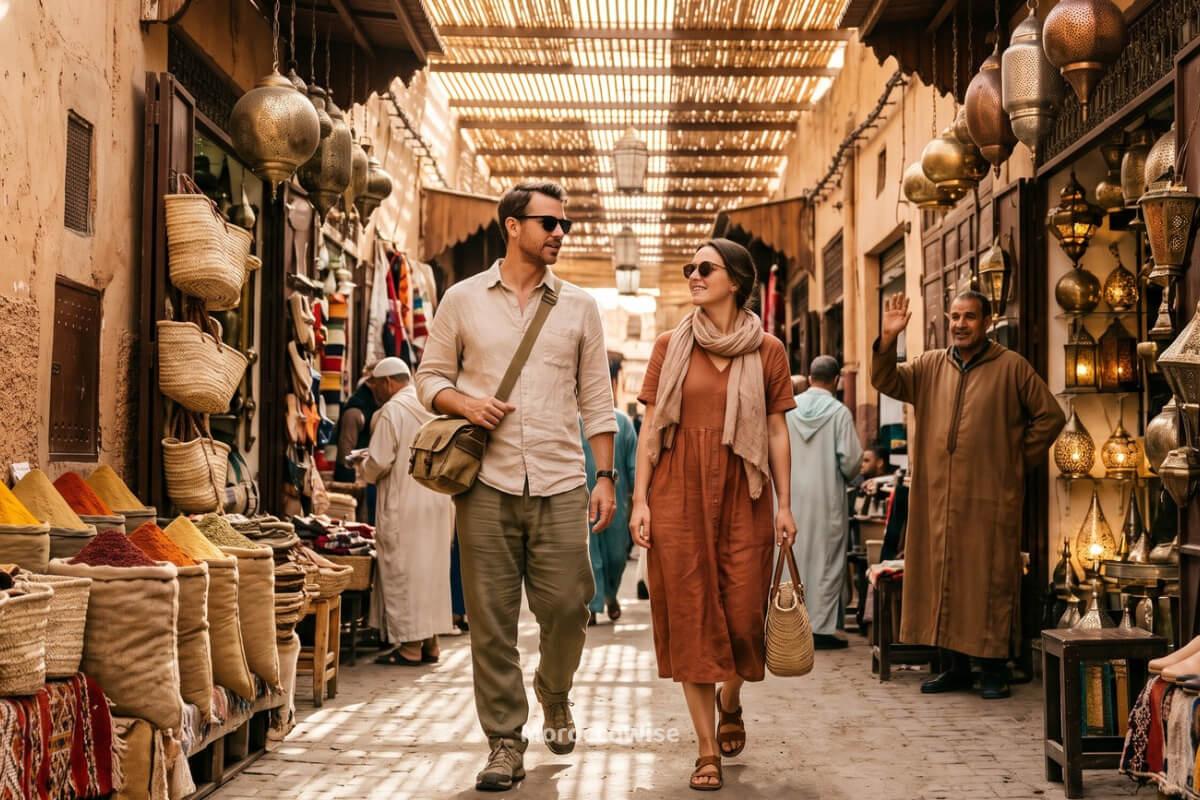
Knowing how to deal with persistent street sellers in Morocco—along with street touts and unofficial ("faux") guides—is the single most valuable skill you can pack for a trip to Marrakech, Fes, Tangier, or Casablanca. For many first-time visitors, stepping into a historic Moroccan medina feels like walking onto a live theater stage where every shopkeeper wants to be your best friend, every young man on a corner claims your street is closed, and every glance at a leather bag triggers a ten-minute sales pitch.
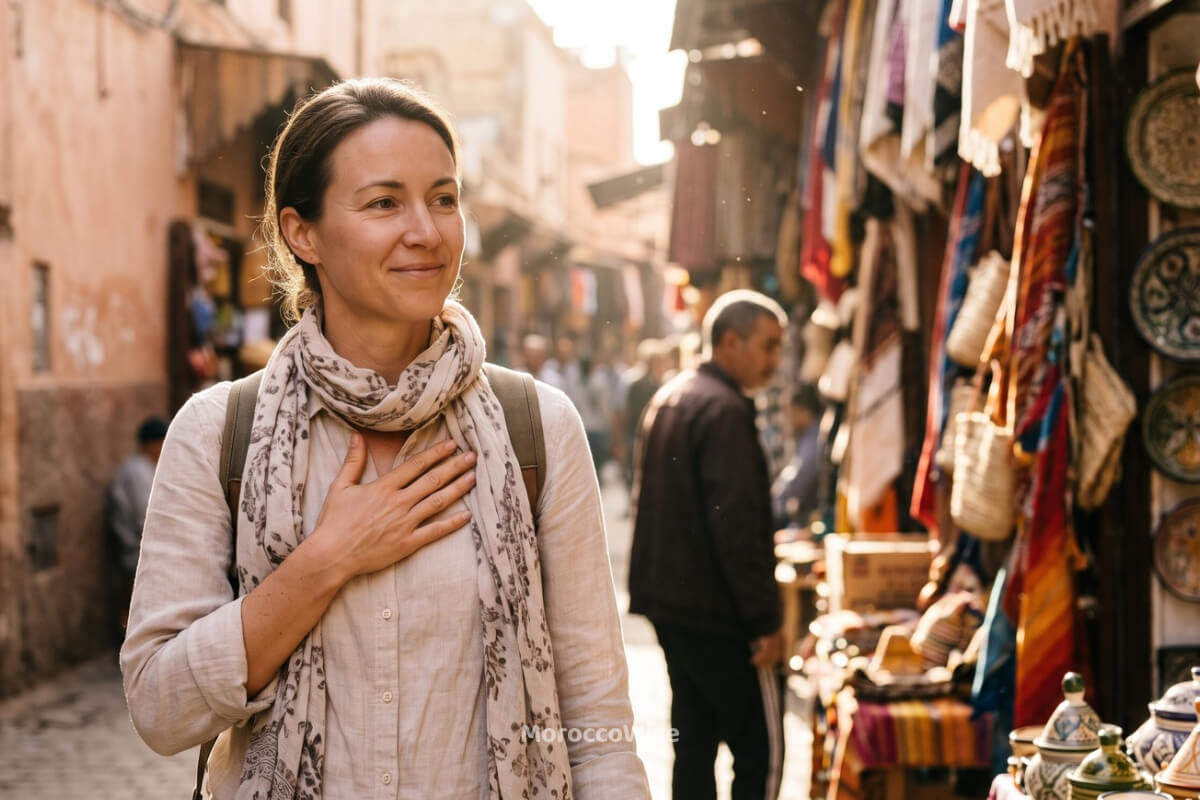
Handling persistent street sellers, touts, or unofficial ("faux") guides in Morocco requires a balance of firm boundaries and calm courtesy. The golden formula is simple: offer a clear, polite "La, shukran" (No, thank you) with your right hand over your heart, keep walking at a steady, purposeful pace without breaking stride, never check your phone map openly at a busy intersection, and never follow strangers who claim a monument or tannery is "closed today."
This comprehensive 2027 survival guide breaks down the psychology of Moroccan souk commerce, gives you the exact verbal and body-language tools to shut down street hassle in seconds, explains Morocco's strict laws against illegal faux guides, and shows you how to enjoy the magic of the medinas with total confidence.
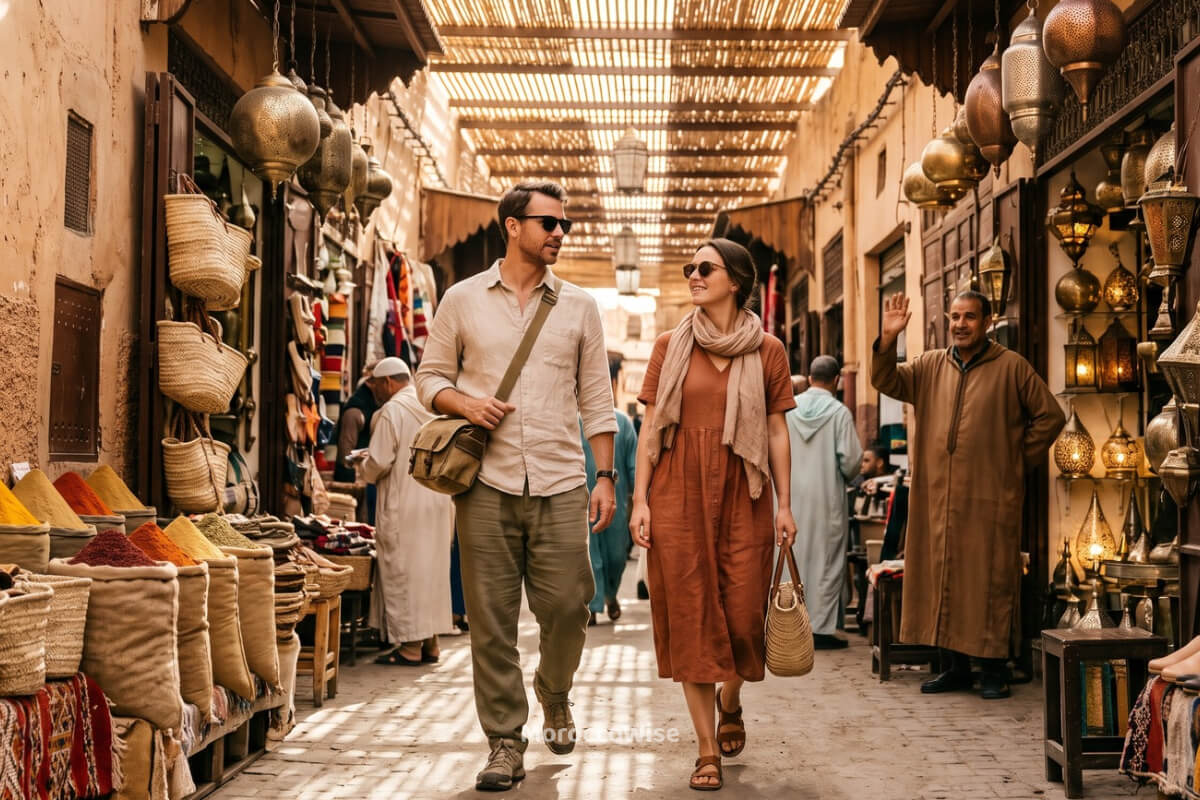
Quick-Answer Cheat Sheet: How to Handle Street Sellers, Touts & Faux Guides
When travelers ask, "How should I deal with persistent street sellers or unofficial guides?", matching the right response to the specific street scenario prevents 95% of awkward encounters:
| Street Scenario in Morocco | What They Say or Do | What Is Actually Happening | Your Exact Response & Action |
|---|---|---|---|
| Souk Shopkeeper Calling Out | "My friend! Look, no money, just look! Cheaper than Carrefour!" | Standard humorous Moroccan sales banter to get you across the shop threshold. | Smile briefly, place your right hand on your heart, say "La, shukran" (No, thank you), and keep walking without stopping. |
| The "Road/Mosque Is Closed" Trick | "Stop! That street is closed / for Muslims only today. Follow me to the big square!" | Classic faux guide trap in Marrakech and Fes designed to get you lost and demand 100–200 MAD. | Do not stop or argue. Say "I live at the riad right there" or step inside an open shop/café to check your offline map. |
| The "My Friend's Shop / Cooperative" Trap | "I work at your hotel! Today is a special Berber auction at the women's cooperative, come see!" | A commission runner (rabatteur) steering you to a store where 30%–50% is added to your bill as their kickback. | Decline firmly: "No thank you, we already have an appointment." Never follow a street stranger into a carpet or argan shop. |
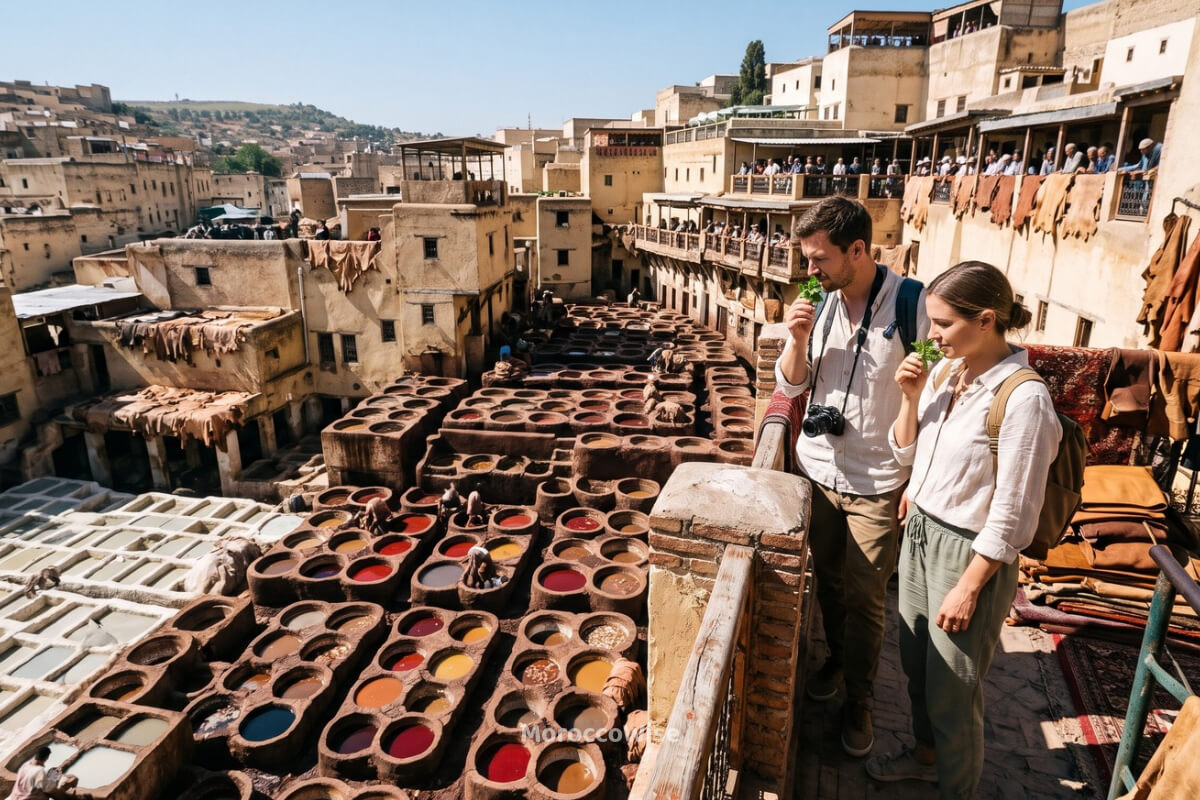
| The Fes Tannery "Free Mint" Handout | A man hands you a sprig of mint at a doorway and says "Free terrace view, follow me!" | He is guiding you into a specific leather shop terrace and will demand a tip or pressure you to buy a jacket. | Only accept the mint if you are ready to tip 10–20 MAD (or browse the shop) upon exiting. |
| Jemaa el-Fnaa Henna / Monkey / Snake Approach | Someone reaches for your hand with a henna syringe or steps toward you with a monkey/snake. | Forced "gift" or photo hustle followed by an aggressive demand for 200–400 MAD. | Keep your hands in your pockets or holding your bag strap, step back immediately, and say a sharp "La!" (No!). |
| Persistent Kid or Teenager Walking Beside You | Walks 3 feet ahead of you toward a monument, then turns around at the entrance demanding "Pay me for guiding!" | Passive "shadow guiding"—claiming credit for walking down the same public street you were already on. | Stop immediately for 10 seconds, point the opposite way, or say loudly: "No guide! Do not walk with us!" |
(Planning your very first itinerary? Read our foundational guide on Visiting Morocco for the First Time to understand how medina culture works).
Key Strategies for Handling Touts and Unofficial Guides in Morocco
To understand how to deal with persistent street sellers in Morocco, you first need to realize that persistence is not personal hostility. In Moroccan souk culture, salesmanship is an art form built on conversation, humor, and connection. If you hesitate, make prolonged eye contact, or offer a polite excuse like "Maybe tomorrow," a vendor hears "Convince me today!"
Here are the four core field-tested strategies for handling touts and unofficial guides with zero stress:
1. Be Firm and Direct with "No" (And Don't Explain Yourself)
When a street seller or tout approaches you, say "No, thank you" (or in Moroccan Darija: "La, shukran") clearly on the very first approach, and avoid stopping or lingering.
- Why Politeness Can Backfire if You Linger: In Western countries, stopping to explain "Oh, I'm only carrying a carry-on bag so I don't have room for a rug" or "We already ate lunch an hour ago" is considered polite. In a Moroccan souk, stopping to explain yourself is treated as an opening to negotiate! If you say you have no room in your suitcase, the merchant will happily show you his DHL shipping receipts.
- The One-and-Done Rule: Give one polite, firm "La, shukran" with a slight smile, then look straight ahead and do not respond to any second or third follow-up joke. Silence after a polite "no" is universally understood.
2. Keep Walking at a Steady, Purposeful Pace
Body language accounts for 80% of whether touts target you. Maintain a steady, purposeful walking pace as if you are late for a dinner reservation.
- Never Pause at Medina Intersections: Street touts and unofficial guides congregate specifically at confusing three-way alley forks in Marrakech and Fes. Pausing on a street corner to look up at street signs, pull out a paper map, or squint at your smartphone screen is like ringing a dinner bell—it immediately invites unsolicited offers for directions or help.
- Wear Dark Sunglasses in Daytime Souks: Shopkeepers rely on catching your eye to launch their pitch (and to see which item on their shelf you glanced at). Wearing sunglasses allows you to admire the architecture and colorful stalls while walking past undetected.
3. Use Offline Maps Discreetly Inside a Shop, Café, or Riad
Because high earthen walls in ancient medinas block satellite signals, standard Google Maps often glitches by 20 to 40 meters.
- Download Maps.me or Organic Maps Before You Arrive: Both apps use open-source pedestrian footpath data mapped by hikers and locals, showing tiny dead-end alleys (derbs) that Google Maps misses.
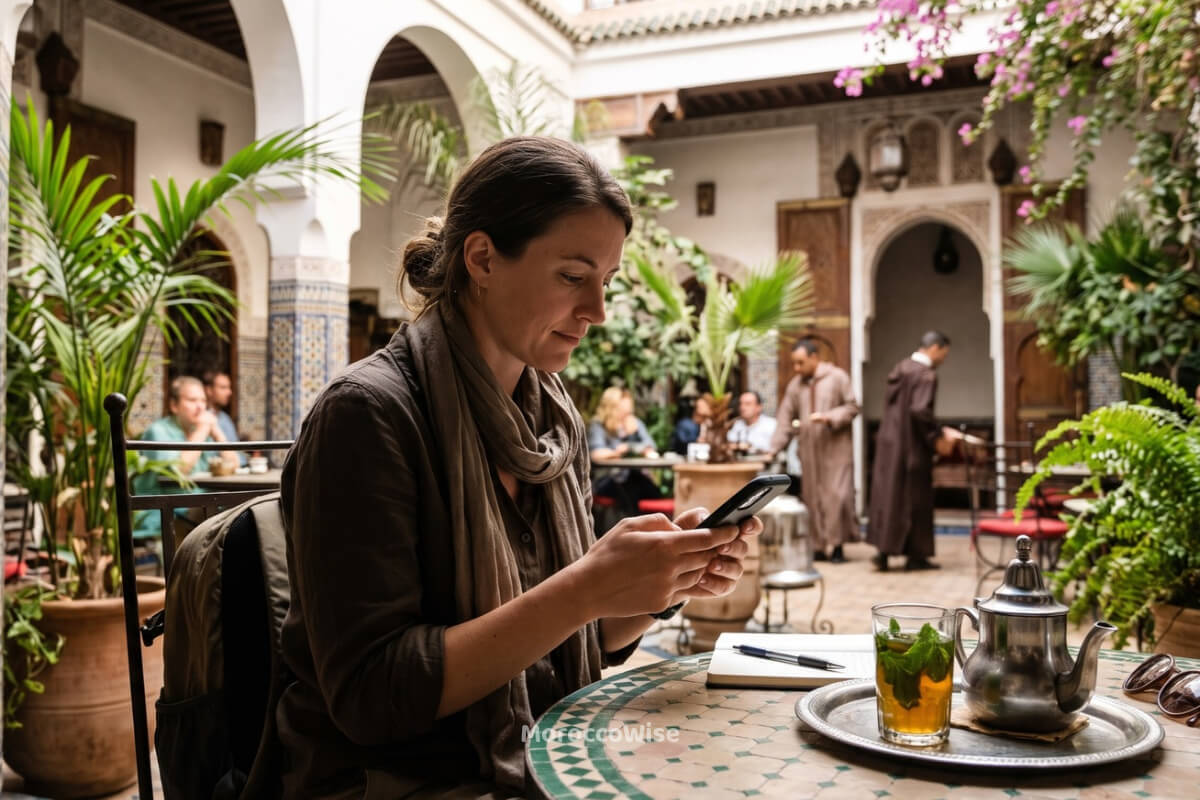
- The Indoor Map Check Rule: If you realize you took a wrong turn and need to reorient yourself, never stand in the middle of the alley staring at your phone. Instead, step inside a bright pharmacy, a fixed-price bakery, a café, or an open shop run by a woman or elderly artisan to check your map discreetly. Acting like you know exactly where you are going when out in the open makes you a much smaller target.
4. Avoid the "My Friend's Shop" and "Closed Today" Trap
One of the oldest tricks used by unofficial guides in Morocco is the redirection hustle. A well-dressed, English-speaking young man will strike up a friendly conversation on the street—often asking where you are from or claiming he is a university student or works as a waiter at your hotel.
- Within two minutes, he will ask where you are heading. If you say "Bahia Palace", "The Chouara Tannery", or "Ben Youssef Madrasa", he will shake his head sadly and claim that the site is closed for prayer, closed for restoration, or closed for a festival—and offer to lead you to a "special Berber market," "authentic cooperative," or "free panoramic viewpoint" instead.
- The Reality: Major Moroccan monuments do not close randomly for daily prayers, and the tanneries are open every single day. This is almost always a tactic to steer you to a specific carpet, spice, or leather shop where the tout receives a 30% to 50% commission built into whatever you buy! Always walk all the way to the official ticket booth of a monument yourself to verify its hours.
Understanding Unofficial ("Faux") Guides in Morocco: The Law & Your Rights
Many tourists don't realize that acting as an unlicensed tour guide (faux guide) is a serious criminal offense in Morocco.
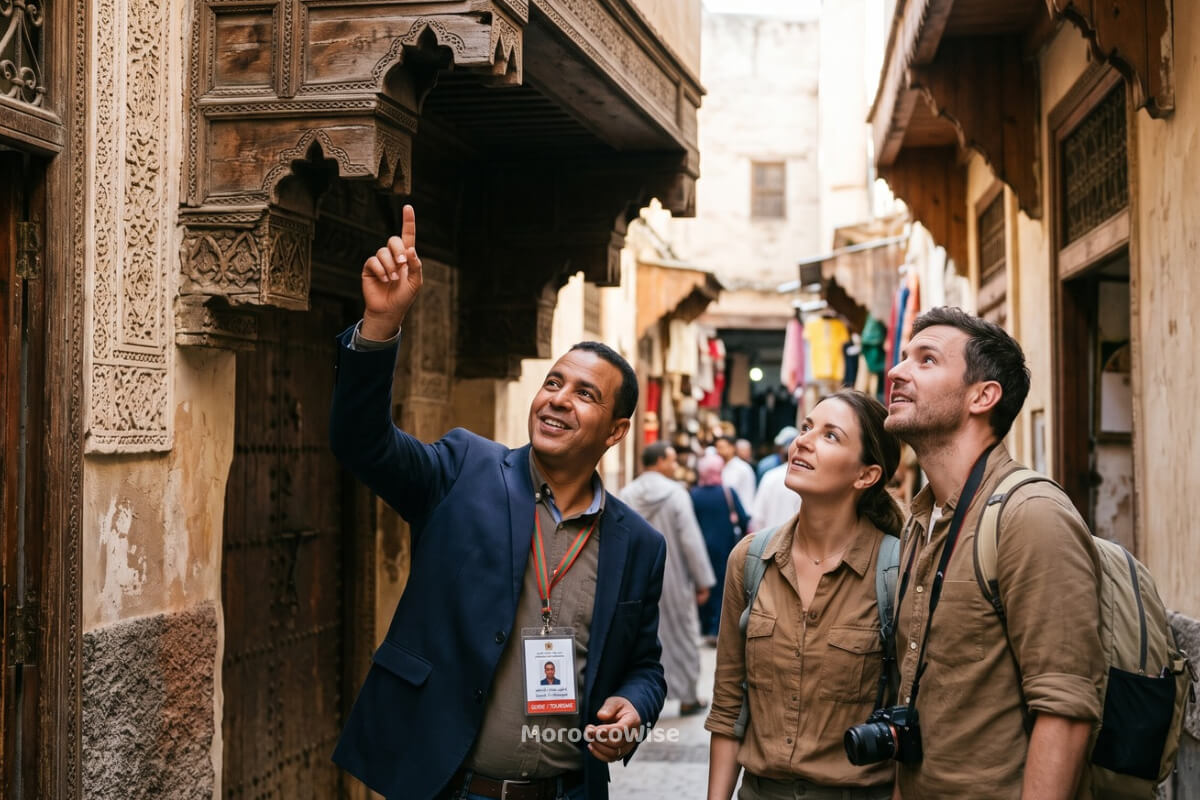
Under Moroccan Tourism Law, every legitimate national or local city guide must pass rigorous government exams in history and foreign languages and must wear an official laminated ID badge and brass medallion issued by the Moroccan Ministry of Tourism around their neck at all times.
Why the Brigade Touristique Cracks Down Hard on Faux Guides
Morocco's undercover and uniformed Tourist Police (Brigade Touristique) patrol the medinas of Marrakech, Fes, Tangier, and Chefchaouen daily to arrest illegal guides. Why? Because unlicensed guides damage Morocco's reputation, harass visitors, and extort kicks-backs from shopkeepers.
- How to Spot a Faux Guide Instantly:
- No Official Badge: An official guide wears their government credential visibly on a lanyard. A faux guide will never have a badge.
- They Approach You Unsolicited on the Street: Licensed Moroccan guides are booked in advance through your riad, a registered travel agency, or an official guide bureau—they rarely hang around dark alley corners begging tourists for work.
- They Duck Down Side Alleys When Seeing Police: If a "friendly local" walking with you suddenly tells you to wait or ducks into a doorway when a uniformed police officer appears, he is an illegal faux guide avoiding arrest.
- Your Ultimate Trump Card Phrase: If an unofficial guide refuses to leave you alone or demands an outrageous sum of money (like 300–500 MAD) after walking beside you uninvited for three minutes, calmly say: "Let's walk over to the Brigade Touristique (Tourist Police) together and ask them what the fair price is." Mentioning the Brigade Touristique will make any illegal tout vanish in five seconds flat! (Read more on how police protect visitors in Is Marrakech Safe to Walk Around at Night?).
6 Magic Darija & French Phrases That Stop Street Sellers Instantly
When you reply to a persistent street seller in English ("No thanks, mate"), it confirms you just stepped off the plane. When you reply calmly in Moroccan Arabic (Darija) with the proper hand gesture, local vendors immediately respect your street smarts and move on to the next tourist.
Memorize these six high-impact phrases before entering the souks:
| Phrase to Say | Pronunciation | Literal Meaning | When to Use It in the Souks |
|---|---|---|---|
| 1. "La, shukran" (+ hand on heart) | Lah, shook-rahn | "No, thank you." | Your polite, everyday default for 90% of shopkeepers, restaurant touts, and taxi drivers. |
| 2. "Baraka Allahu fik" | Bah-rah-kah-lah-hoo feek | "May God bless you (I have enough)." | A deeply respectful religious/cultural phrase used by Moroccans to politely decline a beggar or persistent vendor. |
| 3. "Ghir kanchouf, shukran" | Gheer kahn-shoof, shook-rahn | "I am just looking, thank you." | Use this when you step inside a shop to browse and want the seller to give you breathing room. |
| 4. "3andi guide / Ma3a sahbi" | Ahn-dee geed / Mah-ah sah-bee | "I already have a guide / I'm meeting my local friend." | Immediately stops faux guides at medina gates in Fes or Marrakech from offering their services. |
| 5. "Ana mashi اول مرة هـنا" (or French: "Je connais le chemin") | Je ko-neh luh shuh-mahn | "I know the way / It's not my first time here." | Shuts down anyone claiming your street is a dead end or offering unsolicited directions. |
| 6. "Khallini f'tiqar, afak!" (or "Hshouma!") | Khah-lee-nee f-tee-kahr / H-shoo-mah! | "Leave me in peace, please!" / "Shame on you!" | Nuclear Option Only: Use only if someone touches your arm, blocks your path, or aggressively follows you. Locals nearby will immediately step in to help you. |
(Want to learn more about local greetings and social laws? Check our complete guide on Morocco Rules for Tourists).
City-by-City Breakdown: Where Touts Are Most Persistent (And How to Beat Them)
Not every city in Morocco has persistent street sellers. In fact, coastal towns like Essaouira, Rabat, Asilah, and Chefchaouen have remarkably relaxed, low-pressure medinas where shopkeepers sit quietly drinking tea and let you browse in peace.
However, three specific hotspots require your A-game:
1. Marrakech: Jemaa el-Fnaa & The Northern Souks
In Marrakech, 80% of tourist fatigue happens inside a 500-meter radius around Jemaa el-Fnaa and the main souks (Souk Semmarine and the Ben Youssef / Tanneries quarter).
- The Marrakech Tannery Scam ("Big Berber Market Today"): Dozens of touts around Bab Debbagh and Ben Youssef will tell you that the Marrakech tanneries are holding a "once-a-month Berber auction today only" and try to lead you there. Avoid the Marrakech tanneries completely—unlike the historic Fes tanneries, the Marrakech tanneries are notorious for aggressive gangs of faux guides who intimidate tourists into paying 200–400 MAD for a 5-minute walk.
- Jemaa el-Fnaa Evening Food Stalls: Between Stalls #1 and #100, touts with laminated menus will stand in your path clapping and shouting jokes. Do not feel intimidated—treat it as theater, laugh it off, and walk straight to the stall that is packed with Moroccan families!
2. Fes: Fes el-Bali Gates (Bab Bou Jeloud) & The Chouara Tannery
Because Fes el-Bali has over 9,000 car-free medieval alleys, getting lost is normal—and faux guides wait around Bab Bou Jeloud (The Blue Gate) and the approaches to the Chouara Tannery.
- How to Visit the Fes Tanneries Without Hassle: As you walk down the leather-shop street toward the Chouara Tannery, men in the street will try to grab you and claim the tannery entrance is "private." Ignore the men in the street! Instead, walk directly into one of the established multi-story leather shops bordering the dye pits (look for numbered shop signs #10, #64, etc.), ask the shopkeeper politely if you can view the terrace, and if you don't buy any leather goods, hand the attendant a polite 10 to 20 MAD ($1–$2) tip on your way out.
- Hire a Licensed Guide for Your First Morning in Fes: Spending 300–400 MAD ($30–$40) through your riad for a licensed half-day guide on Day 1 in Fes teaches you the main two streets (Talaa Kebira and Talaa Seghira) and acts as an invisible forcefield against every street tout in the city.
3. Tangier: The Ferry Port & Kasbah Steps
In Tangier, decades of modernization have cleaned up 90% of the old port hustle, but day-trippers arriving on the ferry from Tarifa, Spain still encounter older faux guides waiting outside the port gate and at the bottom of the Kasbah steps. Simply walk past them up toward the Petit Socco or Kasbah Museum—the Tangier medina is compact and very easy to navigate on your own.
What If You Actually DO Get Lost in the Medina? (Who Is Safe to Ask)
Even with offline maps, everyone takes a wrong turn in Marrakech or Fes at least once. If you genuinely need directions, who you ask determines whether you get free, friendly help or a 100 MAD extortion attempt:
- NEVER Ask: Young men standing idly against walls, sitting on parked motorbikes, or hanging around medina gates. Even if they don't look like touts, they will offer to "walk you there" and demand cash at the end.
- ALWAYS Ask Instead:
- A Shopkeeper Sitting Inside an Open Store (especially a pharmacy, grocery hanout, or bakery): Because they cannot abandon their cash register to walk with you, they will simply point down the alley and give you honest verbal directions for free!
- Local Women or Mothers Walking with Children: Moroccan women will gladly point you toward the nearest main gate (Bab) or square with zero ulterior motive. (Solo female travelers can read more safety tips in Is It Safe for Women to Travel Alone in Morocco?).
- Uniformed Police Officers or Municipal Street Sweepers.
How to Shop in peace When You Actually WANT to Buy Something
Once you know how to deal with persistent street sellers in Morocco, shopping in the souks becomes one of the most fun parts of your holiday! Follow these five rules whenever an item catches your eye:
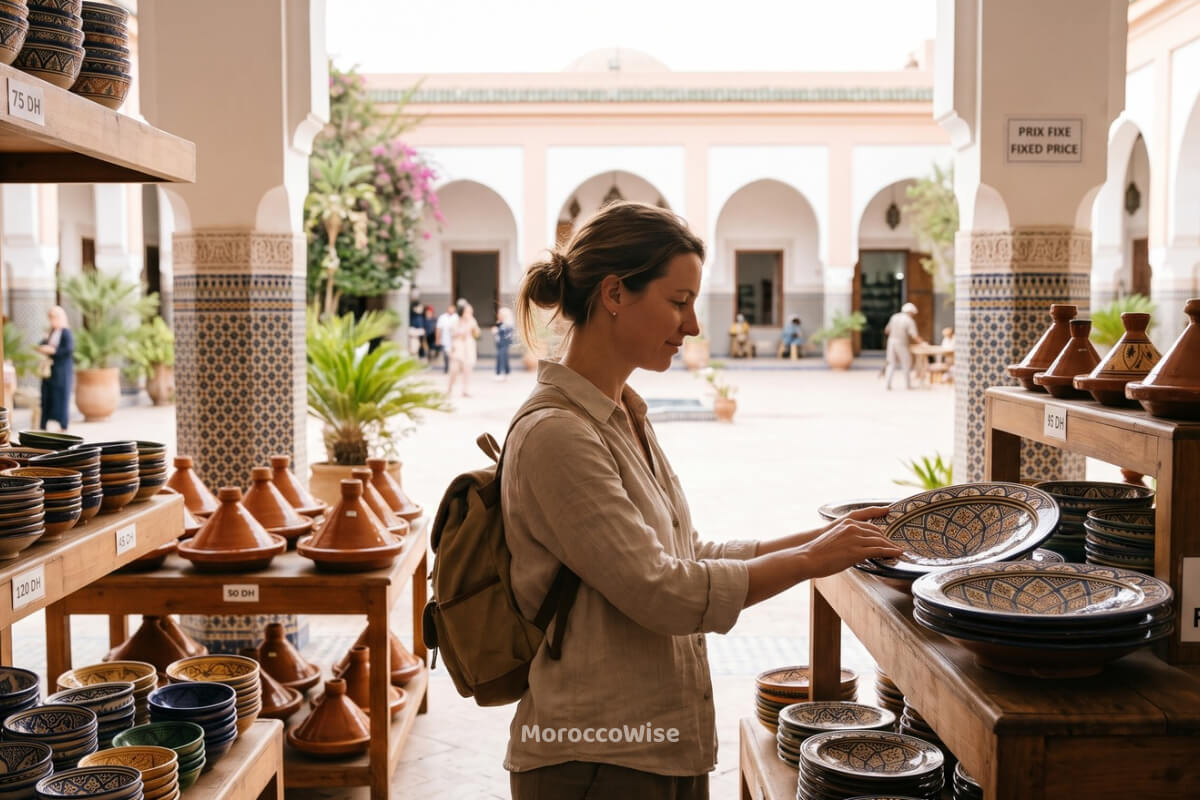
- Visit the Ensemble Artisanal First to Learn Real Fixed Prices: In Marrakech (on Avenue Mohammed V near Cyber Park), Fes, and Tangier, the Moroccan government runs fixed-price artisan complexes called the Ensemble Artisanal. Spend 30 minutes browsing here on your first day! You can see the exact printed fair price for a leather pouf (200–300 MAD), a ceramic tagine (80–150 MAD), or a silver lantern—and either buy stress-free on the spot or use those prices as your benchmark in the souks.
- Never Ask "How Much?" Unless You Would Buy It at the Right Price: In a Moroccan souk, asking the price of an item signals genuine intent to buy and kicks off the haggling dance.
- Never Name a Counter-Offer Unless You Will Honour It: If a vendor asks 400 MAD for a lantern and you jokingly say "I'll give you 100 MAD," and he says "Deal!", walking away without paying is considered a breach of etiquette. Only state a price you are ready to pull out of your wallet.
- Shop Early in the Morning (9:30 AM – 11:00 AM): Moroccans believe the very first sale of the morning (Ftitah) brings good luck and blessing (Baraka) to their shop for the rest of the day. Vendors are calmer, less pushy, and much more willing to give you a fair price at 10:00 AM than at 6:00 PM.
- Carry Small Dirham Banknotes in a Separate Pocket: If you just spent 10 minutes haggling a souvenir down from 200 MAD to 60 MAD, pulling out a crisp 200 MAD note (or worse, a thick wad of bills) ruins your negotiating leverage and invites the "I have no change, take two more bowls!" trick. Keep 20, 50, and 100 MAD bills in an accessible pocket. (See our complete money guides on What Currency Is Used in Morocco? and How Much Money Should I Budget Per Day in Morocco?).
Do's and Don'ts: Dealing with Street Sellers & Unofficial Guides in Morocco
| Do | Don't |
|---|---|
| Say a clear, polite "La, shukran" (No, thank you) with your hand on your heart and keep walking | Stop walking to explain why you don't want an item or engage in long debates |
| Check your offline phone map (Maps.me) discreetly inside a café, pharmacy, or shop | Stand on a busy medina street corner looking confused while holding out your phone |
| Ask shopkeepers sitting inside their stores or local mothers with kids if you need directions | Ask young men hanging out on street corners or sitting on parked mopeds for directions |
| Verify monument opening hours at the official ticket gate yourself | Believe strangers on the street who claim a palace, square, or tannery is "closed today" |
| Book licensed tour guides (with official Ministry of Tourism badges) through your riad | Follow "friendly locals" to their "family cooperative" or "Berber auction" (you'll pay a 40% commission markup) |
| Visit the government Ensemble Artisanal first to learn fair fixed prices before entering the souks | Pull out a 200 MAD banknote after haggling an item down to 40 MAD |
Frequently Asked Questions (FAQ)
How should I deal with persistent street sellers or unofficial guides in Morocco?
The most effective way to deal with persistent street sellers and unofficial ("faux") guides in Morocco is a combination of firm boundaries and calm courtesy. Say "La, shukran" (No, thank you) clearly on the first approach, place your right hand over your heart, avoid direct eye contact with the merchandise, and keep walking at a steady pace without stopping. Never explain yourself or hesitate, as lingering is interpreted as an invitation to negotiate.
What should I do if an unofficial faux guide follows me and demands money?
First, prevent "shadow guiding" by stopping immediately if someone walks ahead of you uninvited and saying firmly: "No guide—do not walk with us." If they still demand money at a destination, either ignore them and walk inside a shop/monument, or calmly state that you will call the Brigade Touristique (Tourist Police — dial 19). Because acting as an unlicensed guide is illegal in Morocco, mentioning the Tourist Police causes faux guides to leave immediately.
How can I tell if a tour guide in Morocco is official or a faux guide?
Every legal, licensed tour guide in Morocco is certified by the Ministry of Tourism and is legally required to wear an official laminated photo ID card and a metal/brass guide badge on a lanyard around their neck at all times. If someone approaches you on the street without an official government badge, they are an unlicensed faux guide.
Which cities in Morocco have the least pushy street sellers?
If you want a relaxed, hassle-free medina experience with almost zero touts or aggressive sales pitches, visit Essaouira, Chefchaouen, Rabat, or Asilah. By contrast, the souks around Jemaa el-Fnaa in Marrakech and the tannery quarters of Fes el-Bali have the highest concentration of persistent sellers and require confident street boundaries.
Official and Practical Reference Links
Before your trip, consult these official government travel advisories and Moroccan tourism portals for verified safety guidance, official guide regulations, and emergency contacts:
- Visit Morocco – Official Moroccan National Tourist Office Practical Advice & Authorized Guides
- UK Foreign, Commonwealth & Development Office (FCDO) – Morocco Safety, Touts & Fake Guides Advice
- US Department of State – Official Morocco Travel Advisory & Tourist Police Info
- Moroccan Ministry of Tourism, Handicrafts and Social Economy – Official Regulation of Tourist Guides & Artisans
(Want to stay one step ahead of every street hustle? Read our complete breakdown of Common Scams in Morocco and our essential Where to Exchange Money in Morocco guide!)