
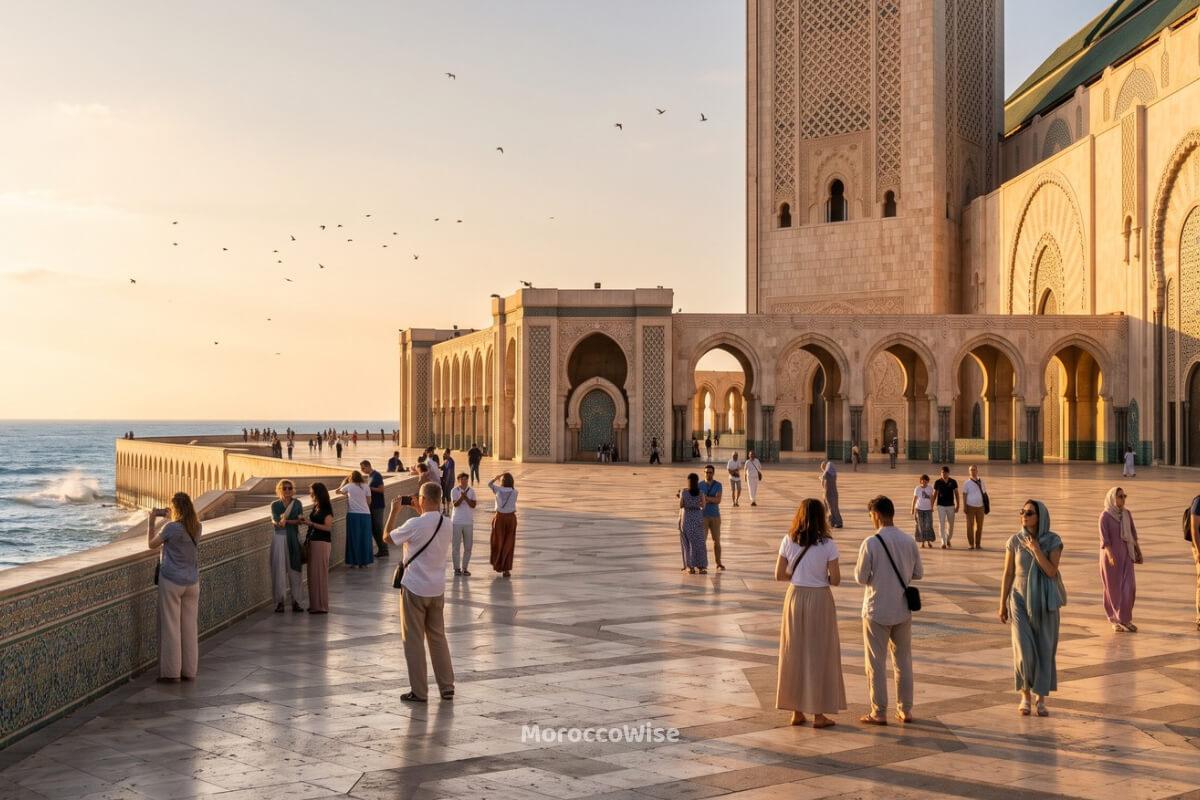
Understanding the core Morocco rules for tourists is the key to unlocking a smooth, respectful, and deeply rewarding journey across North Africa. Often, first-time visitors ask: "Are there any cultural or religious rules tourists should know before landing in Marrakech, Fes, or Tangier?" The short answer is yes. While Morocco is one of the most welcoming, tolerant, and tourism-friendly nations in the Arab and Muslim world, it remains a traditional Kingdom where Islamic customs, royal laws, and social modesty shape everyday life.
For foreign visitors, the most important Morocco rules for tourists boil down to six essentials: non-Muslims cannot enter active mosques (with the famous exception of the Hassan II Mosque in Casablanca), public displays of affection should be kept minimal, bringing a drone without a permit is strictly illegal, alcohol can only be consumed inside licensed bars, hotels, and restaurants, photographing police or military sites is forbidden, and dressing modestly (covering shoulders and knees) earns instant respect in historic medinas.
This definitive 2027 cultural and legal handbook breaks down every unwritten social custom and strict legal rule—from rules in Morocco for women and unmarried couples to traditional greetings, souk shopping etiquette, and official Morocco customs tariff allowances at the airport.
Quick-Answer Cheat Sheet: Cultural, Religious & Legal Rules in Morocco
When travelers search "are there any cultural or religious rules tourists should know", distinguishing between polite cultural etiquette and strict national law prevents awkward misunderstandings. Use this quick-reference matrix before your trip:
| Topic / Situation | Is It a Strict Law or Cultural Custom? | The Rule for Foreign Tourists in 2027 |
|---|---|---|
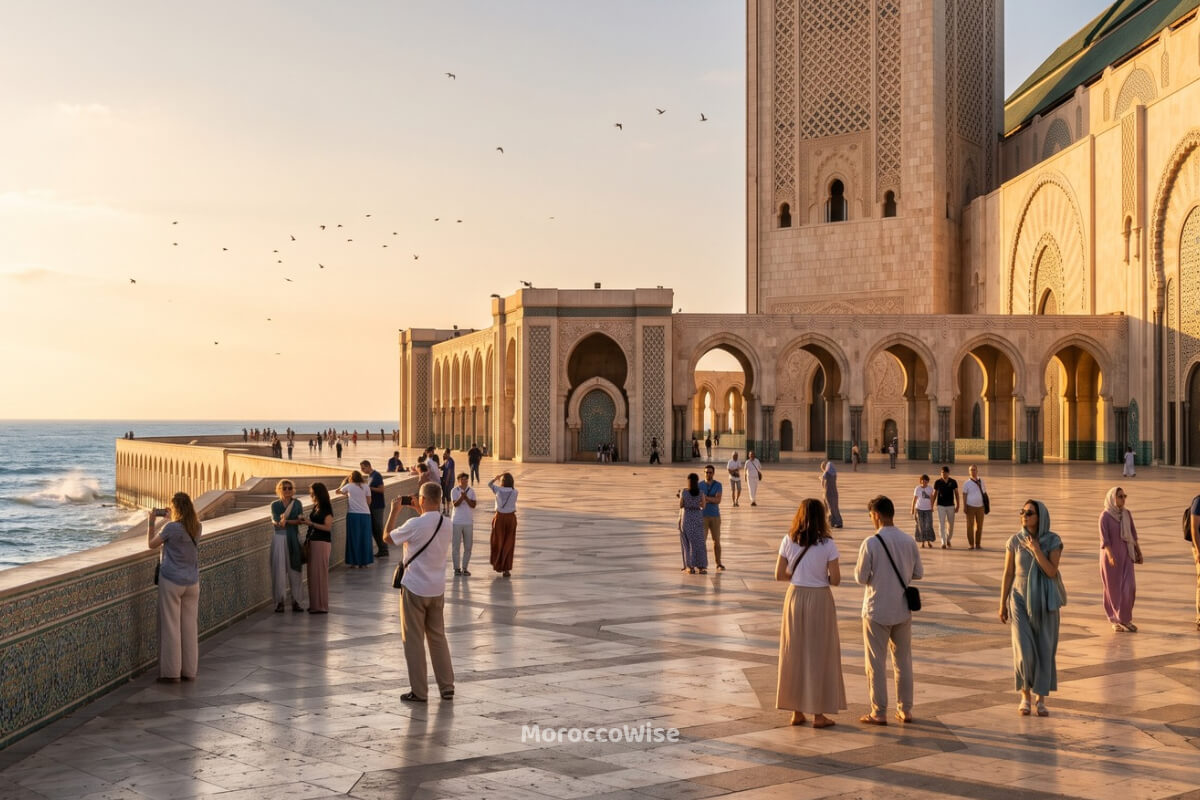
| Entering Mosques | Strict Religious & Legal Rule | Non-Muslims are prohibited from entering active mosques in Morocco, except for the Hassan II Mosque in Casablanca (outside prayer times) and historical ruins like Tinmel. |
| Unmarried Foreign Couples Sharing a Room | Legal for Foreigners | Foreign tourist couples (where neither partner is a Moroccan citizen) can legally share a hotel or riad room without showing a marriage certificate. |
| Dress Code & Headscarves | Cultural Custom (No Legal Mandate) | No law requires tourists to cover up or wear a hijab, but covering shoulders and knees in medinas and rural areas is strongly advised for respect and comfort. |
| Drinking Alcohol | Strict Legal Rule | Legal in licensed hotels, tourist restaurants, bars, and designated supermarket sections. Strictly illegal to drink in public streets or near mosques. |
| Bringing a Drone | Strict Legal Ban | Illegal without prior aviation clearance. Drones are confiscated immediately by airport X-ray customs scanners. |
| Public Displays of Affection (PDA) | Cultural & Public Decency Rule | Holding hands is fine for opposite-sex couples; heavy kissing or groping in public streets is offensive and frowned upon. |
| Eating & Greeting | Cultural & Religious Custom | Always use your right hand for shaking hands, passing money, and eating communal dishes like tagine or couscous. |
| Photographing Police / Military | Strict Legal Ban | Strictly forbidden to photograph police checkpoints, soldiers, royal palaces guards, or government buildings. |
(First time heading to North Africa? Read our foundational survival guide on Visiting Morocco for the First Time).
Are There Any Cultural or Religious Rules Tourists Should Know?
Morocco is a constitutional monarchy where Sunni Islam is the state religion, harmoniously blended with deep Amazigh (Berber), Arab, Andalusian, and French influences. When travelers ask, "Are there any cultural or religious rules tourists should know?", these five religious pillars govern daily life:
1. Mosque Entry Rules for Non-Muslims
Unlike in Turkey, the UAE, or Egypt—where tourists can visit many active mosques outside prayer hours—Morocco enforces a strict tradition dating back to the French Protectorate era (originally instituted by Marshal Lyautey to protect Moroccan religious spaces from colonial intrusion): non-Muslims are not permitted inside active mosques or zaouias (mausoleums/shrines).
- The 2 Major Exceptions:
- The Hassan II Mosque in Casablanca: Foreign tourists are warmly welcomed on official guided tours outside of prayer times (shoes must be removed, and knees and shoulders must be covered).
- The Mausoleum of Mohammed V in Rabat & Historic Deconsecrated Sites: Non-Muslims may respectfully visit the chamber overlooking the royal tombs in Rabat, as well as historic deconsecrated religious schools (Madrasas) such as the Ben Youssef Madrasa in Marrakech and Bou Inania and Al-Attarine Madrasas in Fes.
- Respect the Threshold: At famous active mosques like the Koutoubia in Marrakech or the Al-Qarawiyyin in Fes, feel free to admire the open wooden doorways from the street, but never step across the threshold onto the prayer carpets, and avoid pointing camera lenses directly at worshippers during prayer.
2. The 5 Daily Calls to Prayer (Adhan)
Five times a day—starting at dawn (Fajr) and ending at night (Isha)—the melodic call to prayer echoes from minarets across every city and village. Tourists do not need to stop walking or pause conversations, but it is polite to lower loud music, step aside if locals are hurrying toward a mosque entrance, and note that small family-run souk shops may briefly close for 15 to 20 minutes during the Friday midday prayer (Jumu'ah).
3. Ramadan Rules for Tourists
During the holy month of Ramadan (expected to run from approximately 8 February to 9 March in 2027), Muslims fast from dawn until sunset—abstaining from food, water, gum, and cigarettes during daylight hours.
- Are tourists required to fast? No. Tourist restaurants, hotel dining rooms, and major cafés in Marrakech, Fes, and Tangier remain open for foreigners at lunchtime.
- The Golden Etiquette Rule: Out of empathy for locals fasting in the heat, avoid eating street snacks, chugging water, or smoking cigarettes openly while walking down crowded public streets during the day. Step inside a café patio, your riad, or a quiet corner to drink water. (Check exact 2027 dates in our guide to the Best Time of Year to Visit Morocco).
4. Alcohol Laws & Friday/Religious Holiday Closures
Alcohol is widely available to foreign tourists in Morocco, served in licensed restaurants, hotel bars, beach clubs, and nightclubs, and sold in sealed "Cave" sections inside major supermarkets (Carrefour, Marjane, Atacadao).
- Important Rules: Never carry an open bottle of beer or wine in public streets, never drink within sight of a mosque, and note that supermarkets and liquor stores legally close their alcohol sections several days before and throughout Ramadan and during major Islamic holidays (Eid al-Fitr and Eid al-Adha), though licensed international hotels usually continue serving foreign guests inside private bars.
Rules in Morocco for Women (Dress Code, Solo Travel & Social Etiquette)
One of the highest-volume searches in Google is "rules in Morocco for women". Many female travelers worry that Morocco has strict legal clothing mandates similar to Iran or Saudi Arabia's past policies. Let's clear the air immediately.
1. There Is No Legal Dress Code for Foreign Women
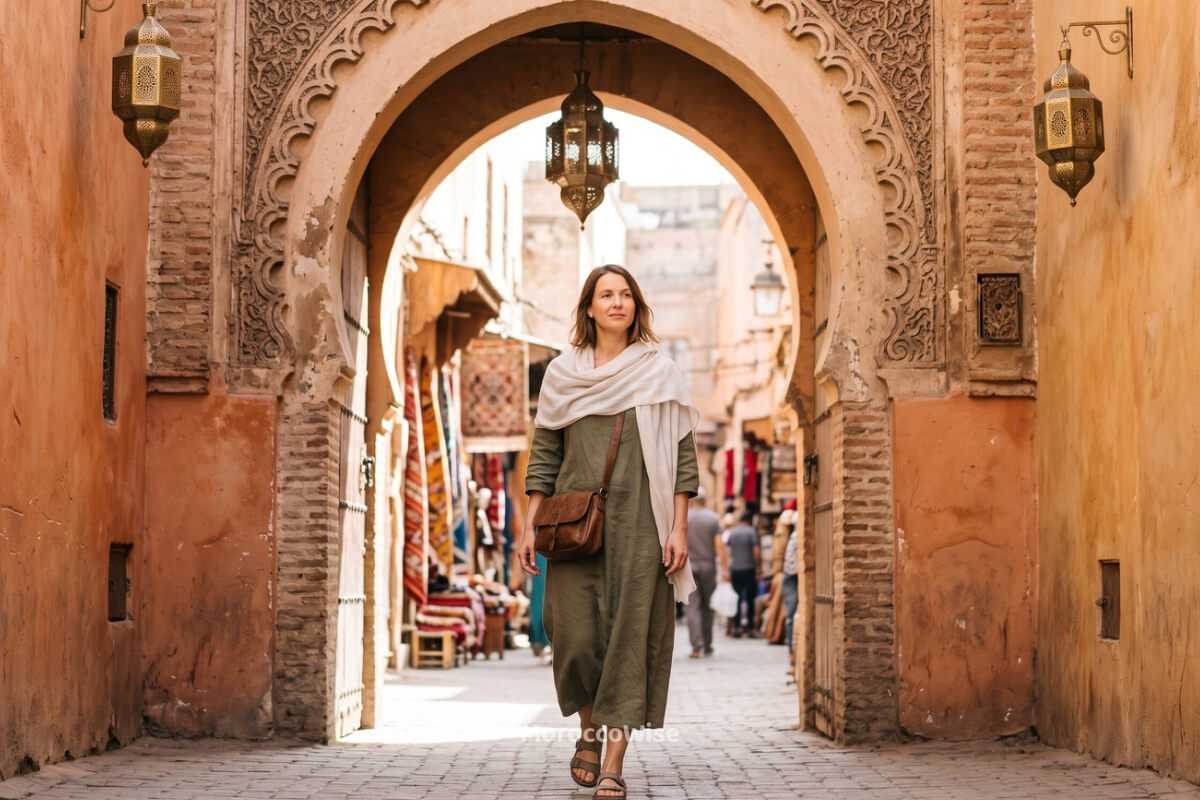
In Morocco, Moroccan women themselves dress across a wide spectrum—from full traditional djellabas and headscarves in conservative medinas to jeans, blazers, and uncovered hair in modern neighborhoods like Gueliz (Marrakech), Maarif (Casablanca), and Agdal (Rabat).
- Do female tourists have to wear a headscarf? No. Foreign women do not need to cover their hair anywhere in Morocco, except occasionally if entering a specific rural religious shrine where a scarf is requested.
- Can women travel alone, drive, and book hotels? Yes, 100%. Solo female travelers have the exact same legal rights to rent cars, ride trains, dine alone, and check into hotels as anywhere in Europe.
2. Cultural Modesty Rules for Women (How to Avoid Street Hassle)
While the law allows you to wear whatever you want, cultural modesty is the single smartest tool for female travelers:
- Cover Shoulders, Cleavage, and Knees in Public: Wearing loose linen trousers, midi or maxi skirts, and breathable tops with sleeves signals cultural awareness. Women who wear short shorts or spaghetti-strap crop tops inside traditional souks will not be arrested, but they will attract relentless staring and catcalling.
- Beach vs. Street: Standard two-piece bikinis are completely acceptable at hotel pools, private beach clubs, and tourist beaches in Agadir or Essaouira. However, always put on a cover-up dress or shirt and shorts before leaving the sand to walk along the boardwalk.
- Traditional Café Culture: You may notice that small, gritty roadside cafés with plastic chairs facing the street are filled exclusively with local men drinking espresso and watching football. While women are not banned from them, female travelers will feel much more comfortable sitting at rooftop terraces, garden cafés, patisseries, or family restaurants. (Read our dedicated safety guides on Is Marrakech Safe to Walk Around at Night? and What to Pack for a Trip to Morocco).
Morocco Customs and Traditions: Greeting in Morocco & Table Manners
Understanding Morocco customs and traditions transforms you from an outsider into an honored guest. Moroccan hospitality (Karam) is legendary, and mastering a few local habits goes a long way.
1. Greeting in Morocco (The Hand-Over-Heart Gesture)
When searching "greeting in Morocco", here is how locals greet one another politely:
- The Verbal Greeting: Start every interaction in a shop, taxi, or riad with "Salam Alaikum" (Peace be upon you — the reply is "Wa Alaikum Salam") or a polite French "Bonjour" / "Bonsoir".
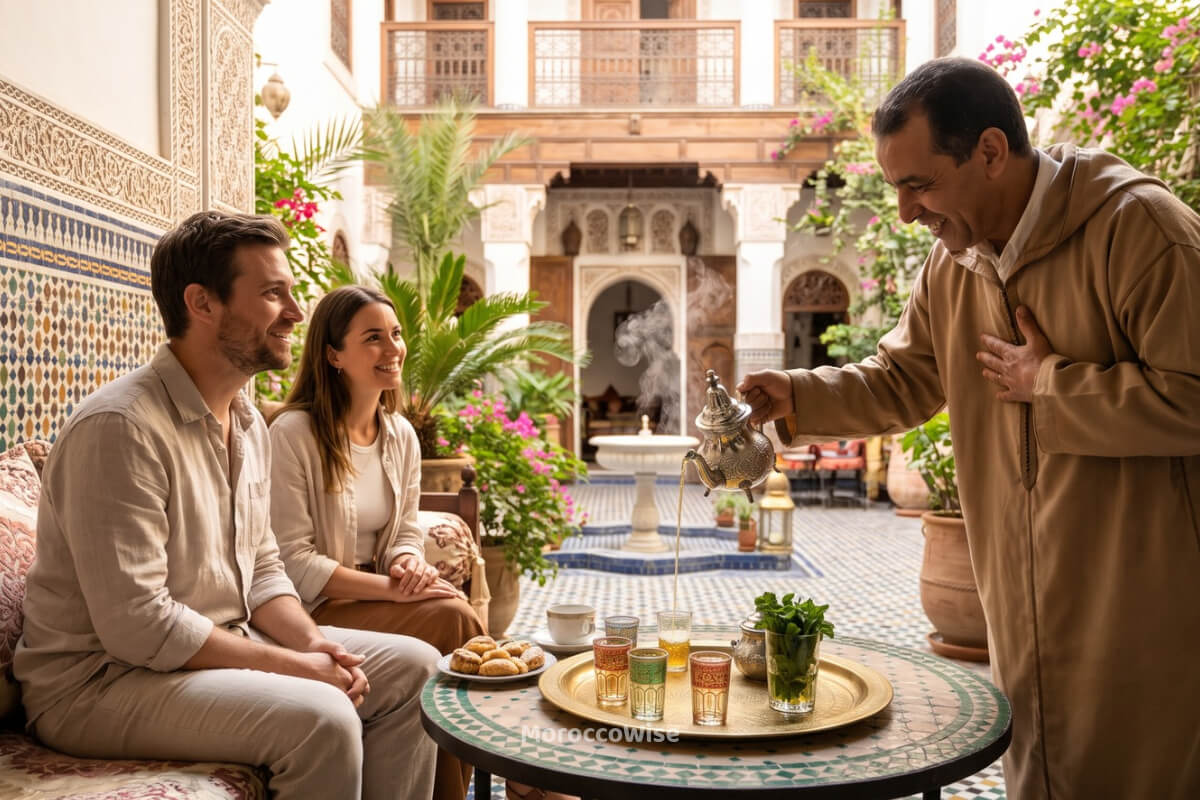
- The Physical Gesture (Opposite Sex Rule): Men shake hands with men, and women shake hands with women. When a man greets a woman (or vice versa), wait for the Moroccan person to extend their hand first. Many observant Muslim men and women prefer not to shake hands with the opposite sex; instead, they will smile warmly and place their right hand over their heart while bowing their head slightly. Copying this hand-over-heart gesture is the most respectful, universally loved greeting you can use in Morocco!
2. The Sacred Ritual of Moroccan Mint Tea (Atay)
Known locally as "Berber Whiskey," sweet green tea infused with fresh spearmint is offered at riad check-ins, family homes, and carpet shops.
- Rule #1: Never refuse a welcoming glass of mint tea when visiting someone's home or riad—it is a symbol of friendship and hospitality. (If you cannot have sugar for medical reasons, politely ask for "Atay bla sukkar" before they pour).
- Rule #2: In a souk shop, accepting a glass of mint tea does not obligate you to buy anything. It is simply part of the social theater of Moroccan commerce.
3. Dining Customs: The Right-Hand Rule & Communal Tagines
If you are invited to eat a traditional meal in a local home or rural Berber village:
- Take Off Your Shoes: Always remove your shoes at the entrance before stepping onto Moroccan rugs or living room cushions (seddari).
- Eat Only With Your Right Hand: In Islamic tradition, the left hand is reserved for personal hygiene and bathroom use. Always use your right hand when tearing bread (khobz), scooping meat and vegetables from a shared clay tagine, or handing money and items to someone.
- Eat From Your Own "Triangle": A traditional tagine or couscous platter is placed in the center of the table without individual plates. Do not reach across the center of the dish; eat only from the wedge-shaped section directly in front of you, leaving the tender meat in the center until the host encourages everyone to share it.
Can You Show Affection in Morocco? (Rules for Couples & Room Sharing)
Couples planning a romantic getaway frequently search "can you show affection in Morocco". Here is the exact breakdown for both public behavior and hotel check-ins.
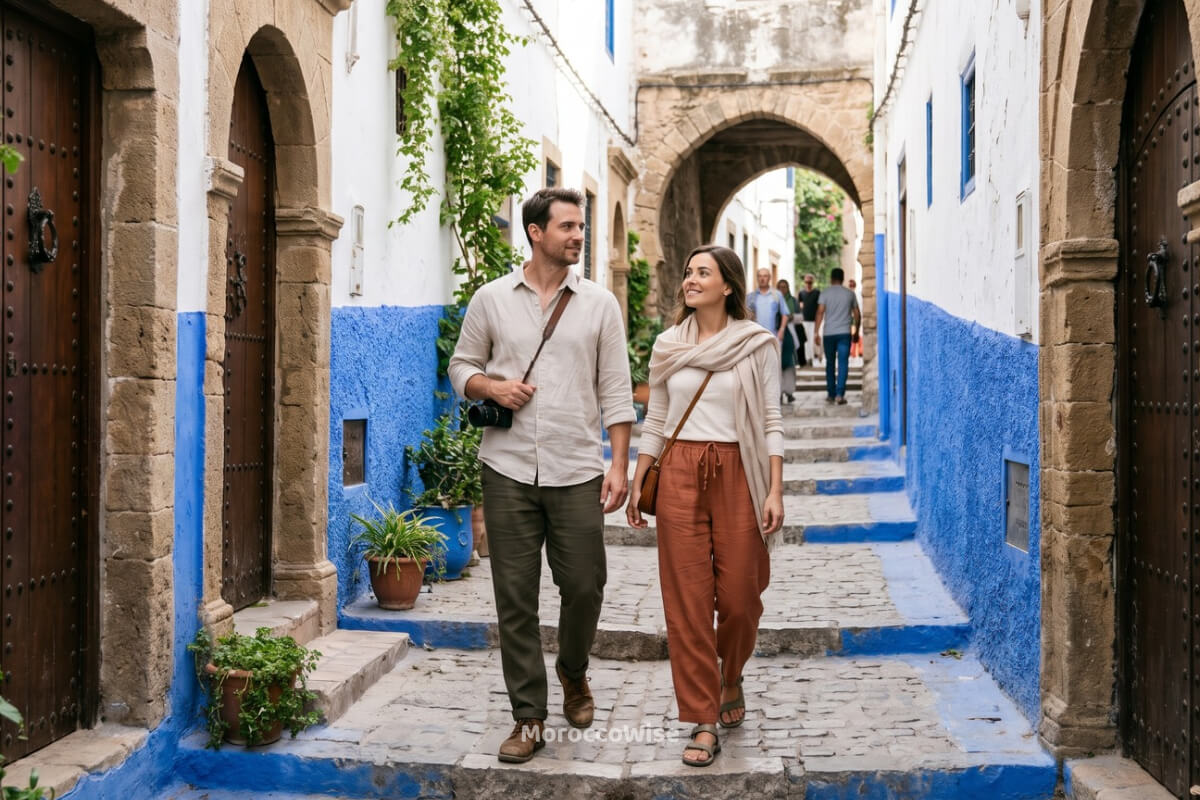
1. Public Displays of Affection (PDA) on the Street
Morocco is a socially conservative country where even married Moroccan couples keep physical intimacy private.
- What Is Acceptable: Opposite-sex couples holding hands, walking arm-in-arm, or putting a brief arm around your partner's shoulder for a photo is completely fine and common in tourist cities.
- What to Avoid: Passionate kissing on the lips, prolonged hugging, sitting on each other's laps, or groping in public streets, parks, or taxis is considered disrespectful to public decency and will draw disapproving stares or comments from locals. Save romantic moments for the privacy of your riad courtyard or hotel room.
2. Can Unmarried Couples Share a Hotel Room in Morocco?
You may read online about Article 490 of the Moroccan Penal Code, which historically prohibited unmarried couples from sharing a hotel room. Here is the crucial legal distinction for tourists:
- Both Partners Are Foreign Tourists: The rule does NOT apply to foreign nationals. Unmarried American, British, European, Canadian, or Australian couples can check into any hotel, riad, desert camp, or Airbnb in Morocco together with zero issues. You will never be asked for a marriage certificate.
- One Partner Is a Moroccan Citizen: If a foreign tourist is traveling with a romantic partner who holds Moroccan citizenship (or dual Moroccan nationality), hotels are legally required to ask the Moroccan citizen for a marriage certificate (Acte de Mariage) before allowing them to share a room.
3. Rules for LGBTQ+ Travelers in Morocco
Under Article 489 of the Moroccan Penal Code, same-sex sexual activity remains technically illegal in Morocco. While millions of LGBTQ+ tourists visit Marrakech, Essaouira, Tangier, and Agadir every year without incident—and foreign same-sex friends or couples regularly book twin or double hotel rooms together—it is essential to avoid all public displays of affection on the street and exercise discretion.
What Is Illegal in Morocco for Tourists? (8 Strict Laws That Carry Heavy Penalties)
To stay out of legal trouble, every visitor must read this section answering "what is illegal in Morocco for tourists". Moroccan authorities are exceedingly polite to tourists, but they enforce the following eight laws strictly:
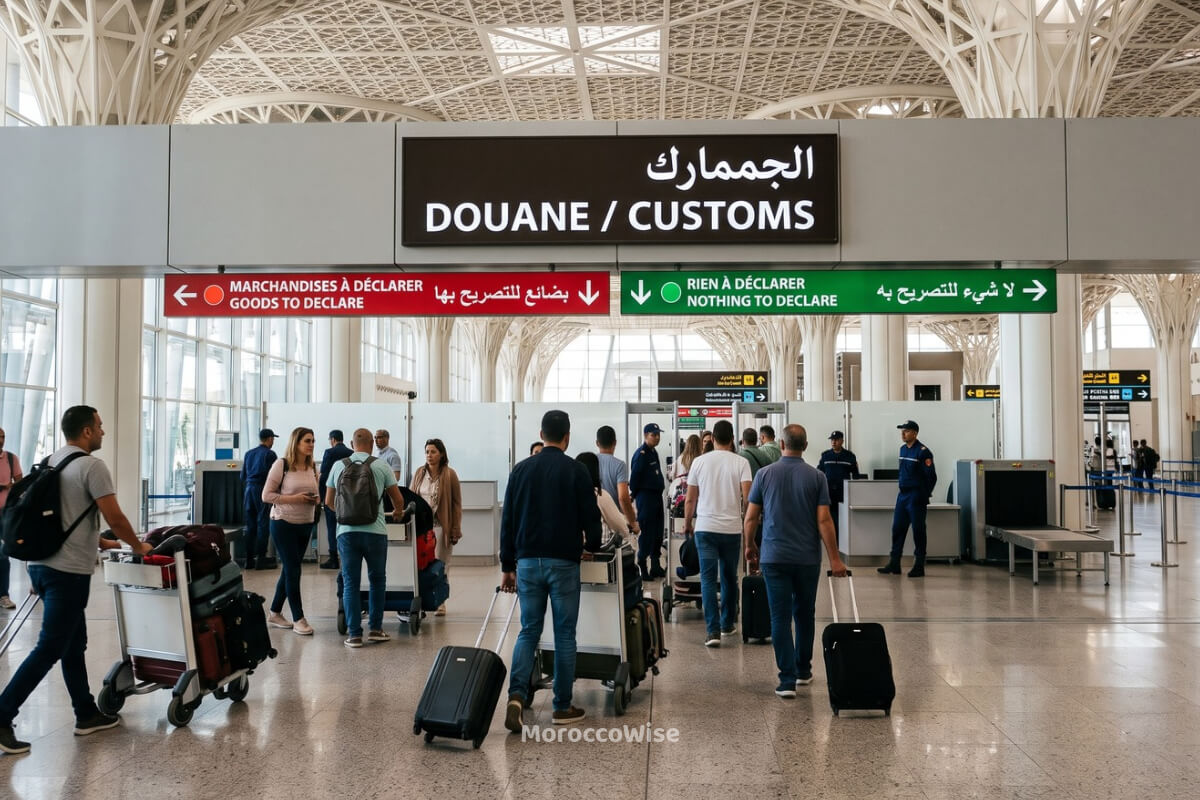
- Flying or Importing a Drone Without a Permit (#1 Tourist Trap): Bringing a recreational drone (even a tiny DJI Mini under 250g) into Morocco without an official import and aviation license from the Direction Générale de l'Aviation Civile is strictly illegal for national security reasons. Every suitcase and backpack passes through X-ray scanners upon exiting Moroccan airports. If customs officers spot a drone, it will be confiscated immediately, and you may be detained for questioning.
- Disrespecting the King, the Royal Family, or Islam: Criticizing King Mohammed VI, the Moroccan monarchy, Morocco's territorial integrity (Western Sahara), or the Islamic religion in public or on social media is a serious criminal offense in Morocco. Never deface, tear, or burn Moroccan Dirham banknotes, as they bear the portrait of the King.
- Possessing, Buying, or Smoking Recreational Cannabis (Kif / Hashish): Many tourists mistakenly believe cannabis is legal in Morocco because they see it grown in the Rif Mountains around Chefchaouen. While Morocco recently legalized regulated industrial and medical cannabis cooperatives for export, recreational possession, purchase, and smoking of cannabis or hashish remains 100% illegal for tourists. Street dealers in Chefchaouen or Marrakech sometimes work with police informants to extort tourists—always say a firm "No."
- Photographing Police, Military, Royal Palaces, or Airports: Never take photos or videos of police officers, gendarmes, military barracks, border crossings, or the guards standing at Royal Palace gates (even if their uniforms look photogenic, unless an officer explicitly gives permission at designated tourist spots like the Mausoleum in Rabat).
- Importing Arabic Bibles or Proselytizing: Tourists are completely free to bring one personal Bible, Torah, or religious text in their own language for private prayer. However, attempting to convert Moroccan Muslims to another religion (proselytizing) or importing multiple Bibles translated into Arabic for distribution is a criminal offense resulting in immediate deportation or arrest.
- Exporting More Than 2,000 MAD in Local Currency: Under Office des Changes law, it is illegal to take more than 2,000 Moroccan Dirhams in cash out of the country. (Read our guides on What Currency Is Used in Morocco? and Where to Exchange Money in Morocco).
- Buying Protected Fossils, Antiquities, or Wildlife Products: Do not buy products made from endangered species (such as tortoise shell guitars, desert monitor lizards, or chameleons sold in apothecary stalls), and ensure any expensive antique carpets or geological fossils come with official export documentation.
Morocco Customs Tariff & Duty-Free Allowances (Airport Rules for 2027)
Travelers searching "Morocco customs tariff" need to know exactly what Morocco's Customs Administration (ADII — Administration des Douanes et Impôts Indirects) allows foreign visitors to bring into the country duty-free, and what triggers heavy import tariffs at the airport:
| Item Category | Duty-Free Allowance per Adult Traveler (2027) | Morocco Customs Tariff & Restriction Rules |
|---|---|---|
| Alcohol & Spirits | 1 Liter bottle of spirits/liquor + 1 Liter bottle of wine | Anything exceeding this limit is subject to heavy customs duties or confiscation. |
| Tobacco & Cigarettes | 200 cigarettes (1 carton), OR 100 cigarillos, OR 25 cigars, OR 250g of loose tobacco | Strictly enforced per adult aged 18+. |
| Perfume & Eau de Toilette | 150 ml of perfume + 250 ml of eau de toilette | Must be for personal use, not commercial resale in boxed bulk. |
| Personal Electronics (Cameras, Laptops) | 1 per category for personal use (must leave the country with you) | Professional cinema cameras, multiple boxed laptops, or satellite phones (Starlink/Garmin InReach with satellite voice) require customs declaration/permits. |
| Foreign Cash (EUR, GBP, USD) | Unlimited (Must declare if equal to or exceeding 100,000 MAD ≈ €9,500 / $10,000) | Declare large foreign cash sums on arrival at the Douane desk so you can legally take unspent funds back out when departing. |
| Drones, Weapons & Walkie-Talkies | 0 (Strictly Prohibited) | Confiscated at airport X-ray; requires prior Ministry of Interior / Aviation authorization. |
Shopping in Morocco: Souk Rules, Haggling Etiquette & Photography
Finally, no guide to Morocco rules for tourists is complete without mastering the rules of shopping in Morocco and taking photos inside historic medinas.
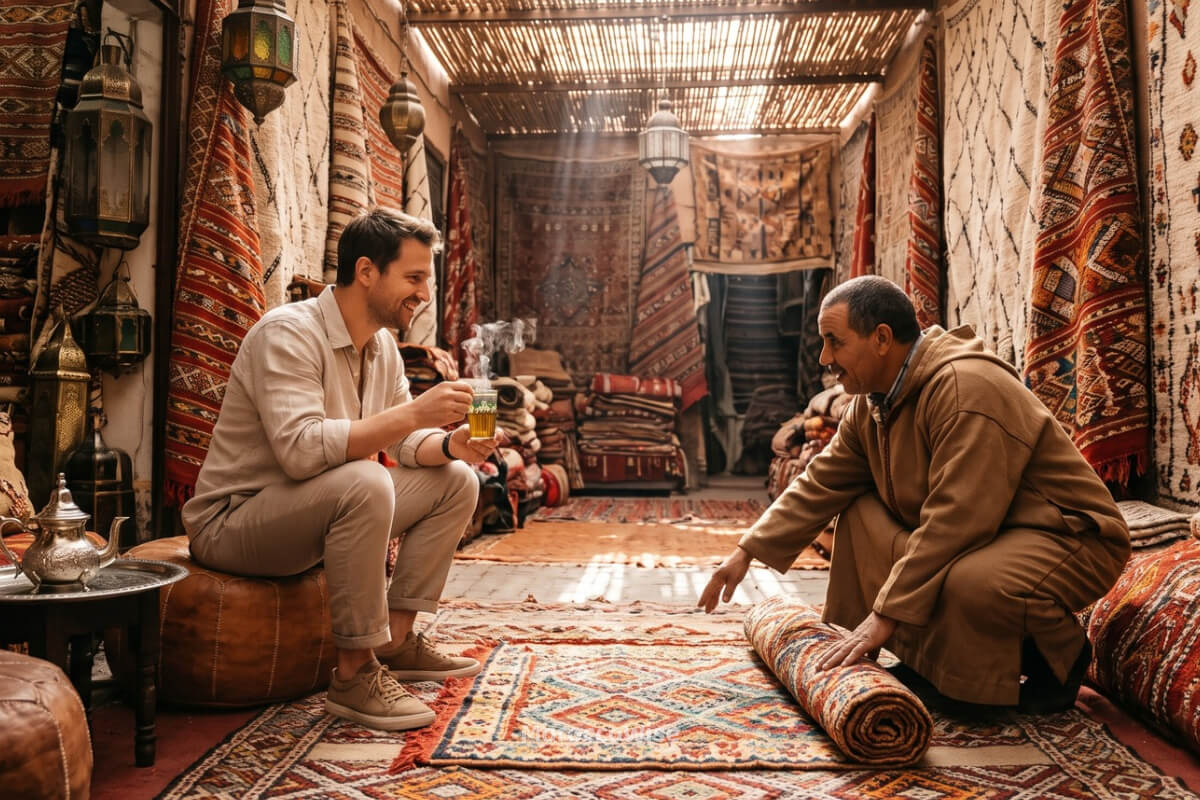
1. The Unwritten Rules of Haggling in Moroccan Souks
In supermarkets, pharmacies, modern mall stores, and Ensemble Artisanal government craft cooperatives, prices are fixed and printed on tags. Inside traditional medina souks, haggling is expected:
- Rule #1 (Never Ask a Price or Make an Offer Unless You Might Buy): Asking "How much?" and throwing out a counter-offer starts a formal negotiation. If you are just browsing, smile and say "Just looking, thank you" ("Je regarde seulement, merci").
- Rule #2 (Once the Seller Accepts Your Price, You Should Buy): In Moroccan souk culture, if you offer 150 MAD for a leather bag and the shopkeeper shakes your hand and says "Deal!", walking away without buying is considered extremely rude. Only name a price you are genuinely happy to pay!
- Rule #3 (Keep It Warm and Respectful): Start around 40% to 50% of the vendor's opening tourist quote and work toward a middle ground where both of you are smiling. Never insult the craftsmanship of an item to drive the price down.
2. Street Photography Etiquette (Ask Before You Shoot!)
Morocco is one of the most photogenic places on Earth, but locals are not props for Instagram:
- Never Photograph People Without Explicit Permission: Pointing a camera lens at veiled women, elderly men, artisans in their workshops, or rural villagers without asking is deeply offensive. Always point to your camera and ask "Photo? Wakha?" (Okay?). If they wave their hand "no," lower your camera immediately with a smile.
- Jemaa el-Fnaa Performers Expect a Tip: If you take a photo—even from 20 feet away—of snake charmers, Gnawa musicians, water sellers (Guerrab), or acrobats in Marrakech's main square, they will walk straight over and demand 20 to 50 MAD. Agree on a small tip (10–20 MAD) before snapping the photo! (Learn how to handle square hustles in our Common Scams in Morocco guide).
Do's and Don'ts: Essential Morocco Rules for Tourists
| Do | Don't |
|---|---|
| Dress modestly in medinas and villages (cover shoulders and knees) | Enter active mosques if you are non-Muslim (except Hassan II Mosque in Casablanca) |
| Use your right hand for eating communal food, shaking hands, and passing money | Eat, drink, or smoke openly in public streets during Ramadan daylight hours |
| Place your right hand over your heart when greeting someone of the opposite sex | Show heavy public displays of affection (passionate kissing) on the street |
| Ask permission before photographing locals, artisans, or shop fronts | Take photos of police officers, military sites, Royal Palace guards, or borders |
| Drink alcohol only inside licensed bars, hotels, restaurants, or private riads | Bring a drone in your luggage—it will be confiscated at airport customs |
| Walk away politely from street souk offers unless you genuinely intend to buy | Criticize the King, the Royal Family, or Islam in public or online |
Frequently Asked Questions (FAQ)
What are the most important Morocco rules for tourists to know in 2027?
The most important rules are: do not enter active mosques if you are non-Muslim (except Casablanca's Hassan II Mosque), do not bring a drone into the country without an aviation permit, dress modestly (covering shoulders and knees) in traditional medinas, consume alcohol only inside licensed venues, never photograph police or military personnel, and treat the Moroccan monarchy and Islamic traditions with respect.
What is illegal in Morocco for tourists that is legal at home?
Key items and actions that are legal in Western countries but illegal in Morocco include flying recreational drones without a government permit, drinking alcohol in public streets or parks, possessing or smoking recreational cannabis/hashish, photographing police checkpoints or military buildings, defacing Moroccan currency banknotes, and exporting more than 2,000 MAD in local cash.
Do female tourists have to cover their head or wear long clothes in Morocco?
No, there is no legal requirement for foreign women to wear a headscarf (hijab) or cover up in Morocco. However, culturally, wearing loose, breathable clothing that covers your shoulders, cleavage, and knees when walking through traditional medinas and rural areas shows cultural respect and significantly reduces unwanted staring.
Can unmarried tourist couples share a hotel room in Morocco?
Yes. While Moroccan law restricts unmarried Moroccan citizens from sharing a hotel room, foreign tourists are completely exempt from this rule. Unmarried international couples (where neither partner holds Moroccan citizenship) can legally book and share hotel rooms, riads, and desert camps across Morocco without ever needing to show a marriage certificate.
Official and Practical Reference Links
Before flying, review the official customs regulations, legal advisories, and cultural guidelines published by Moroccan and international government authorities:
- Administration des Douanes et Impôts Indirects (ADII) – Official Morocco Customs Tariff, Allowances & Prohibited Items
- UK Foreign, Commonwealth & Development Office (FCDO) – Morocco Local Laws & Cultural Customs
- US Department of State – Official Morocco Local Laws & Special Circumstances
- Visit Morocco – Official Moroccan National Tourist Office Cultural & Practical Guide
(Continuing your trip preparation? Check our medical guide on Do I Need Vaccinations for Morocco? and explore our regional guides for Tangier and Chefchaouen!)