
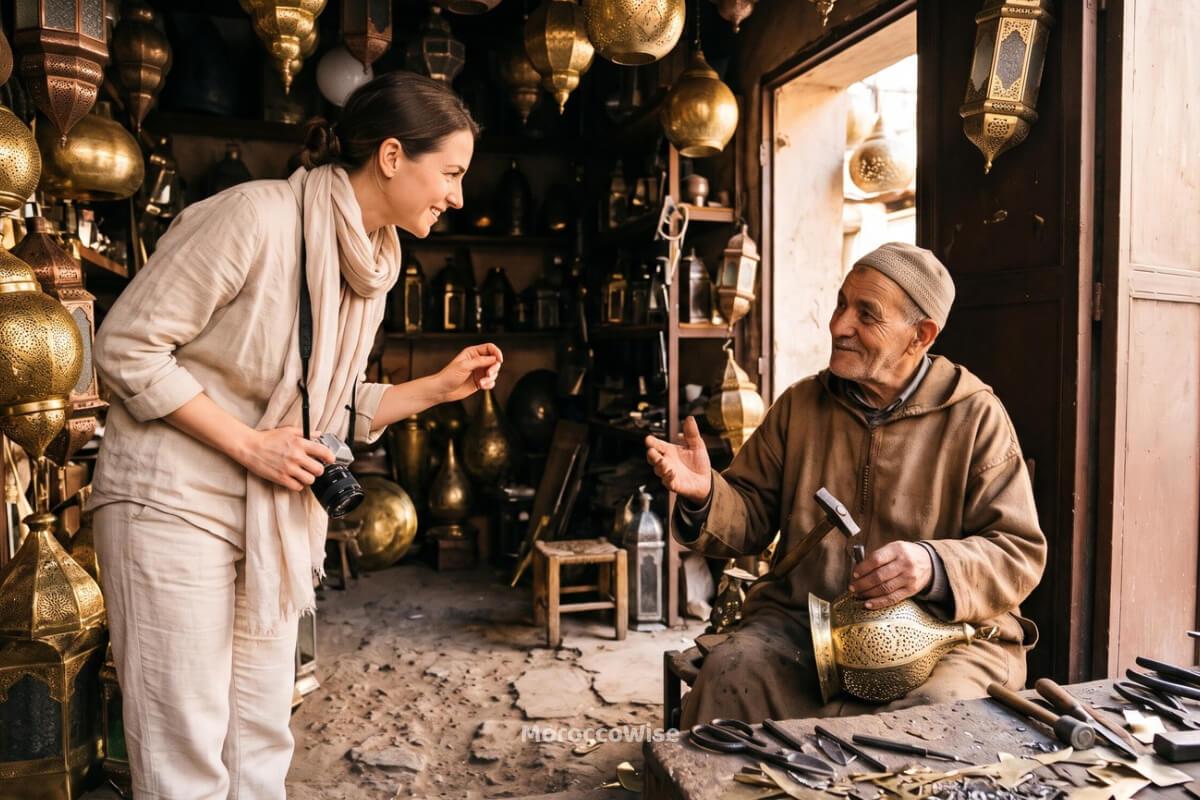
With its sun-drenched terracotta medinas, indigo-blue mountain alleys, and vibrant spice souks, Morocco is a dream destination for photographers. Yet before raising your lens, understanding the legal and cultural reality of taking photos of people in Morocco is essential. Many travelers search online asking: "Is it okay to take photos of people in Morocco?" and "Is it illegal to take pictures of people in Morocco?"
Here is the direct legal and cultural answer for 2027: Yes, taking close-up, recognizable photos or videos of people in Morocco—and especially publishing them on social media—without their explicit consent is both culturally offensive and strictly illegal under Moroccan privacy law (Article 447-1 of the Moroccan Penal Code / Law 103-13). Furthermore, photographing police officers, military personnel, border checkpoints, or Royal Palace guards is a serious national security offense.
However, can you take pictures of people in Morocco if you ask politely first? Absolutely! When you approach locals with warmth, ask "Wakha photo?" ("Is a photo okay?"), or agree on a small 10 to 20 MAD tip for street performers, you can capture extraordinary portraits while respecting local dignity.
This definitive 2027 photography guide breaks down the exact Moroccan privacy laws, answers whether it is haram to take photos of people, explains whether it is safe to carry a $2,500 camera in Moroccan medinas, and reveals the unspoken rules of street photography across the Kingdom.
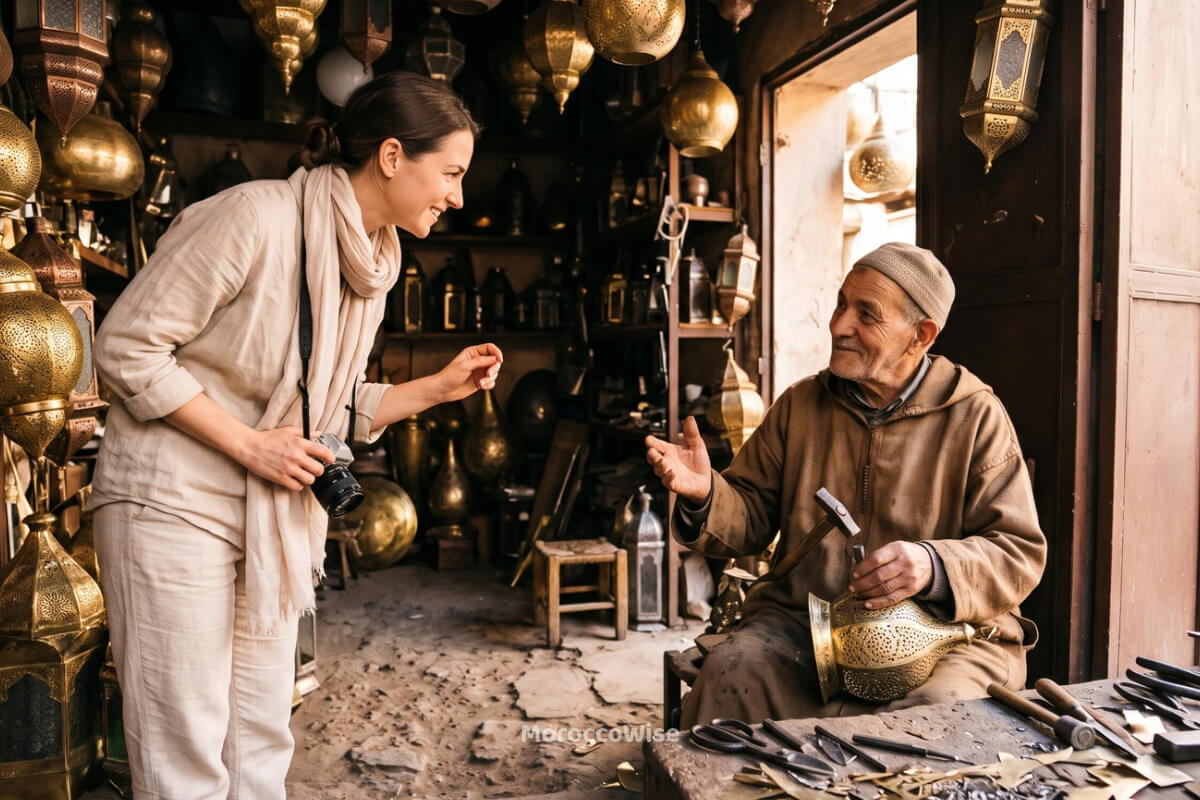
Quick-Answer Matrix: Morocco Photography Rules & Etiquette at a Glance
Whether you are shooting on an iPhone or carrying a professional full-frame mirrorless rig, use this quick-reference matrix to know what is allowed, what requires a tip, and what is strictly forbidden when taking photos of people in Morocco:
| Photography Subject / Location | Is It Allowed? | Consent & Tipping Rule | Legal or Cultural Consequence |
|---|---|---|---|
| Wide Street Scenes & Architecture (Crowds in distance) | Yes (Allowed) | No individual permission needed if faces are not the primary focus. | Perfectly legal; avoid lingering with a lens pointed at one person. |
| Close-Up Portraits of Locals & Artisans | Only With Permission | Always ask "Photo, wakha?" first. Offer 10–20 MAD if an artisan poses in their workshop. | Illegal under Article 447-1 & deeply rude if taken secretly without consent. |
| Jemaa el-Fnaa Performers (Snake charmers, Water sellers, Monkeys) | Yes (Pay-to-Shoot) | Mandatory Tip (10–20 MAD per person). Agree on the price before raising your camera! | Performers will aggressively surround you demanding 100–200 MAD if you shoot without paying. |
| Rural Women & Children (Atlas Mountains & Villages) | Extreme Caution | Never photograph veiled/rural women without asking; always ask parents before photographing kids. | High cultural sensitivity; locals may scold you or demand you delete the image. |
| Police, Military, Royal Palace Guards & Checkpoints | Strictly Illegal | Never photograph under any circumstances (except mounted tourist guards at Rabat Mausoleum). | Police will detain you on the spot and inspect your camera roll/SD card to delete the files. |
| Inside Active Mosques (Worshippers praying) | Prohibited | Non-Muslims cannot enter active mosques; do not shoot through open mosque doors during prayer. | Exceptions: Hassan II Mosque (Casablanca) during official tourist visiting hours. |
| Drones & Professional Tripods in Public | Permit Required | Drones are banned at customs; heavy cinema tripods in medinas require a CCM filming permit. | Drones are confiscated at the airport; tripod users without a permit are stopped by authorities. |
(First time visiting the country? Read our complete cultural handbook on Morocco Rules for Tourists.)
Is It Illegal to Take Pictures of People in Morocco? (What Moroccan Law Actually Says)
When travelers search "is it illegal to take pictures of people in Morocco" or ask on Reddit "Does anyone know what the Moroccan law is on street photography?", they often receive vague guesses. Let's look at the actual Moroccan legislation in force in 2027.
1. Law 103-13 & Article 447-1 of the Moroccan Penal Code (Right to Privacy)
In September 2018, Morocco enacted Law 103-13, which introduced Articles 447-1, 447-2, and 447-3 into the Moroccan Penal Code. While originally designed to combat digital harassment and non-consensual filming, the statute is broad and strictly enforced:
- What the Law States: It is a criminal offense to intentionally capture, record, broadcast, or distribute the photograph or video of a person in a private place—or to publish/distribute a recognizable person's likeness on social media, YouTube, TikTok, or blogs without their consent.
- The Legal Penalty: Violating Article 447-1 carries a penalty of 6 months to 3 years in prison and a fine of 2,000 to 20,000 MAD ($200–$2,000 USD), and Moroccan courts have prosecuted both locals and vloggers when a resident files a formal complaint after seeing themselves filmed without permission on TikTok or Instagram.
- Law 09-08 (Personal Data Protection): Managed by Morocco's CNDP, a recognizable close-up photograph of an individual's face is legally classified as protected personal data.
2. What About Public Street Photography?
Does this mean you cannot take a photo of a busy street in Marrakech or Fes? No—taking wide architectural or atmospheric photos of public squares, souks, and monuments where passersby appear incidentally in the background is completely fine.
The legal and cultural red line is crossed when you single out a specific person (such as a woman buying vegetables, an elderly man praying, or a tanner working) as the central subject of your frame without asking their permission first, or when you shove a smartphone or GoPro in people's faces while livestreaming through a medina.
3. Strictly Prohibited Subjects: Police, Military & Royal Palaces
Regardless of whether you use a phone or a DSLR, never take photos of:
- Police officers (Sûreté Nationale), Tourist Police, or Royal Gendarmerie checkpoints.
- Military barracks, naval ports, airport security zones, or government ministries.
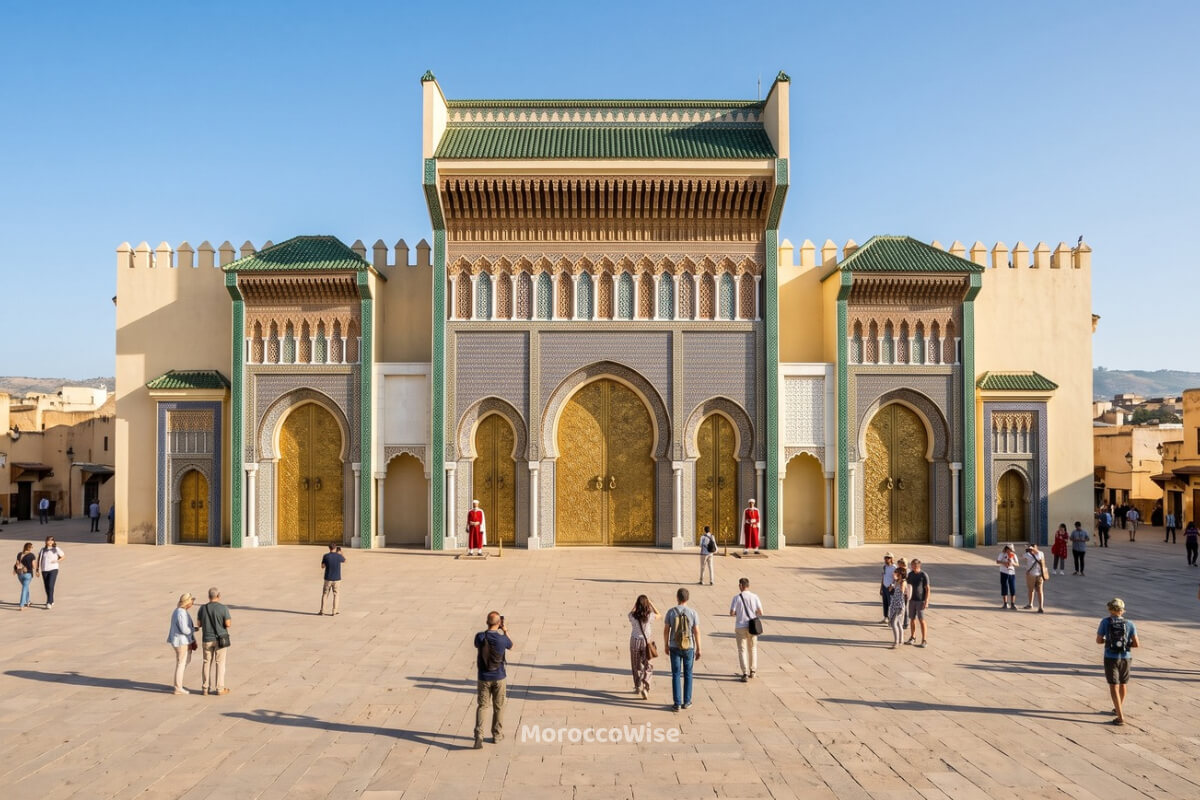
- Royal Palaces (Dar el-Makhzen) and their guards: While tourists in Fes routinely photograph the famous brass outer doors of the Royal Palace (which is permitted from the public square), you must never photograph the armed guards or point a camera through open security gates in Rabat, Marrakech, or Casablanca. If an officer sees you, remain calm and polite—they will ask you to unlock your phone or camera and delete the photo from both your gallery and your "Recently Deleted" folder.
People Also Ask: Religion, Unspoken Rules & Legal Questions
Let's directly answer the four most common questions that appear in Google's People Also Ask box when travelers research taking photos of people in Morocco:
1. Is It Haram to Take Photos of People?
Why do many older Moroccans, rural villagers, and traditional artisans wave their hands and shout "La! Haram!" when a tourist points a camera at them?
- The Religious Context (Taswir): In traditional Islamic jurisprudence, creating physical likenesses or images of living beings (Taswir) was historically debated by scholars to prevent idolatry. While modern Islamic scholars across Morocco and the Muslim world hold that digital photography is permissible (Halal) for everyday, educational, and documentary purposes, many devout older Moroccans and conservative rural residents still consider being photographed uncomfortable or religiously inappropriate (Haram).
- The Cultural & Social Privacy Factor (Hshouma): Beyond religion, Moroccan culture places enormous value on family privacy and modesty (Sitra). Many local women do not want their faces posted on a stranger's Instagram account, and humble workers in the medina do not want to be photographed like exhibits in a "human zoo."
2. What Are the Unspoken Rules in Morocco for Photographers?
When asking "what are the unspoken rules in Morocco?", mastering these five street-level habits will keep you out of trouble and earn local respect:
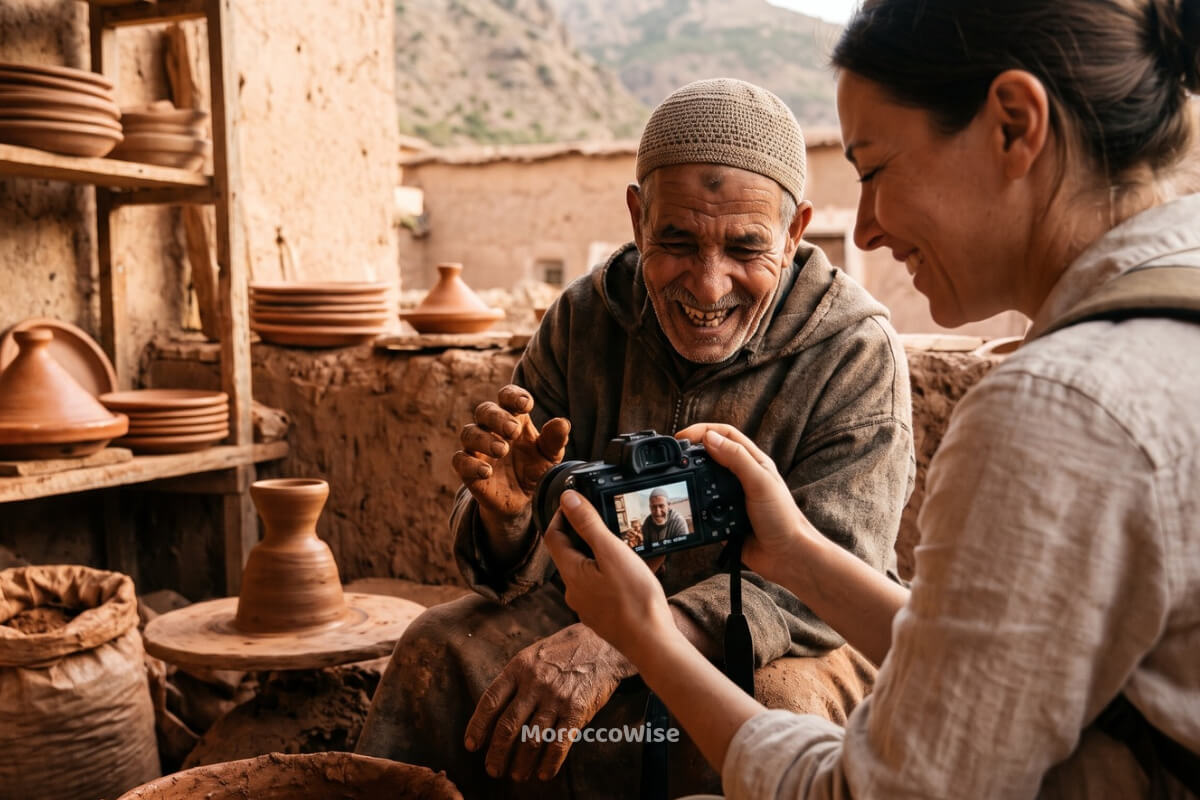
- The "Point, Smile, and Ask" Rule: Before photographing any individual or their shop stall, hold your camera at chest level, point to it with a warm smile, and ask: "Photo, wakha?" (Is a photo okay?) or in French: "Je peux prendre une photo?"
- Never Use a Telephoto Lens to "Sniper-Shoot" Locals From Afar: Standing across the street with a 70–200mm zoom lens to secretly photograph locals who already said "no" is the fastest way to start an angry confrontation in a Moroccan souk. Locals have eagle eyes and spot zoom lenses immediately.
- Never Photograph Shop Merchandise Without Asking (Or Buying): Many artisans in the souks of Marrakech and Fes spend days arranging colorful spice cones, ceramic displays, and brass lamps. Some shops even post "No Photo" or "Photo = 10 DH" signs because thousands of Instagrammers block their doorway for photos without buying a single item. Always ask the shopkeeper before shooting their display!
- Show Them the Photo Afterward: When a local artisan or market vendor agrees to let you take their portrait, turn your camera or phone screen around afterward to show them the shot. It transforms a transactional moment into a genuine human connection.
- Never Photograph Children Without Parental Consent: Even if children in the Atlas Mountains or Chefchaouen run up to you smiling, always look for their mother or father nearby and ask permission before taking a picture.
3. Is Photography Allowed in Morocco? (Tripods, Drones & CCM Permits)
Yes, general tourist and street photography is allowed across Morocco. However, Morocco draws a sharp legal line between handheld tourist photography and commercial/cinema production:
- Tripods in Public Medinas & Monuments: Setting up a large full-size tripod in the middle of Jemaa el-Fnaa, around the Hassan II Mosque, or inside Bahia Palace is classified by Moroccan police as "professional filming," which legally requires an official shooting authorization (Autorisation de Tournage) from the Centre Cinématographique Marocain (CCM). Security guards will immediately tell you to fold up your tripod. Stick to handheld shooting (using In-Body Image Stabilization) or a tiny tabletop pocket tripod on your own riad rooftop.
- Drones Are Strictly Illegal: You cannot bring a drone into Morocco without a commercial aviation permit issued weeks in advance. Airport X-ray scanners confiscate all tourist drones upon arrival. (See our complete Prohibited Items checklist in What to Pack for a Trip to Morocco).
4. What Is Rule 490 in Morocco?
Travelers researching Moroccan laws alongside photography rules often come across "What is rule 490 in Morocco?"
- Article 490 of the Moroccan Penal Code is the law that criminalizes sexual relations outside of marriage (Zina).
- How It Applies to Tourists: As we explain in our legal guide, Article 490 is NOT enforced against unmarried foreign tourists (where neither partner holds Moroccan citizenship)—international couples can legally share hotel and riad rooms across Morocco without showing a marriage certificate. However, because public decency laws are taken seriously, tourists must never take boudoir, nude, or sexually explicit photographs in public spaces, desert dunes, or historic monuments, as doing so violates Moroccan public morality laws and results in immediate arrest.
Is It Safe to Carry a $2,500 Camera in Morocco? (Reddit Gear & Safety Guide)
One of the top-ranking Reddit threads on Google asks: "Is it safe to carry a $2,500 USD camera in Morocco?"
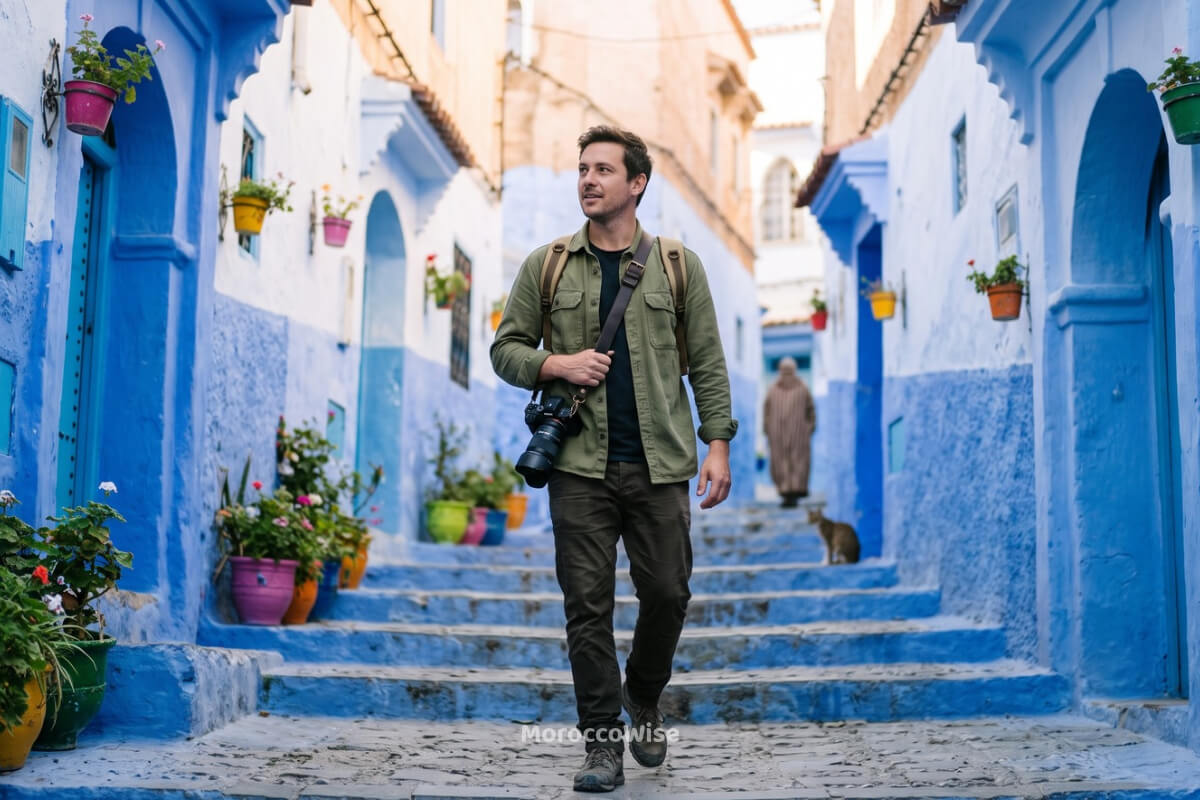
Yes—carrying a high-end Sony, Canon, Nikon, Leica, or Fujifilm camera in Morocco is physically very safe. Violent muggings or armed camera robberies are extraordinarily rare in Moroccan tourist cities. Thousands of professional travel photographers walk through Marrakech, Fes, Tangier, and Essaouira every year with $3,000+ camera bodies and lenses without incident.
However, carrying a big professional camera changes how locals react to you on the street. Follow these 6 Pro Camera Safety & Discretion Tips:
- A Big Camera Signals "Professional" (And Triggers Higher Tip Demands): When you walk through the medina with an iPhone, locals barely notice. When you walk around with a giant DSLR and a white 70–200mm lens, every street performer and tout assumes you are shooting for National Geographic and will demand money if your lens even points in their general direction.
- Use a Prime Lens (35mm or 50mm) & Tape Over Logos: Swap bulky zoom lenses for a compact 35mm or 50mm prime lens. It looks much less intimidating to locals, excels in low-light covered souks, and keeps your setup lightweight.
- Wear a Cross-Body Sling Strap (Never Dangle From One Shoulder): In narrow medina alleys, mopeds and motorbikes zip past pedestrians constantly. Never carry a camera dangling loosely off one shoulder or in an unzipped backpack pocket. Use a sturdy cross-body camera strap (like a Peak Design Slide or wrist cuff) and keep the camera resting against your front hip when walking through crowds.
- Keep a Lens Cap On (Or Point the Lens Down) When Not Shooting: Walking through a residential alley (derb) with an uncovered camera held at chest level makes local women worry that you are secretly filming video. Keep your lens cap on or hold the camera pointed clearly toward the ground when walking between spots. (Learn how to handle touts in How to Deal with Persistent Street Sellers in Morocco).
- Protect Your Gear From Sahara Sand: If taking your expensive camera to the Erg Chebbi dunes in Merzouga, never change lenses in the desert. Fine Saharan dust will penetrate weather-sealed zooms; bring a rain/dust sleeve and a rocket air blower.
- Insure Your Gear Before Flying: Ensure your travel insurance policy includes high-value single-item coverage for electronics above $1,500–$2,500, and register your camera serial numbers.
The Jemaa el-Fnaa & Fes Tannery Photo Trap: How Much Should You Tip?
Many negative photography stories in Morocco happen because tourists accidentally trigger a pay-for-photo hustle in Marrakech's Jemaa el-Fnaa square or at the Fes tanneries.
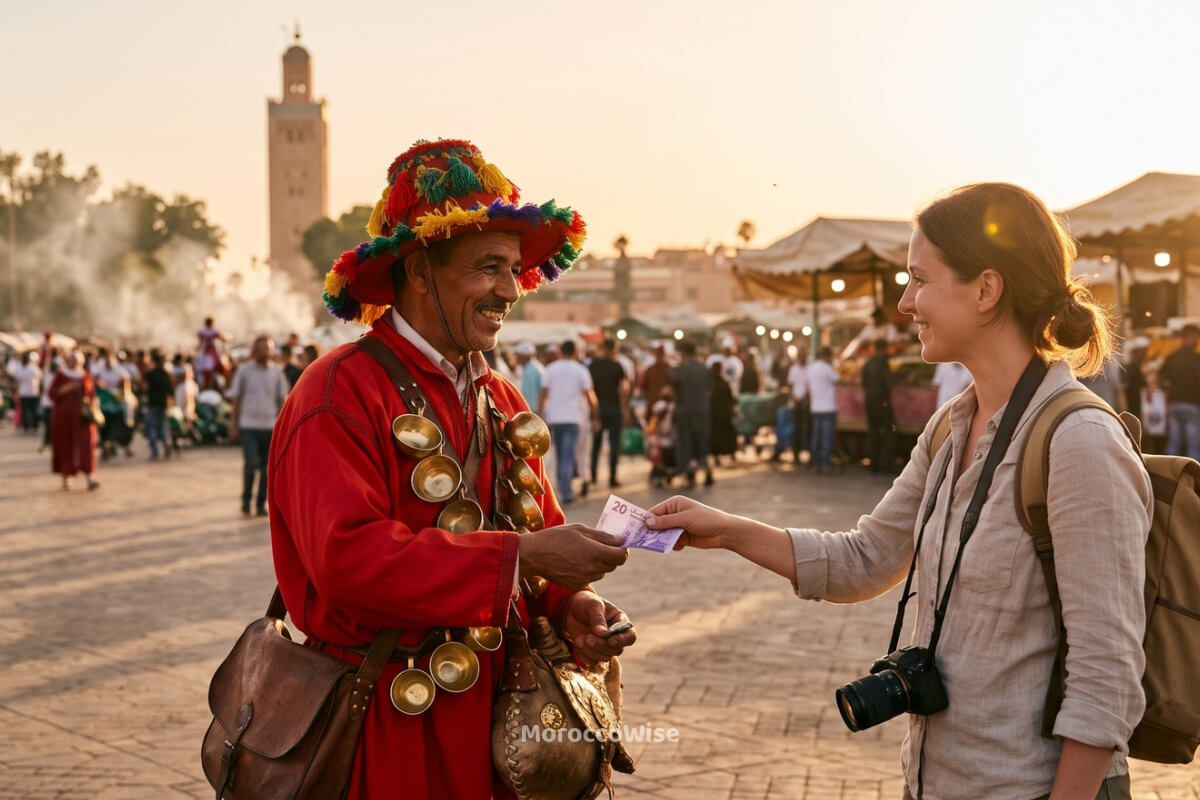
1. Photographing Performers in Jemaa el-Fnaa (Marrakech)
The snake charmers, monkey handlers, Gnawa musicians, acrobats, and traditional red-hatted water sellers (Guerrab) in Jemaa el-Fnaa do not get paid a salary by the city—posing for tourist photos is how they earn their living.
- The Trap: If you stand 30 feet away and try to sneak a photo of a snake charmer or water seller with your phone or zoom lens, one of their "spotters" in the crowd will immediately walk over, block your lens, and aggressively demand 100 to 200 MAD ($10–$20).
- The Right Way to Do It:
- First, we strongly advise avoiding photos with chained monkeys or snakes due to ethical animal welfare and rabies risks. (See our health guide on Do I Need Vaccinations for Morocco?).
- For cultural performers like Gnawa musicians or traditional water sellers, walk up with a smile, pull a 20 MAD note ($2 / £1.60) from your pocket (never open your full wallet!), hold it up to agree on the price before taking the photo, hand them the 20 MAD, and snap your portraits stress-free! (Read our guide on What Currency Is Used in Morocco? to learn why carrying small 10 and 20 MAD notes is vital).
2. Photographing Artisans in Workshops & The Fes Tanneries
- Small Medina Workshops (Blacksmiths, Weavers, Woodcarvers): Many true master artisans (Maâlems) in the backstreets of Fes and Marrakech are proud of their craft and will gladly let you take a photo for free if you ask politely ("Wakha photo?") and compliment their work ("Tbarkallah!" — God bless!). If someone stops working to pose specifically for you, offering a 10 to 20 MAD coin/note is a kind gesture.
- The Chouara Tannery Terraces (Fes): Viewing and photographing the dye vats from the surrounding leather shop balconies is free if you browse the shop politely, or you can hand the terrace attendant 10 to 20 MAD as a tip on your way out so you feel zero obligation to buy leather.
How to Take Stunning Street Photos in Morocco Without Offending Anyone
Want to bring home portfolio-worthy images while respecting local privacy 100%? Use these four pro composition techniques:
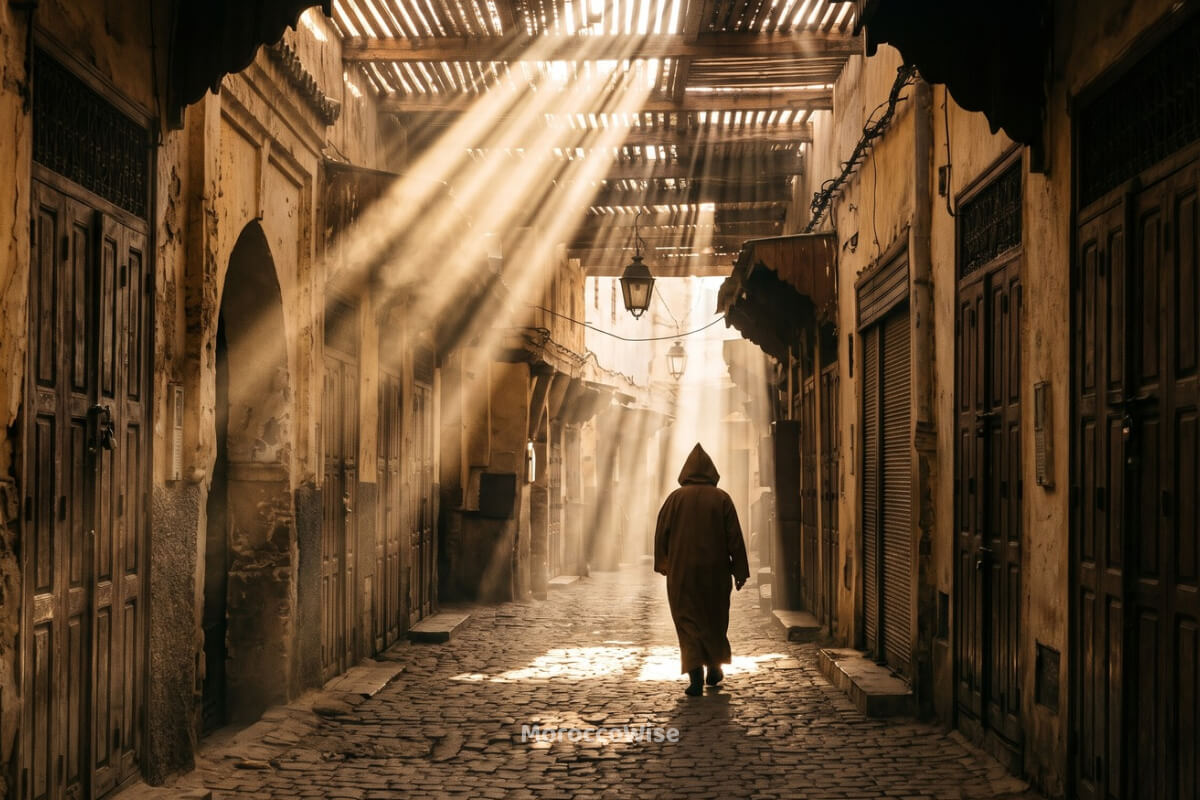
- Shoot "Frame-First" Silhouettes & Backlit Figures: Instead of chasing people down the street, find a stunning geometric archway, a sunbeam piercing through the reed roof of the souks, or a colorful wall in Chefchaouen. Frame your shot on the architecture first, wait for a local wearing a traditional hooded djellaba to walk through the light (captured from behind or in silhouette so their face is anonymous), and click the shutter.
- Focus on Hands and Craftsmanship: If an artisan is shy about having their face photographed, ask if you can photograph only their hands shaping clay on a pottery wheel, hammering brass, or weaving a Berber carpet. Almost every artisan says yes to a close-up of their hands!
- Wake Up for the 7:00 AM–9:00 AM Golden Window: At sunrise, the medinas of Marrakech, Fes, and Chefchaouen are peaceful, bathed in soft golden light, and virtually empty of touts. You can photograph intricate doorways, cats, and street perspectives in total tranquility.
- Hire a Local Guide for Portrait Sessions: If portrait photography is your passion, ask your licensed Moroccan tour guide to translate and ask permission from locals on your behalf. When a trusted local guide introduces you in Darija, shopkeepers and villagers relax immediately and open up for authentic portraits.
Do's and Don'ts: Taking Photos of People in Morocco
| Do | Don't |
|---|---|
| Always ask "Photo, wakha?" with a smile before taking a close-up portrait of a person | Shove a camera or smartphone in locals' faces or use a long zoom lens to shoot people secretly |
| Keep 10 and 20 MAD coins/notes in your pocket to agree on tips before photographing Jemaa el-Fnaa performers | Sneak photos of snake charmers or water sellers from afar without paying (they will chase you down) |
| Frame wide architectural shots where passersby are in silhouette or walking away | Photograph veiled women, rural villagers, or children without explicit permission |
| Ask permission from the shopkeeper before photographing colorful spice or lantern displays | Block narrow shop doorways for 10 minutes taking Instagram poses without buying anything |
| Carry your DSLR/mirrorless camera on a secure cross-body strap with the lens pointed down when walking | Photograph police officers, military checkpoints, Royal Palace guards, or inside active mosques |
| Show the subject the photo on your LCD screen afterward and say "Shukran, Tbarkallah!" | Bring a drone in your luggage—it is illegal in Morocco without an aviation permit and will be confiscated |
Frequently Asked Questions (FAQ)
Is it okay to take photos of people in Morocco?
It is only okay to take close-up photos of people in Morocco if you ask for their explicit permission first. Many Moroccans value their personal privacy for cultural and religious reasons and strongly dislike being photographed by strangers without consent. Always smile, point to your camera, and ask "Photo, wakha?" before raising your viewfinder.
Is it illegal to take pictures of people in Morocco without permission?
Yes. Under Article 447-1 of the Moroccan Penal Code (Law 103-13) and Law 09-08, capturing, filming, or publishing recognizable photographs or videos of individuals without their consent is illegal in Morocco and carries strict penalties, particularly if the images are shared on social media. Additionally, photographing police, military personnel, or government security installations is strictly prohibited by law.
How much should I tip for taking a photo in Morocco?
For street performers, musicians, and traditional water sellers in tourist squares like Jemaa el-Fnaa in Marrakech, the standard tip is 10 to 20 Moroccan Dirhams ($1–$2 USD / £0.80–£1.60 GBP) per performer. Always agree on the exact amount and hold out the specific 10 or 20 MAD coin/note before taking the photograph. Everyday citizens do not expect money if they agree to a friendly portrait, though tipping a humble workshop artisan 10–20 MAD is appreciated.
Is it safe to walk around Marrakech and Fes with an expensive camera?
Yes, Morocco is very safe from violent camera muggings, and photographers regularly carry $2,500+ DSLR and mirrorless kits through Marrakech, Fes, and Chefchaouen. To stay safe and low-profile, use a cross-body sling strap (to protect against passing motorbikes in narrow alleys), use a compact prime lens rather than a massive telephoto zoom, and put your camera away in dimly lit alleys late at night. (Read our complete evening safety guide: Is Marrakech Safe to Walk Around at Night?).
Official and Practical Reference Links
Before traveling to Morocco with camera equipment, review these official legal, cultural, and filming regulations from Moroccan and international government portals:
- Centre Cinématographique Marocain (CCM) – Official Moroccan Filming & Professional Photography Permits
- UK Foreign, Commonwealth & Development Office (FCDO) – Morocco Local Laws & Photography Restrictions
- CNDP Morocco – National Commission for the Control of Personal Data Protection (Law 09-08)
- Moroccan Customs Administration (ADII) – Official Rules on Camera Equipment & Drone Restrictions
(Planning the rest of your trip? Check our daily cost breakdown in How Much Money Should I Budget Per Day in Morocco? and our solo safety guide in Is It Safe for Women to Travel Alone in Morocco?!)